Apply Within 24–48 Hours: A Morning Routine That Gets You Noticed
10 September 20269 min read
Contents11 sections
- 1Table of Contents
- 2What’s the fastest way to decide when to hit send?
- 3How ATS queues and recruiter habits shape your odds
- 4What are the best days and times to apply?
- 5Should you apply fast or apply perfect?
- 6How do you actually hit the morning window every week?
- 7A note on habits that actually stick
- 8Catch new postings before the queue fills up
- 9Sources
- 10FAQ
- 11Recommended
Apply Within 24–48 Hours: A Morning Routine That Gets You Noticed
Submit tailored applications within 24 to 48 hours of a job posting, and send them during the employer’s morning hours on a weekday, ideally Tuesday. Speed beats waiting for the “perfect” version of your resume. Data-backed timing studies and practitioner reasoning from platforms like FindJobsZA both point the same way: early and morning wins, almost every time.
TL;DR:
- Applying early in the morning between 8am and 10am on Tuesdays in the employer’s local time yields the best callback rates, with late evenings and weekends performing worse.
- The timing of your application matters more than the day, as applying during the morning window consistently outperforms late-day submissions regardless of the weekday.
- Draft applications the night before and schedule them to send during early hours to maintain a regular routine without additional stress.
- Using alerts to receive new job postings promptly increases the chance of applying within the critical first 24 to 48 hours.
- Prioritize full tailoring for top targets within this timing window and batch less urgent applications with modular tweaks to stay efficient.
Table of Contents
- What’s the fastest way to decide when to hit send?
- How ATS queues and recruiter habits shape your odds
- What are the best days and times to apply?
- Should you apply fast or apply perfect?
- How do you actually hit the morning window every week?
- A note on habits that actually stick
- Catch new postings before the queue fills up
- Sources
- FAQ
What’s the fastest way to decide when to hit send?
You don’t need a spreadsheet to figure out optimal application timing. You need a 90 second gut check the moment you spot a posting.
- Assess fit fast (2 to 3 minutes): does the role match your skills and experience closely enough to be worth a shot?
- High priority? Tailor three to five resume bullets, then submit within 24 hours, aiming for the next weekday morning.
- Lower priority? Use your standard template, but still schedule it for the coming weekday morning rather than firing it off at 11pm.
- Time-sensitive posting? (urgent hiring language, small applicant pool, tight deadline) Apply immediately, no matter the day or hour.
Pro Tip: Keep a folder of five reusable bullet points per role type you target. Swapping two or three of them to match a posting takes minutes, and it’s the difference between applying today and applying next week.
How ATS queues and recruiter habits shape your odds
Most mid-size and large employers run applications through an applicant tracking system, and many of those systems display new submissions in the order they arrive. Apply early in the morning and your resume sits near the top of a recruiter’s queue before the pile grows. Apply at midnight on a Sunday and you’re buried under everyone who applied Monday and Tuesday morning.
Recruiters also work in rhythms, not random bursts. Most start the day by triaging new applications, then run a deeper review block mid-morning once meetings haven’t yet eaten the calendar. Weekly pipeline planning tends to happen early in the week, which is why a posting that goes live Monday often gets its first real look Tuesday morning. Callback data from 200 tracked applications over 30 days found that morning submissions produced a noticeably wider spread of callbacks than evening ones, and that the time-of-day gap was larger than the day-of-week gap.
Day matters. Hour matters more. That’s the whole mechanism behind the advice you’ll read in the next section.
What are the best days and times to apply?
Tuesday between 8am and 10am, in the employer’s local time, shows up repeatedly as the strongest single window. A large-scale review of job postings found Tuesday is the busiest day for new listings, with invites clustering around late morning, and a separate data study on submission timing pinned Tuesday 8am to 10am as the single best combined day and time slot, with late evenings and weekends performing worst.
Monday mornings run a close second. If Tuesday isn’t realistic, most guides point to a general early-morning window of roughly 6am to 10am as your next-best bet, and a data-backed 2025 guide also flags early afternoon (1pm to 3pm) as a workable backup for typical office roles.
Here’s the part people get backwards: they obsess over which day to apply and ignore the hour. The evidence says the opposite ordering matters more. A Tuesday afternoon submission usually underperforms a Wednesday 8am one.
When applying across time zones, translate the employer’s morning into your own clock before you hit submit. If you’re targeting a company that runs on Eastern time and it’s currently your evening, draft the application now, then schedule or send it so it lands between 8am and 10am their time, not yours.
Avoid these windows when you have a choice:
- Friday afternoon (attention is already gone for the week)
- Sunday night (buried under Monday’s flood by breakfast)
- Any weekday after roughly 8pm
None of this is absolute. A posting that says “urgent” or “immediate start” overrides every timing rule above.
Should you apply fast or apply perfect?
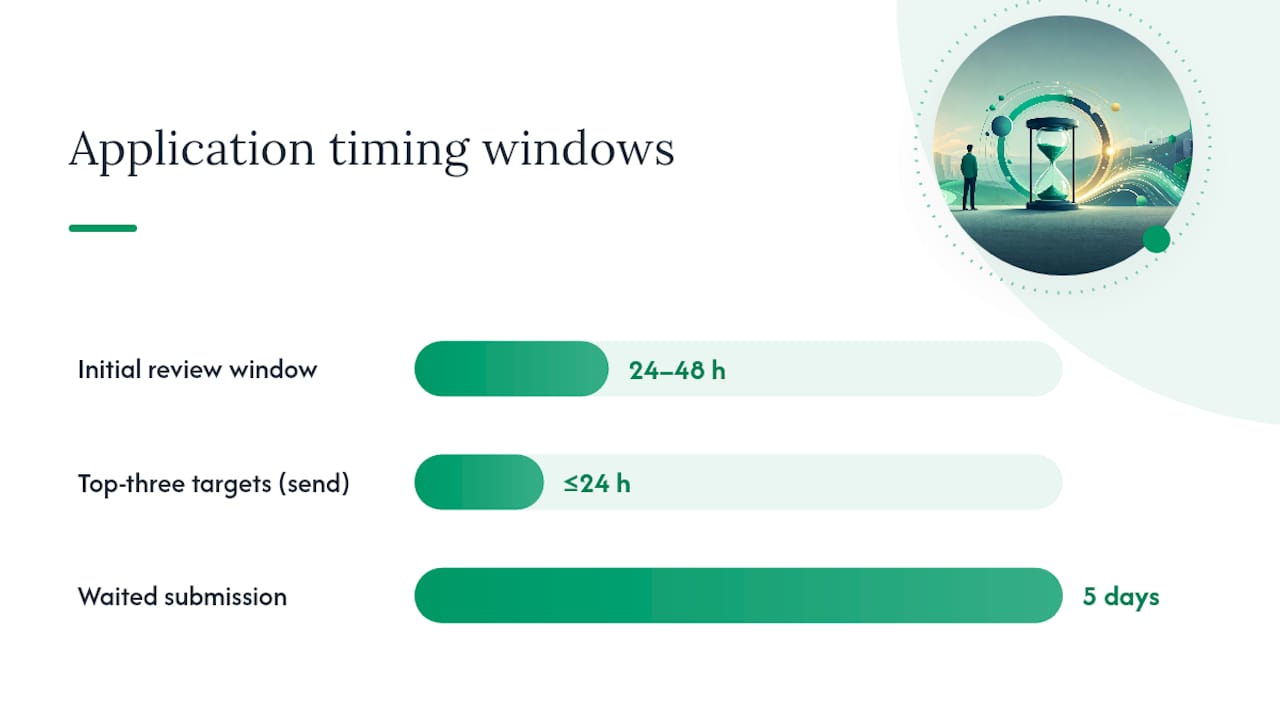
Neither extreme wins. Analysis on early-applicant advantage shows visibility decays fast: the shortlist recruiters build in the first 24 to 48 hours after a posting goes live often determines who gets a callback at all, and ATS ordering tends to favor whoever applied before that initial review window closes. Wait five days to submit a flawless application and you may be applying to a role that’s already been filled in practice, even if it’s still listed as open.
Triage your target list instead of treating every posting the same way:
- Top three targets this week: full tailoring, custom opener in your cover note, submitted within 24 hours during a morning window.
- Everything else you’re genuinely interested in: modular tweaks to your existing template, still sent on a weekday morning.
- Long-shot or exploratory applications: template as-is, batch them, send whenever you have five minutes.
Pro Tip: Build one short cover-note template with two or three swappable sentences instead of writing from scratch each time. Check that your resume includes the exact keywords from the posting’s title and top three requirements. That alone often matters more than another hour of polishing.
How do you actually hit the morning window every week?
Good timing only works if you can repeat it without turning your job search into a second job. A few habits make that realistic.
- Draft applications the evening before, then schedule or hold them to send between 6am and 10am the next weekday.
- Turn on daily alerts or saved searches so new postings reach you within hours, not days, and check them the same morning they arrive.
- Run a weekly routine: batch-tailor your templates on a Sunday afternoon, prioritize your top three targets for Monday or Tuesday morning submission, then actually rest over the weekend instead of refreshing job boards.
- FindJobsZA sends new listings each morning via WhatsApp, which is a practical way to see a posting within its first 24 hours without hunting across multiple sites.
Tools like a tracking template help you remember which templates you sent where, which matters more once you’re applying to a dozen roles a week.
A note on habits that actually stick
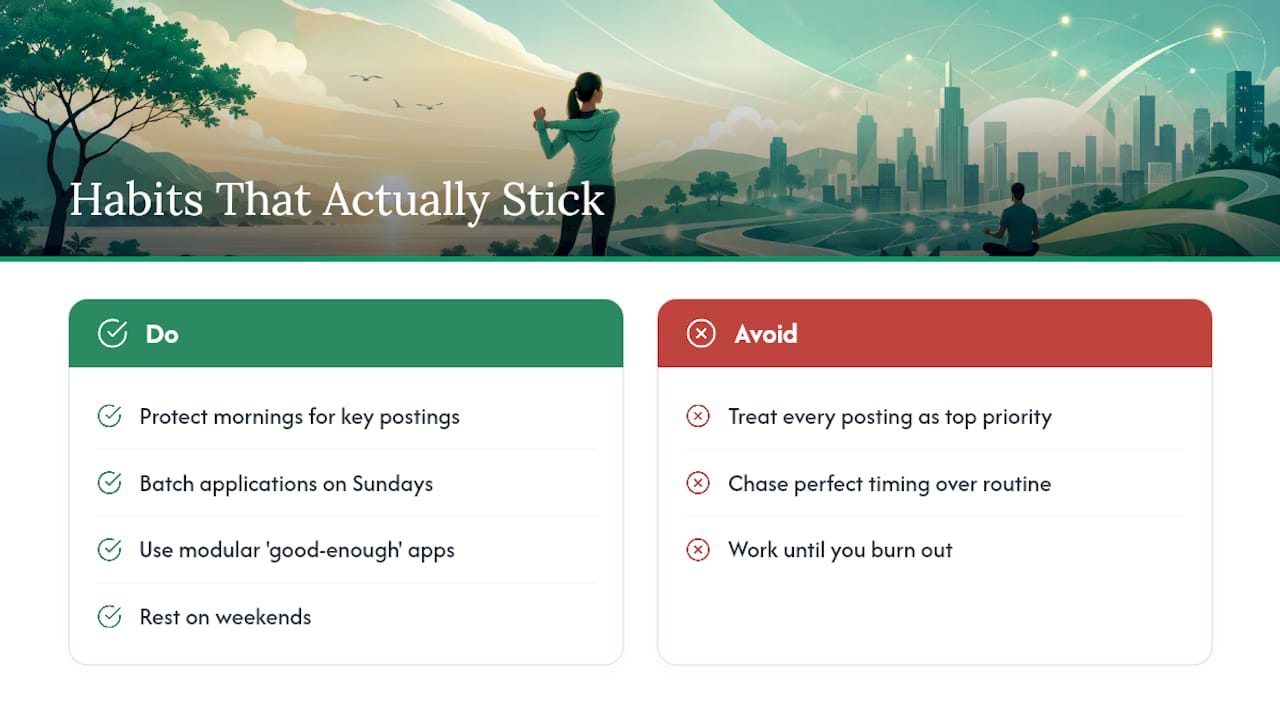
The timing data is convincing, but the habit is where most people fall off. I’ve watched job seekers nail the “apply Tuesday morning” rule for one week and then burn out by week three because they treated every posting like a top-priority application.
The real win isn’t perfect timing. It’s a routine you can repeat for six weeks straight without dreading it. That means giving yourself permission to send a modular, good-enough application to your second-tier targets, and saving your full effort for the handful of roles you actually want. Rest on weekends. Batch on Sundays. Protect your mornings for the postings that matter most, and check our job search tips if the routine itself needs a rebuild.
— Nkosi
Catch new postings before the queue fills up
Everything above only works if you actually see the posting within its first day or two, and that’s the part most job seekers get stuck on. Some job platforms send new listings straight to your WhatsApp every morning, so you’re reading fresh postings at the same hour recruiters start their review, not days later when the shortlist is already closed.
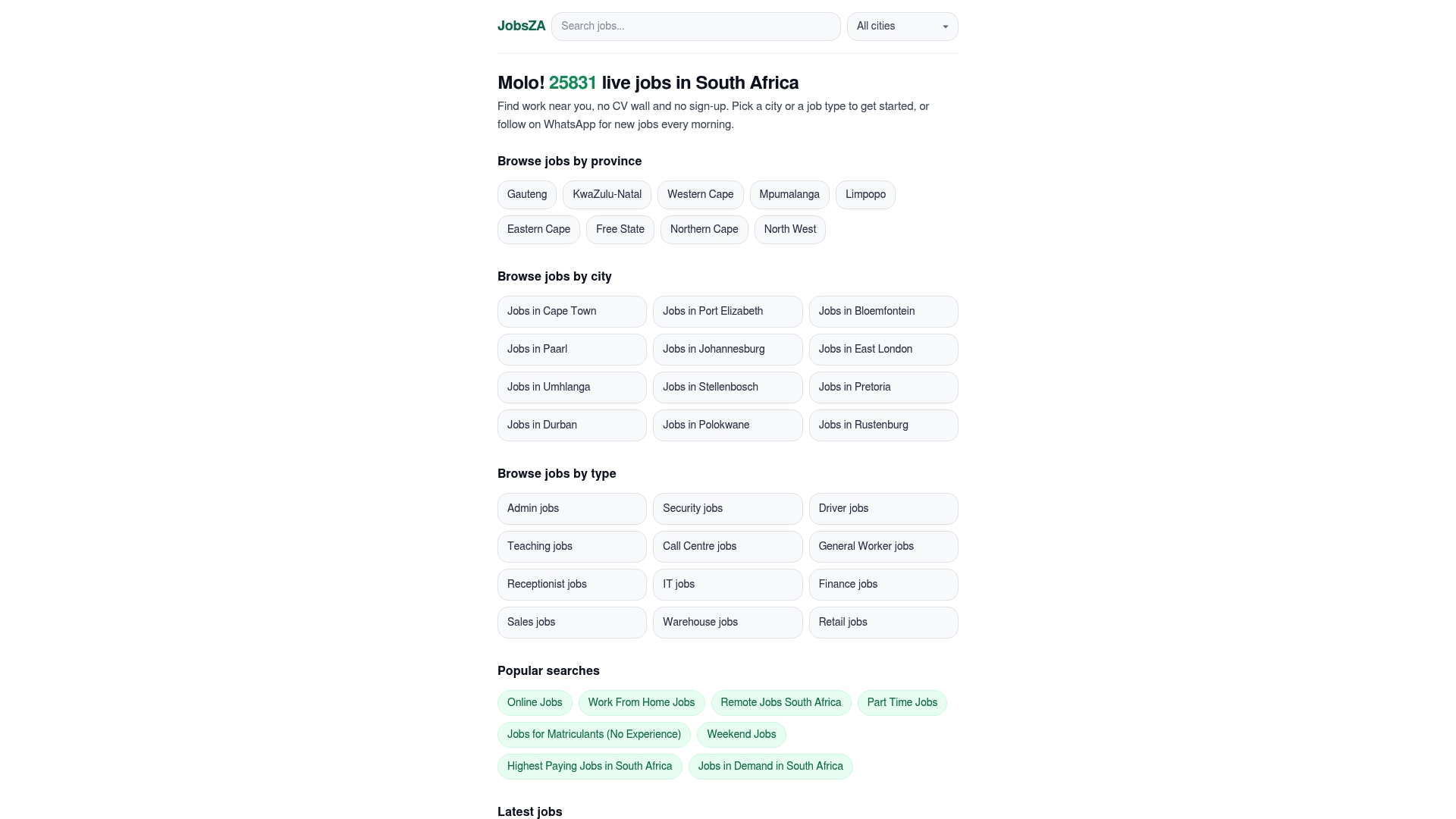
There’s no CV upload, no account creation, no extra login standing between you and the listing. Browse by city or job type, spot a role that fits, and apply directly during that early window this article just walked you through. If you’re targeting positions that run on a different schedule than a typical office job, the remote jobs and weekend jobs pages are worth bookmarking too. Set up your morning alerts today and give your next application the timing advantage it needs.
Sources
- Best Time To Apply For Jobs: 2026 Research Report
- Best Time to Submit Job Applications: Morning vs Evening (Data Study)
- Does Being an Early Applicant Actually Matter in 2026? | FindMeJobs
- Best Time to Apply for Jobs in 2025 (Data-Backed Guide) | GoApply
FAQ
What is the best time to apply for a job?
Weekday mornings, ideally Tuesday between 8am and 10am in the employer’s local time, consistently show the strongest response rates across multiple timing studies.
Is it better to apply fast or wait and perfect my resume?
Apply within 24 to 48 hours with a reasonably tailored resume rather than waiting days for a flawless one, since visibility and shortlist odds drop fast after the first review window closes.
Does the day of the week really matter?
It matters less than the time of day. Morning submissions consistently outperform evening ones by a wider margin than any single weekday outperforms another.
How do I time applications across different time zones?
Draft your application ahead of time, then schedule or send it so it arrives between 6am and 10am in the employer’s local time, even if that’s evening or night where you are.
How can I spot new postings early enough to apply within 24 hours?
Daily alerts make the biggest difference. Findjobsza sends new listings each morning via WhatsApp, which helps you see and apply to fresh roles before the applicant queue fills up.
Recommended
Start with your city.
27 342 live jobs, filtered by city and suburb. No sign-up wall, no CV upload just to look.