Search Jobs by Province in South Africa in 3 Steps
9 September 202612 min read

Contents13 sections
- 1Table of Contents
- 2How do you filter and save job searches by province?
- 3What does Stats SA’s provincial data tell you about your odds?
- 4Where do province-filtered listings actually live?
- 5How do you apply and actually stand out for a local role?
- 6Which sectors and employers actually drive hiring in each province?
- 7How does commuting shape which provincial jobs make sense?
- 8Do labour laws differ from province to province?
- 9What I’ve noticed running province searches and WhatsApp alerts
- 10Search jobs by province the fast way, with FindJobsZA
- 11Sources
- 12FAQ
- 13Recommended
Search Jobs by Province in South Africa in 3 Steps
To search jobs by province in South Africa, set the province filter on a job site or app, narrow it with a role keyword, and switch on that province’s alerts, including WhatsApp updates. Cross-check Stats SA’s quarterly provincial data to see whether your target province is gaining or shedding jobs, so you know what kind of competition you’re walking into.
TL;DR:
- Focusing on provinces with recent employment gains, like Mpumalanga, increases the chance of landing a job with less competition compared to high-unemployment areas like Gauteng.
- Targeting sectors that drive growth in specific provinces, such as mining in Mpumalanga or manufacturing in Eastern Cape, improves the relevance of your applications.
- Using provincial job board pages and government circulars simultaneously ensures access to the most up-to-date and comprehensive local job listings.
- Tailoring your CV and application approach to local logistics and employer contexts significantly boosts your chances of standing out for nearby roles.
- Relying on WhatsApp alerts and direct provincial pages reduces search fatigue and speeds up your response time to new job postings.
Table of Contents
- How do you filter and save job searches by province?
- What does Stats SA’s provincial data tell you about your odds?
- Where do province-filtered listings actually live?
- How do you apply and actually stand out for a local role?
- Which sectors and employers actually drive hiring in each province?
- How does commuting shape which provincial jobs make sense?
- Do labour laws differ from province to province?
- What I’ve noticed running province searches and WhatsApp alerts
- Search jobs by province the fast way, with FindJobsZA
- Sources
- FAQ
How do you filter and save job searches by province?
Most South African job platforms let you narrow results by location before you ever look at a job title. The trick is stacking filters in the right order so you aren’t scrolling through 400 irrelevant listings from Gauteng when you live in Mpumalanga.
- Set your province first. Open the location or province filter and pick your target area. Some platforms let you refine further by city or a travel radius, useful if you’re weighing a move between, say, Polokwane and a smaller town nearby.
- Add a role keyword. Typing “admin Mpumalanga” or “security Free State” cuts the noise dramatically compared to browsing an unfiltered province feed.
- Use dedicated province pages. Curated province landing pages, like ones for the Eastern Cape or Free State, already strip out irrelevant listings, saving you the filtering step entirely.
Pro Tip: Combine a sector filter with your province filter instead of searching province alone. “Sales jobs in Free State” returns a tighter, more relevant list than “jobs in Free State,” which can bury sales roles under hundreds of unrelated postings.
What does Stats SA’s provincial data tell you about your odds?
Provincial unemployment figures aren’t just background reading. They tell you whether you’re stepping into a province with rising demand or one where you’ll be one of thousands chasing the same handful of openings.
The Quarterly Labour Force Survey for Q2:2026 breaks employment changes and unemployment rates down by province in its Tables D and E. Reading those tables takes two minutes and can save you weeks of misdirected applications.
Here’s what actually matters when you scan the report:
- Look at quarter-on-quarter employment change first. A province adding jobs is a province worth prioritizing.
- Check the unemployment rate next to that gain. A high rate paired with job growth still means real competition, just less brutal than a province losing jobs and holding a high rate.
- Note which industries drove the change. The Provincial Labour Bulletin breaks this down by sector, so you can see whether a province’s gains came from construction, trade, or finance.
According to the Stats SA media release for that quarter, Mpumalanga posted notable employment gains while Western Cape and Gauteng recorded losses. That doesn’t mean avoid Gauteng entirely. It means expect more applicants per post there, and consider whether a specific sector within that province is still hiring even while the overall number drops.
The practical move: target provinces showing net gains for broad job hunting, but if you’re locked into a high-competition province by location or family ties, get specific. Find the one or two sectors still growing there and aim directly at those instead of applying broadly.
Where do province-filtered listings actually live?
Not every source updates at the same speed, and picking the wrong one wastes time you don’t have.
- Job board province pages. These are the fastest-moving source. A platform’s dedicated province page, like one listing hundreds of live Mpumalanga vacancies, refreshes daily and skips the noise of a generic search bar.
- Government vacancy circulars. For formal public-sector posts, the national government jobs portal publishes the Public Service Vacancy Circular, the primary source for provincial government hiring. These update weekly rather than daily, so check on a set day rather than constantly refreshing.
- Provincial department pages. Education and health vacancies often post directly through provincial department sites or agency pages rather than general job boards. A gender equality commission vacancy page is a good example of how narrow and department-specific these listings can get.
- Local channels. WhatsApp groups, municipal notice boards, and community recruitment groups surface roles that never make it to a formal listing site, particularly for entry-level and informal-sector work.
Running all four in parallel beats relying on just one. A single job board might miss the government circular entirely, and the circular won’t show you private-sector openings.
How do you apply and actually stand out for a local role?
Getting the listing is half the job. Converting it into an interview means moving faster and looking more locally credible than the next applicant.
- Tailor your CV to the province. Mention specific towns, transport routes, or local employer names you’ve worked with. A generic CV reads as generic; one that names local context reads as ready.
- Confirm your logistics upfront. If the role is in a different city within your province, state your availability for in-person interviews and how you’ll get there. Employers filter out uncertainty fast.
- Respond within hours, not days. WhatsApp-delivered listings tend to draw applicants who move quickly. If you see a same-morning post, apply that morning.
- Track applications by province. A simple spreadsheet noting the province, role, and date applied stops you from losing track when you’re running four or five searches simultaneously.
Pro Tip: Send one polite follow-up message about a week after applying if you haven’t heard back. It signals genuine interest without pestering, and for local roles it can put your name back at the top of a small applicant pool. If you need help sharpening your CV or cover note before you hit send, CV Made Better’s application support offers a second set of eyes on both.
Which sectors and employers actually drive hiring in each province?
Provincial economies don’t look alike, and that shapes which roles are realistically available to you.
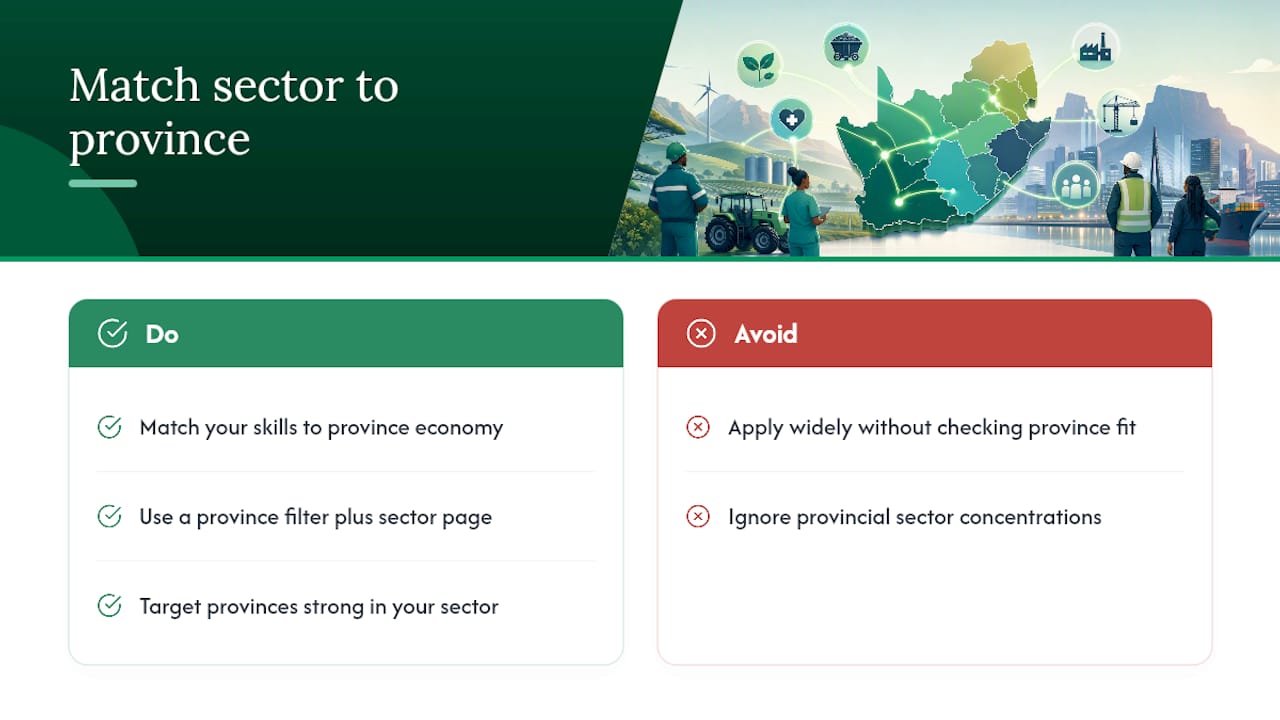
Gauteng runs on finance, corporate services, and logistics, given its concentration of head offices and the country’s busiest freight corridors. Western Cape leans on tourism, agriculture-linked manufacturing, and a growing tech and BPO sector centred on Cape Town. KwaZulu-Natal’s economy runs heavily through the Durban port, meaning shipping, logistics, and manufacturing dominate its job postings.
Mpumalanga’s recent employment gains track closely with mining and energy activity, while the Eastern Cape’s manufacturing base, particularly automotive assembly around Gqeberha and East London, still anchors a large share of formal employment there. Free State and Northern Cape lean more on agriculture and mining, with fewer corporate head offices and a smaller pool of white collar roles.
Matching your skill set to a province’s actual economic base beats applying broadly and hoping. If you’re an admin professional, Gauteng and Western Cape offer more corporate roles per capita. If you’re in logistics or trades, KwaZulu-Natal and the Eastern Cape’s industrial base give you a stronger shot. Searching an admin-specific listing page alongside a province filter narrows this fast, rather than guessing which province suits your sector.
How does commuting shape which provincial jobs make sense?
A job listing in your province doesn’t automatically mean a job you can reasonably get to every day. Provincial size and transport infrastructure vary enormously, and that changes what “local” actually means in practice.
Gauteng’s Gautrain and extensive minibus taxi network make cross-city commuting workable, so a job in Sandton is realistic even if you live in Soweto. In more rural provinces like Limpopo or the Northern Cape, distances between towns stretch much further, and public transport options thin out fast outside major towns. A vacancy listed as “provincial” there might mean a two-hour commute each way, or a need to relocate temporarily.

Before applying, check the actual town or suburb, not just the province, and weigh the transport reality against the salary on offer. A role that pays well but demands three hours of daily travel through taxi ranks changes the math significantly. For roles you genuinely can’t reach daily, it’s worth checking whether the position allows partial remote work or a compressed schedule, since more South African employers are open to hybrid arrangements than they were a few years ago, particularly in admin and sales functions.
Do labour laws differ from province to province?
South Africa’s core labour protections, the Basic Conditions of Employment Act, the Labour Relations Act, and the National Minimum Wage, apply nationally. A minimum wage floor in Limpopo is the same number as one in Gauteng. What actually varies provincially is enforcement capacity, sectoral bargaining council reach, and how strongly unions operate in a given local industry.
Provinces with heavier union presence in a dominant sector, mining in Mpumalanga or Free State, or manufacturing in the Eastern Cape, tend to see sectoral bargaining council agreements set wage and condition minimums above the national floor for that industry. That means the same job title can carry meaningfully different pay and leave terms depending on whether it sits inside a bargaining council’s jurisdiction.
Before accepting an offer, ask directly whether the role falls under a bargaining council agreement for that sector and province. It’s a fair question, and a legitimate employer will have a straight answer. It can also explain pay differences between two seemingly identical listings in different provinces.
What I’ve noticed running province searches and WhatsApp alerts
Province pages change the psychology of job hunting more than most people expect. When you strip away every listing outside your target area, you stop scrolling past irrelevant postings and start actually reading the ones that matter. That shift alone cuts search fatigue dramatically.
WhatsApp alerts do something subtler: they turn job hunting from a scheduled chore into a passive habit. You’re not logging in and searching. You’re just checking a message that already found the job for you. That speed matters most in provinces where hiring moves fast and informal, where the difference between applying at 8am and applying at 2pm can be the difference between an interview and silence.
— Nkosi
Search jobs by province the fast way, with FindJobsZA
FindJobsZA strips out the two biggest time sinks in provincial job hunting: account sign-ups and CV uploads before you’ve even seen a real listing. You browse province and city pages directly, see what’s live right now, and apply without a login wall slowing you down.
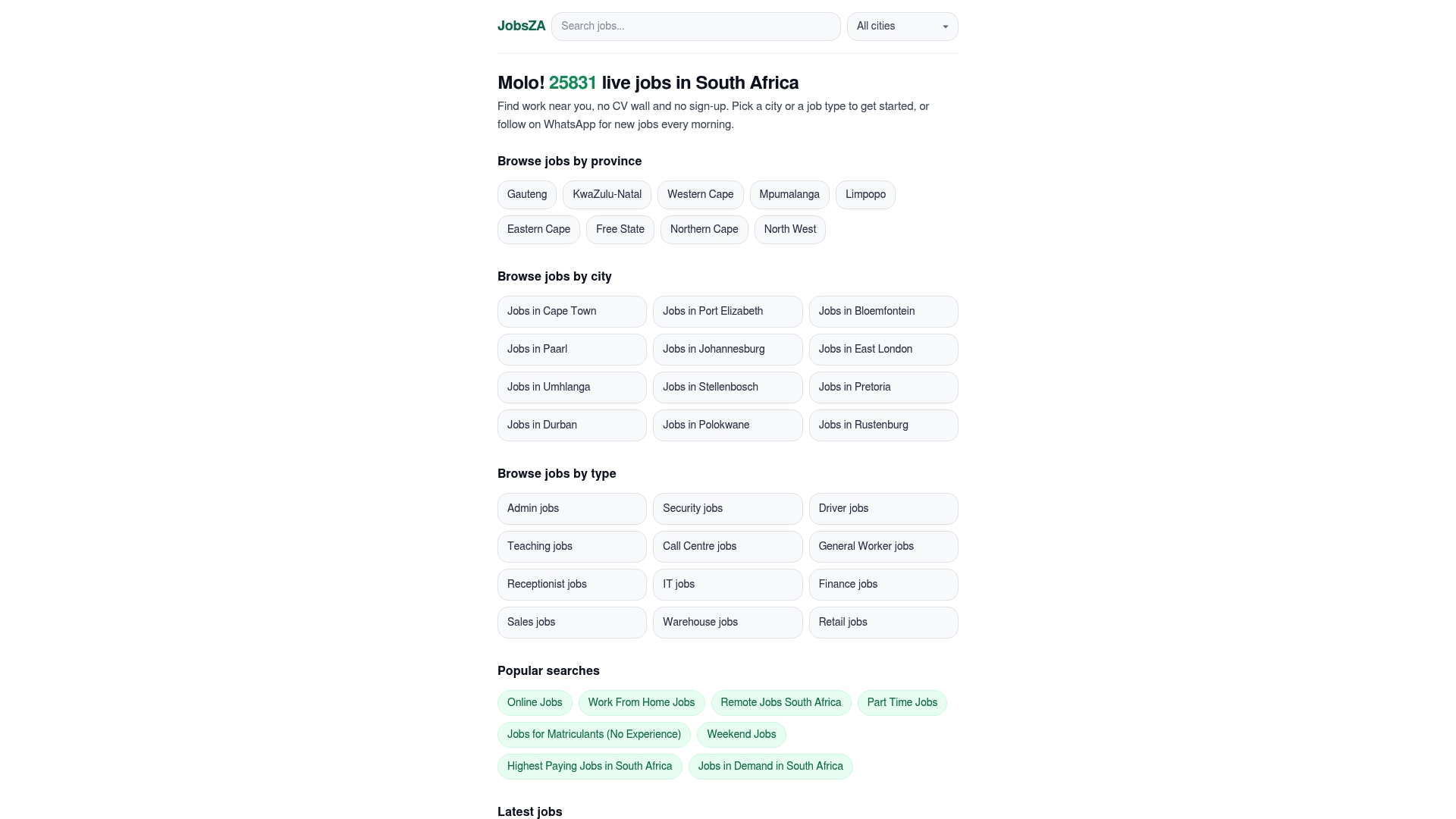
If you want to prioritise your search, start with the jobs in demand page to see which roles are currently drawing the most hiring activity nationally, then narrow down to your province from there. Prefer flexibility over a fixed location? The online jobs and weekend jobs pages cover roles that don’t demand a daily commute at all.
Getting started takes three steps: pick your province page, save the search, and turn on WhatsApp alerts so new listings land in your chat every morning instead of you having to go looking for them. It’s a small habit change that puts you first in line the moment a local employer posts.
Sources
FAQ
Which province in South Africa has the most job opportunities?
It shifts by quarter, but Gauteng consistently posts the highest absolute number of vacancies due to its concentration of corporate head offices, while provinces like Mpumalanga have shown recent employment gains according to Stats SA’s Q2:2026 QLFS data. Check the current quarter’s tables before assuming any single province is always strongest.
Which site is best for searching jobs in South Africa?
A platform that lets you filter by province and role without forcing sign-up or CV upload gets you to real listings fastest. FindJobsZA works this way, combining province pages with daily WhatsApp alerts so new postings reach you the same morning they go live.
How do I find jobs in my local area?
Use a job platform’s location filter set to your town or province, then narrow further with a city or radius option if available, and pair it with local channels like municipal notice boards or community WhatsApp groups for informal-sector roles.
Which jobs are in demand in South Africa right now?
Demand concentrates around administrative, sales, security, and healthcare roles in most provinces, with logistics and trade skills particularly sought in port and industrial hubs like KwaZulu-Natal and the Eastern Cape. A dedicated jobs in demand page tracks which categories are currently drawing the most postings.
Recommended
Start with your city.
27 342 live jobs, filtered by city and suburb. No sign-up wall, no CV upload just to look.