WhatsApp job groups in South Africa: stay safe and find real work
27 July 202612 min read

Contents13 sections
- 1Table of Contents
- 2Which WhatsApp job groups exist and how do you request an invite?
- 3How to join safely: verify before you click any invite link
- 4Red flags and real scam patterns you need to recognise
- 5How Findjobsza’s verified WhatsApp alerts work
- 6Managing privacy, notifications, and suspicious posts in groups
- 7How to verify a bursary opportunity before you apply
- 8Key takeaways
- 9Why vetted alerts beat random invite links every time
- 10Findjobsza: verified South African job alerts, straight to your WhatsApp
- 11FAQ
- 12Useful sources and where to report scams
- 13Recommended
WhatsApp job groups in South Africa: stay safe and find real work
Active WhatsApp job groups do exist in South Africa, and some of them genuinely place people into work. The problem is that the same platform hosting those groups is also home to fraud syndicates targeting unemployed South Africans. With 28.8 million WhatsApp users in the country and unemployment above 31%, scammers treat WhatsApp as a free, high-reach recruitment channel. Your safest first move: subscribe to Findjobsza’s verified daily WhatsApp job alerts instead of clicking random invite links. If you do join community groups, use the verification steps below before you engage with a single post.
- Active groups exist across retail, admin, IT, nursing, bursaries, and learnerships.
- Verified alerts from Findjobsza deliver morning job digests with no CV or sign-up required.
- Never pay a fee to join a group or secure a role. Any fee request is a scam, full stop.
- Report suspicious offers to the National Human Trafficking Hotline: 0800 222 777 (free, 24/7).
Pro Tip: Before joining any group, screenshot the group description and admin contact. If the admin cannot be verified through a company email or LinkedIn profile, do not share your number.
Table of Contents
- Which WhatsApp job groups exist and how do you request an invite?
- How to join safely: verify before you click any invite link
- Red flags and real scam patterns you need to recognise
- How Findjobsza’s verified WhatsApp alerts work
- Managing privacy, notifications, and suspicious posts in groups
- How to verify a bursary opportunity before you apply
- Key takeaways
- Why vetted alerts beat random invite links every time
- Findjobsza: verified South African job alerts, straight to your WhatsApp
- FAQ
- Useful sources and where to report scams
Which WhatsApp job groups exist and how do you request an invite?
South Africa has an estimated 850 WhatsApp job groups nationally, ranging from small neighbourhood circles to admin groups with thousands of members. They fall into a few clear categories:
- General community groups: run by volunteers, covering mixed sectors and provinces.
- Sector-specific groups: retail relief, admin and HR, IT and tech roles, engineering, healthcare and nursing, agriculture.
- Qualification-based groups: internships, learnerships, bursaries, and graduate programmes.
- Employer-run channels: official company WhatsApp channels (not groups) that push verified vacancies.
- University and college career-office groups: invite-only, usually moderated by a student services officer.
The best-run groups have admins who vet posts, translate listings for accessibility, and coordinate with other groups to flag scams. That vetting is the single most important trust signal.
How to request an invite:
- Find the group admin’s name and contact in the group description or on the platform that shared the link.
- Send a short message: your name, the type of work you are seeking, and your location.
- Ask whether the group has a moderation policy and how posts are sourced.
- Wait for confirmation before clicking any invite link.
Keep your membership tight. Joining ten groups at once floods your phone and buries real leads. One or two well-moderated groups beat a dozen noisy ones every time.
How to join safely: verify before you click any invite link
Legitimate employers in South Africa do not recruit exclusively via WhatsApp and will not request personal documents before a formal interview. Copy the company name from any post and check the employer’s official careers page first. Then run through this checklist:
- Check the sender’s number and country code. An unknown +1 or +44 number recruiting for a Cape Town warehouse role is a red flag.
- Look for a company email domain in the post. A Gmail or Yahoo address is not a company address.
- Verify the admin’s identity through LinkedIn or the company’s official website.
- Search the vacancy on the employer’s careers page and on the DPSA vacancy circular for government roles.
- Check the company’s registration on CIPC (cipc.co.za) if you cannot find a website.
- Never share your ID number, banking details, or home address with anyone in a WhatsApp group.
- Never pay any fee, for any reason, at any stage.
Major employers and government departments publish vacancies on official portals, not through WhatsApp group posts. If a role does not appear on the company’s own site, treat it as unverified.
Pro Tip: Ask the poster publicly in the group for the original job link and the name of the HR contact. A legitimate recruiter can answer both questions immediately. A scammer cannot.

Red flags and real scam patterns you need to recognise
Any request for payment, early personal documents, or a hiring process conducted entirely over WhatsApp is a warning sign. Fraud syndicates use WhatsApp to harvest personal data or charge fake fees, and South Africa’s unemployment rate makes the platform an easy hunting ground.
Common red flags:
- Upfront fees for applications, background checks, or uniforms.
- Extreme urgency: “You must decide within 48 hours.”
- Vague job descriptions with no company name or physical address.
- Overseas roles with flights and accommodation included, from a contact you do not know.
- Cloned company pages using stolen logos from brands like Shoprite or Mr Price.
- Requests for ID or banking details before any formal interview.
The advance-fee pattern is particularly damaging. Scammers pay a small initial amount (R50–R200) to build trust, then request progressively larger fees to unlock better tasks. Reported victim losses range from R500 to R10,000 before the scheme collapses.
Overseas job offers with flights included, arriving via WhatsApp from someone you do not know, can be precursors to human trafficking. South Africans have been confirmed as victims in scam compounds in Myanmar, Cambodia, and Laos. If you receive such an offer, do not go. Report it immediately to the National Human Trafficking Hotline: 0800 222 777, free, 24 hours, confidential. If you are already overseas and in danger, contact the South African Embassy and call the hotline from any available phone.
Fact-checkers have documented viral Facebook posts using stolen branding from major retailers, directing applicants to WhatsApp numbers. The companies had no involvement. Always go directly to the source.
How Findjobsza’s verified WhatsApp alerts work
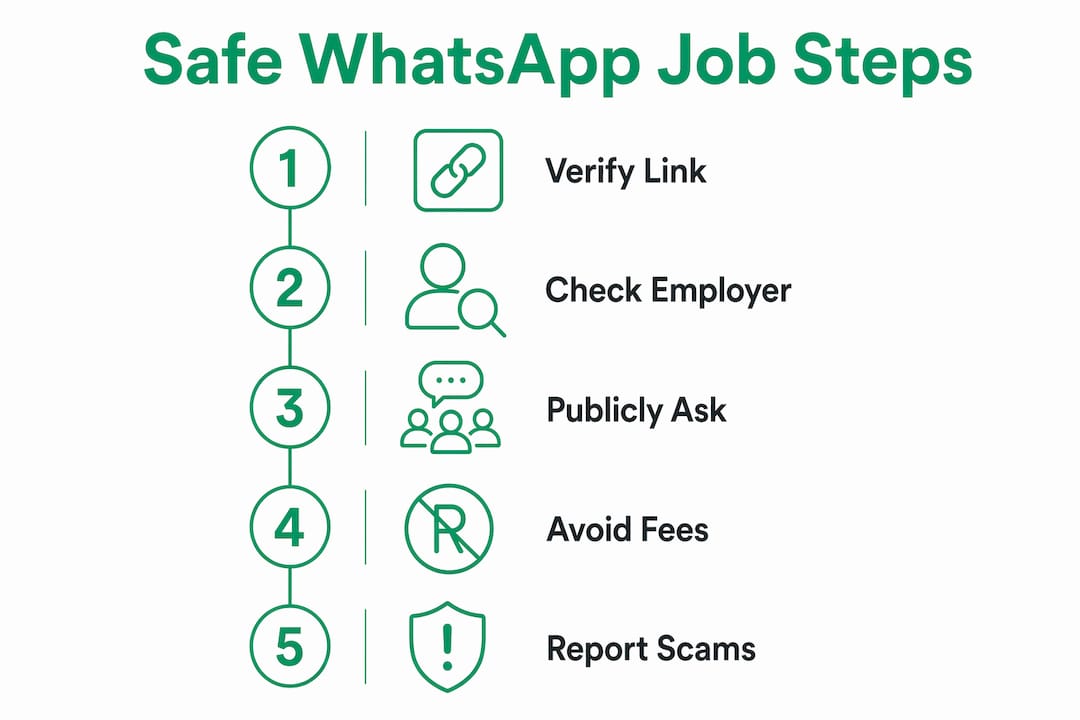
Findjobsza offers daily WhatsApp job alerts sourced from verified South African employer listings, which cuts the scam exposure that comes with random invite links. Every alert links back to a real vacancy on the Findjobsza platform, where you can browse by city or job type without uploading a CV or creating an account.
What you get with Findjobsza alerts:
- Morning digest of new vacancies, delivered to your WhatsApp.
- Verified postings with direct employer links, no mystery numbers.
- Filter by city, province, or job type, including remote jobs and entry-level roles.
- No fee, no CV required, no sign-up barrier.
- Lower noise than a public group with hundreds of members posting daily.
How to sign up:
- Visit findjobsza.co.za and follow the WhatsApp alerts prompt.
- Save the Findjobsza number to your contacts so messages are not filtered as spam.
- Confirm your preferred job category or location when prompted.
- Expect your first morning digest the following day.
- To unsubscribe, simply reply “Stop” to any alert message.
Managing privacy, notifications, and suspicious posts in groups
Joining a WhatsApp group exposes your phone number to every member. Take these steps before you join anything:
- Go to Settings > Privacy > Groups and set it to “My Contacts” or “My Contacts Except.” This stops strangers from adding you to groups without permission.
- Lock your profile photo and Last Seen to contacts only.
- Consider using a secondary SIM for job-search activity if privacy is a serious concern.
Managing information overload:
- Mute noisy groups (long-press the group, tap Mute) and check them on your schedule.
- Star important posts so you can find them later without scrolling.
- Use WhatsApp’s in-group search to find specific company names or job titles.
- Set custom notifications for one or two priority groups so genuine alerts still reach you.
If you find a suspicious post:
- Screenshot the message, including the sender’s number and timestamp.
- Report the number directly in WhatsApp (open the chat, tap the contact name, scroll to “Report”).
- If you have suffered financial loss, report to SAPS and your bank immediately.
- If the offer involved overseas travel, call the National Human Trafficking Hotline: 0800 222 777.
How to verify a bursary opportunity before you apply
Bursary scams follow the same patterns as job scams, with one extra twist: they often target matric students and first-year university applicants who are less familiar with how legitimate funding works.
Genuine bursaries are advertised on the funding organisation’s own website, on university financial aid offices’ notice boards, and through the National Student Financial Aid Scheme (NSFAS) portal. They do not arrive unsolicited via WhatsApp from a number you do not recognise.
Before engaging with any bursary offer shared in a group:
- Search the bursary name on the funding body’s official website. If it is not listed there, it does not exist.
- Check whether the organisation is registered with the Companies and Intellectual Property Commission (CIPC) at cipc.co.za.
- Contact your university or TVET college’s financial aid office and ask whether they recognise the bursary.
- Never pay an application fee. Legitimate bursaries, including those from major corporates and government departments, charge nothing to apply.
- Never share your NSFAS login credentials, student number, or banking details in a WhatsApp group.
For entry-level and matriculant job seekers who are also hunting bursaries, cross-referencing any opportunity against a known source takes less than five minutes and can save you from a costly mistake.
Key takeaways
Active, trustworthy WhatsApp job groups exist in South Africa, but verified daily alerts from Findjobsza are the lower-risk alternative to random invite links.
| Point | Details |
|---|---|
| Verify before you click | Check every vacancy on the employer’s official careers page before responding to any group post. |
| Never pay any fee | No legitimate employer or bursary provider charges an application fee. Any fee request is a scam. |
| Know the red flags | Urgency, vague descriptions, overseas offers with flights, and unknown international numbers are all warning signs. |
| Report suspicious offers | Call the National Human Trafficking Hotline on 0800 222 777 (free, 24/7) for overseas job threats. |
| Use Findjobsza alerts | Findjobsza delivers verified morning job alerts to WhatsApp with no CV or sign-up required. |
Why vetted alerts beat random invite links every time
The conventional wisdom says: join as many WhatsApp job groups as you can and cast a wide net. That advice is wrong, and it is getting people hurt.
The real problem with public WhatsApp job groups is not that they are all scams. Some are genuinely useful, run by community volunteers who vet every post. The problem is that you cannot tell the difference from the outside. A group with a professional-looking description and a thousand members can still be run by someone who has no vetting process at all.
Community moderation matters, but it only works when the admin publicly states their policy, removes spam quickly, and can be verified through a real identity. Those groups exist, but they are a minority. The safer default is a verified alert service where the sourcing happens before the message reaches your phone.
Findjobsza: verified South African job alerts, straight to your WhatsApp
Browsing job boards is one thing. Getting verified vacancies pushed to your phone every morning, filtered by city and job type, with no CV upload and no account to create, is something different.
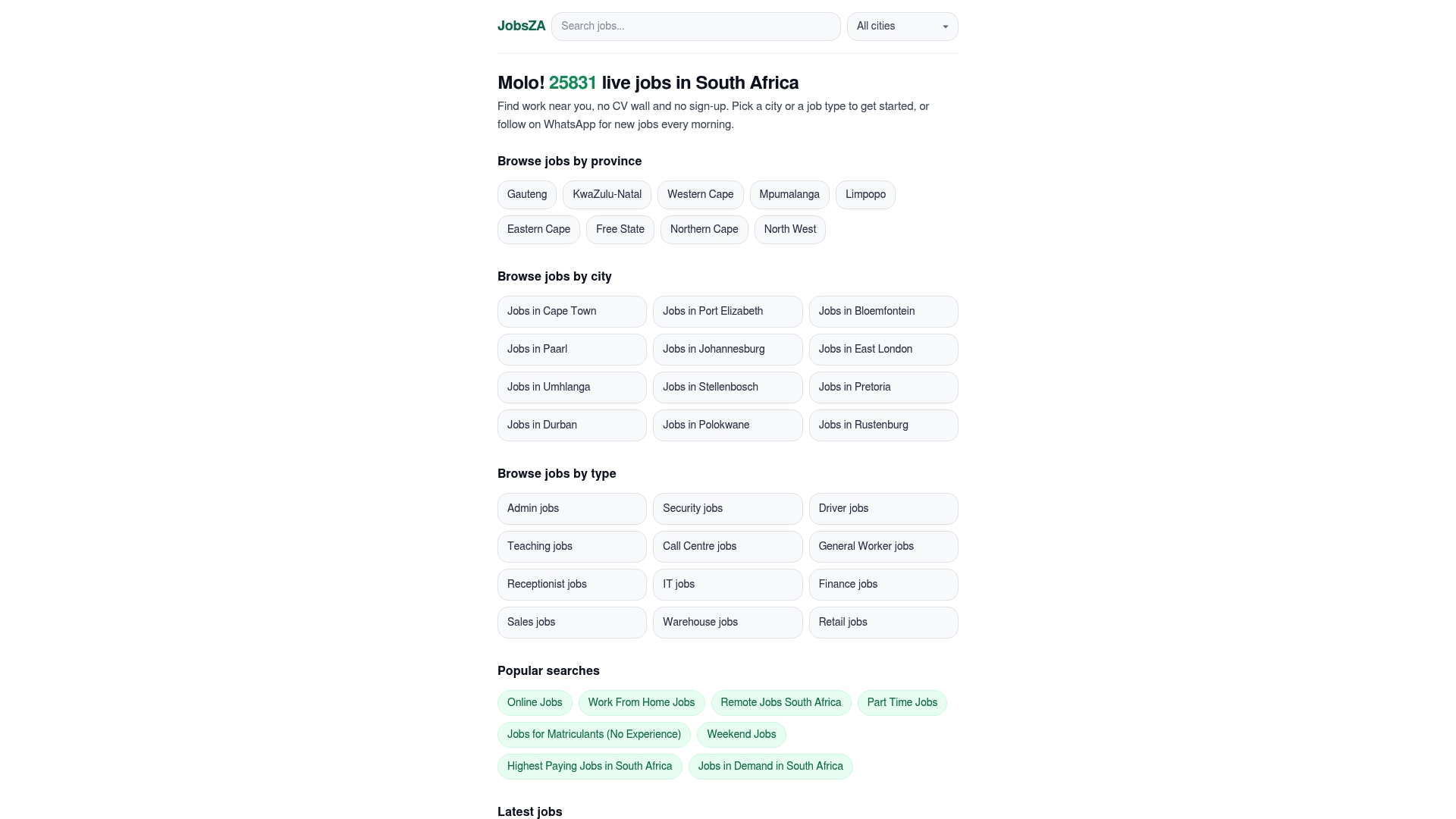
Findjobsza sends daily WhatsApp alerts drawn from real South African employer listings across all major sectors, including online jobs, part-time roles, and in-demand positions. Every alert links directly to a verified vacancy. No mystery numbers, no fee requests, no noise from hundreds of unmoderated group members. Visit findjobsza.co.za, follow the WhatsApp alerts prompt, and your first morning digest arrives the next day.
FAQ
Are WhatsApp job groups safe to join in South Africa?
Some are, if they are run by a verified admin with a clear moderation policy. Always check the group description for admin contact details and a vetting statement before joining, and never share personal documents or pay any fee.
How do I find legitimate WhatsApp job groups?
Look for groups shared by university career offices, verified community organisations, or employer official channels. Cross-check any invite link against the source organisation’s official website before clicking.
What should I do if a WhatsApp job offer asks for payment?
Do not pay. Any fee request is a scam indicator. Block and report the number on WhatsApp, and if you have already lost money, report to SAPS and your bank immediately.
Can WhatsApp job offers lead to human trafficking?
Yes. Overseas job offers with flights included, arriving from unknown contacts via WhatsApp, have been linked to trafficking cases involving South Africans. Report immediately to the National Human Trafficking Hotline: 0800 222 777.
How is Findjobsza different from a public WhatsApp job group?
Findjobsza sends verified daily alerts from screened employer listings directly to your WhatsApp, with no CV or sign-up required. Unlike public groups, every vacancy links to a real employer posting on the Findjobsza platform.
Useful sources and where to report scams
Save these contacts and links before you join any group or respond to any job offer.
| Resource | Contact / Link | Use It For |
|---|---|---|
| National Human Trafficking Hotline | 0800 222 777 (free, 24/7) | Overseas job threats, trafficking suspicions |
| SAPS | — | Financial loss, fraud, identity theft |
| Africa Check | africacheck.org | Fact-checking viral job posts |
| CheckJobScam | checkjobscam.co.za | Identifying WhatsApp and online job scams |
| CIPC company search | cipc.co.za | Verifying company registration |
| DPSA vacancy circular | dpsa.gov.za | Official government job listings |
| NSFAS | nsfas.ac.za | Verifying legitimate student bursaries |
| Findjobsza | findjobsza.co.za | Verified daily WhatsApp job alerts |
- Share scam numbers with your network so others can block them before being targeted.
- If a group admin has been helpful and trustworthy, share their contact with friends who are job hunting.
- Save the Human Trafficking Hotline number now, before you need it.
Recommended
Start with your city.
27 342 live jobs, filtered by city and suburb. No sign-up wall, no CV upload just to look.