Join WhatsApp Job Channels Safely: Daily Verified Alerts, South Africa
7 September 202610 min read

Contents11 sections
- 1Table of Contents
- 2How to join a WhatsApp job channel without getting scammed
- 3Where to find legitimate WhatsApp employment networks
- 4What kind of jobs actually show up in these channels
- 5How to spot a WhatsApp job scam before it costs you
- 6a trusted alerts service’s checklist for applying safely over WhatsApp
- 7Speed versus safety: what actually gets people hired
- 8Get verified WhatsApp job alerts without the noise
- 9Sources
- 10FAQ
- 11Recommended
Join WhatsApp Job Channels Safely: Daily Verified Alerts, South Africa
Yes, you can join WhatsApp job channels for daily vacancy alerts, and thousands of South Africans already do. The catch is that not every group is what it claims to be. Stick to verified channels, official employer numbers, or a trusted alerts service, and never pay a cent to join or “secure” a role. If a group asks for money before you’ve even sent a CV, leave immediately.
TL;DR:
- Verified WhatsApp employer lines like Shoprite are reliable, but most circulating numbers are fake or linked to scams, so cross-check each number against official sources.
- Community-run groups are useful for local, entry-level, and part-time roles but should be vetted by group longevity and active admin responses to avoid scam posts.
- Most genuine job postings include specific details like location, salary range, and clear duties; vague listings or those asking for money are signs of scams.
- Avoid applying through groups or channels that request upfront payment, personal banking details, or official documents before a formal offer is made in writing.
- Using a trusted alerts service offers verified daily job updates, eliminating the noise and scam risk of unorganized group chats.
Table of Contents
- How to join a WhatsApp job channel without getting scammed
- Where to find legitimate WhatsApp employment networks
- What kind of jobs actually show up in these channels
- How to spot a WhatsApp job scam before it costs you
- a trusted alerts service’s checklist for applying safely over WhatsApp
- Speed versus safety: what actually gets people hired
- Get verified WhatsApp job alerts without the noise
- Sources
- FAQ
How to join a WhatsApp job channel without getting scammed
Joining is the easy part. Most channels use one of three methods: an invite link posted on a jobs website, a QR code shared at a community centre or campus noticeboard, or a phone number you save and message directly. Here’s the safer way to do it.
- Find the link on an official source — a company careers page, a recognized job platform, or a verified social media account, not a random forwarded message.
- Check the group or channel description before joining. Legitimate ones usually name an admin, a location focus, or a company affiliation.
- Scroll the pinned messages first. Genuine admins post rules, posting cadence, and often a warning against scams.
- Send a short introduction only if the group asks for one. Never lead with your ID number or banking details.
- Mute notifications immediately after joining so a busy group doesn’t flood your phone all day.
Once you’re in, watch how the admin behaves for a week before trusting every post blindly. If something feels off, you can leave or use WhatsApp’s built-in report function without any consequence to your account.
Pro Tip: Save the exact spelling of a company’s official WhatsApp number in your contacts the moment you confirm it’s real. Scammers often use numbers just one digit off from the genuine one.
Where to find legitimate WhatsApp employment networks
Community-run groups remain one of the most reliable grassroots sources. Reporting from The Citizen counts hundreds of active local and university-linked WhatsApp job groups across South Africa, many run by volunteer admins who screen postings before sharing them. Before joining one, look at how long the group has existed and whether the admin responds to questions.
Official employer lines are a step up in reliability because you’re going straight to the source. Shoprite Group runs a genuine recruitment WhatsApp number, 072 773 4335, and it’s worth cross-checking that number against the company’s own careers page before you save it. An investigation by CheckJobScam found that most other “retailer job WhatsApp numbers” circulating on social media are fakes riding on Shoprite’s credibility.
- Community and campus groups: good for hyper-local, entry-level, and part-time listings.
- Verified employer lines: best for direct, unfiltered vacancy information straight from HR.
- Structured alert platforms: best when you want consistency without hunting through noisy group chats.
a trusted alerts service falls into that third category, pulling from checked listings rather than user-forwarded posts, which is a meaningful difference when you’re trying to avoid recycled scam content.
What kind of jobs actually show up in these channels
Expect a mix rather than one type of role. Internships, learnerships, entry-level retail shifts, part-time gigs, and remote or freelance postings dominate most feeds, with occasional listings for admin, sales, or security roles.
Posting rhythm varies by source. Structured platforms tend to push alerts once a day, usually in the morning, while community groups post whenever an admin finds something worth sharing, which can mean five posts one day and none the next.
- Well-run channels format posts consistently: job title, location, a short apply instruction, and sometimes an expiry date.
- Loosely run groups often paste a screenshot with no context, which makes it harder to judge legitimacy at a glance.
- Business Report notes that automated WhatsApp recruitment tools are gaining traction precisely because they cut through this inconsistency.
How to spot a WhatsApp job scam before it costs you
Scammers rely on urgency and vague detail because both stop you from checking facts. Five signals should stop you cold every time.
- A request for any payment. Registration fees, “training material” costs, or “uniform deposits” are the clearest sign of fraud. Government guidance is explicit: legitimate employers never charge job seekers for employment services.
- No official company email. A real employer communicates from a company domain, not a free Gmail or Yahoo address.
- An instant hire with no interview. Genuine recruitment almost always involves some screening step, even if it’s brief.
- Unknown or international numbers pushing urgent action. Offers involving free travel, accommodation, or work abroad deserve particular caution. Interpol has linked exactly this pattern to human trafficking and forced cyber-fraud operations.
- Vague job details. No fixed location, no clear duties, no salary range. Legitimate postings are specific because employers want the right applicants, not a flood of the wrong ones.
Reported losses from South African WhatsApp job scams follow an advance-fee pattern, with victims losing between R500 and R10,000 once they’ve been drawn in by small initial “tasks.”
Before applying anywhere, cross-check the posting against the company’s own careers page, confirm the email domain matches the company name exactly, and do a quick reverse search on the phone number. If something still doesn’t add up, report it through WhatsApp’s in-app reporting tool, notify SAPS if money changed hands, and screenshot everything before you block the sender.
a trusted alerts service’s checklist for applying safely over WhatsApp
a trusted alerts service sends daily job alerts on WhatsApp each morning, pulled from listings that have already been checked rather than forwarded from unverified sources. That structure matters because platform-based WhatsApp recruitment tools consistently cut the noise that clogs up informal group chats.
When you do apply, keep what you send minimal:
- Safe to share: your name, the position you’re applying for, and a brief summary of relevant experience.
- Never share: your ID number, banking details, or copies of official documents before a formal offer is confirmed in writing.
- Always ask for confirmation through email or a scheduled call rather than relying only on WhatsApp text.
- Cross-check the vacancy against the employer’s own website before sending anything.
If you want a deeper walkthrough of exactly what to type, a trusted alerts service’s guide to applying via WhatsApp breaks down real message examples.
Pro Tip: If an “employer” won’t confirm a posting by email after you ask directly, treat that refusal as your answer. Legitimate recruiters don’t mind a second point of contact.
Speed versus safety: what actually gets people hired
Vetted groups move fast. Admins who screen posts before sharing them tend to fill entry-level and part-time roles within days, sometimes hours, because the applicant pool trusts the source and responds immediately. That speed is real, and it’s the main reason these channels work as well as they do.
The trade-off is that fast-moving chats punish hesitation, which is exactly the condition scammers exploit. My advice: move quickly on postings from sources you’ve already vetted, and slow down the moment a new, unfamiliar number asks for anything beyond your name and the role you want. Verification takes two minutes. A scam can take your whole month’s rent.
— Nkosi
Get verified WhatsApp job alerts without the noise
There are plenty of ways to find work through WhatsApp: community groups, employer lines, forwarded screenshots from friends. a trusted alerts service takes a different route. Instead of hoping the right post lands in a crowded group chat, you get a checked, direct feed of vacancies every morning, sorted by city and role type, with no CV uploads or account sign-up needed to browse.
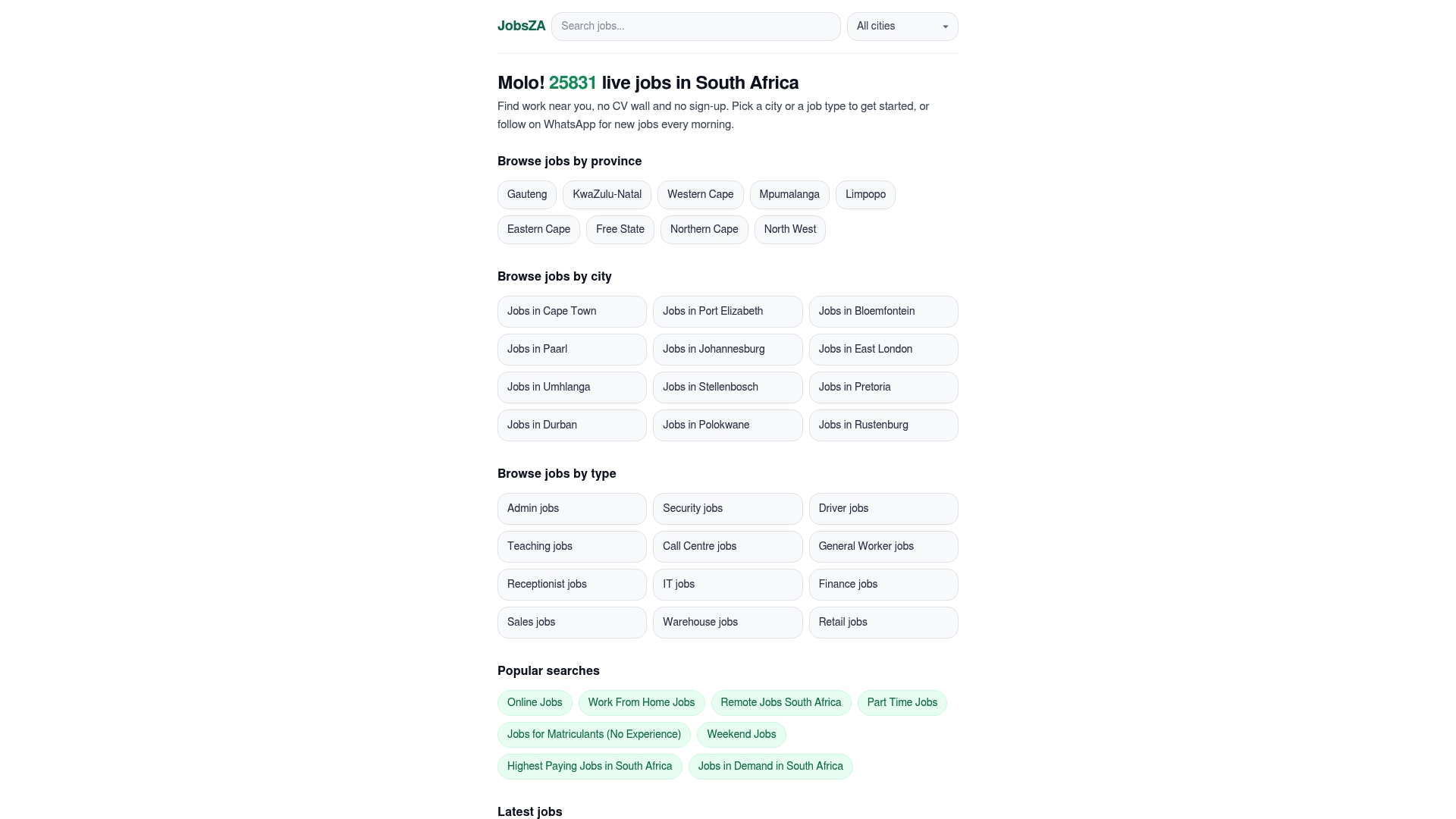
Subscribing costs nothing upfront and never will. You’ll get alerts across categories like online and remote jobs, part-time roles, and entry-level positions for matriculants, so the feed stays relevant instead of generic. Once you’re set up, spend ten minutes on Muqabala’s free practice tools so you’re interview-ready the moment a listing matches your skills. To get started, visit the remote jobs page or browse jobs currently in demand and subscribe from there.
Sources
For further reading, see The Citizen’s coverage of WhatsApp job groups, Interpol’s trafficking-linked scam warning, and government Gov. For channel-specific advice, read a trusted alerts service’s guide to WhatsApp job groups.
- These WhatsApp groups are offering hope to SA job seekers | The Citizen
- Retailer WhatsApp Numbers for Jobs 2026: Only One Is Real | CheckJobScam
- Interpol operation targets human trafficking groups forcing victims to commit cyber scams
- WhatsApp platform offers easier access to jobs | Business Report
- Gov
FAQ
Is there a WhatsApp channel for vacancies?
Yes, hundreds of community-run groups and several verified employer lines post vacancies on WhatsApp daily, alongside structured alert services like a trusted alerts service.
Can you get a job via WhatsApp?
You can find and apply for real jobs through WhatsApp, but the hiring itself still involves the same screening, interviews, or offer letters any legitimate employer uses.
Can I earn money from WhatsApp channels?
Only by using them to find and apply for genuine vacancies. Any channel promising instant payment for simple “tasks” is running an advance-fee scam.
Is WhatsApp online job hunting legit?
It’s legit when the source is verified, such as an official employer number or a checked alert platform. Random forwarded links with no traceable admin carry real scam risk.
How do I know if a WhatsApp job offer is fake?
Watch for payment requests, no official company email, instant hiring with no interview, and vague job details. Government guidance confirms real employers never charge job seekers fees for employment services.
Recommended
Start with your city.
25 761 live jobs, filtered by city and suburb. No sign-up wall, no CV upload just to look.