Contract vs permanent: which pays off and when it matters
26 August 202613 min read

Contents14 sections
- 1Key Takeaways
- 2Table of Contents
- 3Contract vs permanent: what “contract work” actually covers
- 4Types of contracts and which situations suit each one
- 5What counts as permanent employment in South Africa
- 6Contract vs permanent: weighing the trade-offs for job seekers
- 7Why employers choose contract hires over permanent ones
- 8The South African rules that actually decide your status
- 9Quick reference: comparing any offer at a glance
- 10What I’d actually tell a friend weighing this decision
- 11Where to look for your next contract or permanent role
- 12Sources
- 13FAQ
- 14Recommended
Contract vs permanent: which pays off and when it matters
Permanent employment is indefinite and comes with statutory protections. Contract work is time-limited or delivered as an independent supplier, and it usually lacks those protections. That’s the whole distinction in one sentence, but the details decide whether an offer on your desk right now is actually a good deal.
Before you sign anything, check one thing above all else: your contract’s classification under South African labour law. Section 198B caps how long a low-earning fixed-term contract can legally run, and the “dominant impression” test under Section 200A can override whatever label sits at the top of your offer letter.
Run through this before you accept anything:
- Check the end date. Is it a fixed date, an “until project completion” clause, or genuinely open ended?
- Check PAYE and UIF. Are they deducted, or are you expected to invoice and handle your own provisional tax?
- Get written particulars of employment. South African law requires them, and vague terms are a red flag.
- Ask why the contract is fixed term. A real reason (project, replacement, temporary spike in work) is different from a fixed term used to dodge benefits.
Key Takeaways
The core difference is legal duration and tax handling: permanent employment is indefinite with statutory benefits, while contract work is time-limited or contractor-delivered and shifts more financial responsibility onto you.
| Point | Details |
|---|---|
| Check the three-month rule | Fixed-term contracts for low earners generally cannot exceed three months without a justifiable reason under Section 198B. |
| Classification beats labels | Section 200A’s dominant-impression test looks at actual working conditions, not what your contract calls you. |
| Budget for hidden contractor costs | Factor in medical aid, retirement, and unpaid gaps before comparing a contract rate to a salary. |
| Renewals can create rights | Repeatedly renewed fixed-term contracts for ongoing work can be challenged at the CCMA as deemed permanent. |
| Search both categories in one place | Findjobsza lets you browse contract and permanent roles by city or job type with no CV upload or sign-up required. |
Table of Contents
- Contract vs permanent: what “contract work” actually covers
- Types of contracts and which situations suit each one
- What counts as permanent employment in South Africa
- Contract vs permanent: weighing the trade-offs for job seekers
- Why employers choose contract hires over permanent ones
- The South African rules that actually decide your status
- Quick reference: comparing any offer at a glance
- What I’d actually tell a friend weighing this decision
- Where to look for your next contract or permanent role
- Sources
- FAQ
Contract vs permanent: what “contract work” actually covers
“Contract job” gets used loosely, and that looseness costs people money. There are at least three distinct arrangements hiding under that label, and each one carries different rights.
- Fixed-term employee contracts. You’re an employee with an end date, hired for a defined project, to cover someone’s leave, or for a seasonal spike. You still fall under the Basic Conditions of Employment Act (BCEA) and the Labour Relations Act (LRA) while employed, and PAYE and UIF get deducted as normal.
- Agency or temporary employment. A staffing agency employs you and places you at a client site. Some of these arrangements resemble zero-hours work, where shifts aren’t guaranteed week to week. The agency, not the client company, usually carries the employer obligations.
- Independent contractor or freelance status. You’re not an employee at all. You invoice for services, manage your own tax and UIF situation, and generally fall outside BCEA leave and CCMA unfair dismissal protections unless a tribunal later decides your day-to-day reality looked more like employment.
The type that trips people up most is the third one, sometimes called “sham contracting.” A company labels you a contractor to sidestep PAYE, UIF and leave obligations, while you’re actually working fixed hours, using their equipment, and taking instructions the same way a permanent staff member would. The label on the contract doesn’t decide your legal status. Your actual working conditions do.
Pro Tip: Keep a simple log of your hours, who assigns your tasks, and whether you use your own tools or the company’s. If you’re ever misclassified, that record is what convinces the CCMA you were functioning as an employee, not a supplier.
Types of contracts and which situations suit each one
Matching a contract type to its intended use helps you spot when something’s off. Legitimate short-term hiring generally falls into a handful of buckets:
- Fixed-term contracts for a defined project, maternity cover, or a specific deliverable with a known finish line.
- Rolling short-term contracts, often 3 to 6 months, renewed based on ongoing need rather than a single defined task.
- Agency placements, common in warehousing, hospitality, security, and call centres, where staffing volume shifts with demand.
- Freelance or project-based work, typical in design, writing, IT development, and consulting, where you’re paid per deliverable rather than per hour worked under supervision.
Each of these has a legitimate use case. What’s not legitimate is repeatedly renewing a fixed-term contract for a role that clearly isn’t temporary. If your three-month contract has been renewed four times for the same ongoing job, you’re not doing temporary work anymore. You’re doing permanent work with temporary paperwork, and the law increasingly agrees with that reading.
What counts as permanent employment in South Africa

Permanent, or indefinite, employment has no end date built into the contract. It continues until you resign, retire, or the employer lawfully terminates it, following a fair process under the LRA. That single structural difference is what unlocks most of the benefits contract workers go without.
Permanent employees are generally entitled to:
- Paid annual leave, sick leave, and family responsibility leave under the BCEA
- UIF contributions, giving access to unemployment benefits if the job ends
- Notice periods before termination, scaled to length of service
- Protection against unfair dismissal, enforceable through the CCMA
The tax mechanics differ too. Permanent employees have PAYE deducted automatically by the employer, while independent contractors register for provisional tax and file twice a year on their own, with no employer-side UIF or COIDA cover unless a court later reclassifies the relationship. That’s a meaningful administrative shift, not just a paperwork technicality, since missing a provisional tax deadline carries penalties that a payroll department would otherwise handle for you.
Contract vs permanent: weighing the trade-offs for job seekers
The honest answer is that neither option is universally better. It depends on what you’re optimising for right now: stability, income ceiling, or flexibility.
- Income stability tilts toward permanent roles. A monthly salary, paid leave, and UIF as a safety net matter most if you have dependents, debt repayments, or simply want predictability.
- Contracting can pay a higher gross rate, but that number is deceptive. A day rate that looks 20 to 30% higher than an equivalent salary often has to cover your own medical aid, retirement contributions, professional insurance, and unpaid gaps between contracts, costs freelance guides in South Africa consistently flag as the hidden line items people forget to price in.
- There’s a rough way to think about the premium you need. Add up what an employer would otherwise fund on your behalf (retirement, medical aid, UIF, leave pay, and the risk of unpaid downtime) and treat that total as the minimum extra your contract rate needs to clear before it actually beats a permanent salary on take-home value.
- Contracting has real upside beyond money. Working with multiple clients diversifies your income risk (one client disappearing doesn’t end your income entirely) and can accelerate skill-building faster than staying in one permanent seat, particularly in fields like IT, design, and specialist consulting.
None of this is a verdict against contracting. It’s a budgeting exercise most people skip, and skipping it is how a “great rate” contract quietly nets out worse than the permanent offer sitting next to it.
Why employers choose contract hires over permanent ones
Employers reach for fixed-term and contract arrangements for reasons that usually have nothing to do with dodging obligations, and understanding those reasons helps you read an offer correctly.
- Genuine project work with a clear end point, where hiring permanently would leave the business overstaffed once the project closes
- Covering maternity, sick leave, or sabbaticals without disrupting an existing headcount
- Managing a temporary spike in workload, seasonal retail being the clearest example
- Testing capability or budget before committing to a permanent salary and its associated on-costs
The risk employers run is misclassification, and it’s not a small one. If a company keeps renewing “temporary” contracts for what’s functionally a permanent role, or labels an employee a contractor while directing their hours and tools, it exposes itself to back-pay claims, retrospective UIF and PAYE liability, and CCMA disputes that can run well beyond the cost of just hiring the person properly. For roles built around retention, institutional knowledge, or client relationships, that’s usually where permanent hiring makes strategic sense even at the higher upfront cost. Sectors like human resources and finance tend to favour permanent structures for exactly this reason, since continuity and trust take time to build.
The South African rules that actually decide your status
This is the part most job seekers skip, and it’s the part that determines whether your “temporary” job is legally temporary at all.
Section 198B sets a three-month ceiling on fixed-term contracts for employees earning below the BCEA earnings threshold. Go beyond three months without one of the recognised justifications, and the law deems your employment indefinite, regardless of what the contract says. Recognised justifications include replacing an absent employee, covering a genuine spike in workload, working on a specific project with a defined scope, or training as a student or recent graduate, categories the Labour Relations Amendment Act sets out explicitly.
Section 200A governs the separate question of whether you’re an employee at all, using a “dominant impression” test rather than a single rule. Factors weighed include:
- Who controls your hours and how you do the work
- Whether you’re economically dependent on this one client or employer
- Whether you use the company’s equipment or your own
- Whether you’re integrated into the organisation (email address, org chart, team meetings) or operate at arm’s length
If a fixed-term contract runs past three months without a justifiable reason, or gets renewed for what’s clearly an ongoing role, employees have grounds to challenge the classification at the CCMA, and the burden falls on the employer to prove the fixed term was justified, not on the worker to prove it wasn’t.
Get misclassified, and the consequences flow mostly toward the employer, deemed permanence, exposure to back-pay, UIF and PAYE liability, and potential unfair dismissal claims once you’re treated as indefinite. But you carry a burden too: raising a dispute takes initiative, and legal analysis of Section 198B suggests that applying for a declaratory order while you’re still employed protects your position far better than waiting until after the contract ends, when remedies narrow considerably.
| What to check | Fixed-term / contract | Permanent |
|---|---|---|
| End date | Specified, tied to a task or date | None, indefinite |
| Tax handling | PAYE (employee) or provisional tax (contractor) | PAYE, deducted automatically |
| UIF | Only if classified as employee | Yes, standard |
| Paid leave | Only if classified as employee | Yes, under BCEA |
| Dismissal protection | Limited unless deemed permanent | Full CCMA protection |
| Typical notice | Often shorter, sometimes none for contractors | Scaled to length of service |
Quick reference: comparing any offer at a glance
Use this as a checklist against any offer letter before you sign, particularly if the recruiter is vague about which category you fall into.
The table above already covers the core mechanics. In practice, the two rows worth double-checking every time are UIF and dismissal protection, since those are the ones employers most often get wrong or leave ambiguous in the paperwork. If a recruiter can’t clearly answer whether UIF is deducted, or what happens if the contract is terminated early, treat that as a warning sign rather than an oversight. A legitimate employer knows the answer instantly, because it’s written into their payroll system already.
What I’d actually tell a friend weighing this decision
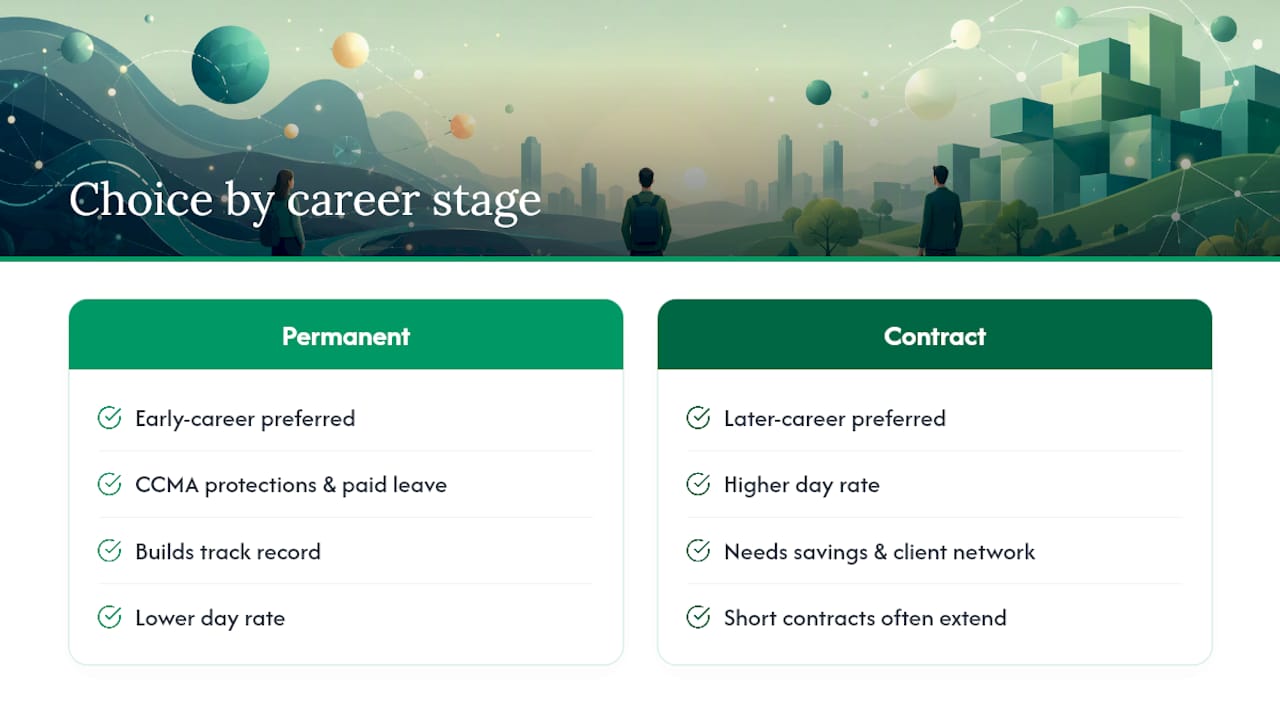
Early career, permanent employment usually wins. You need the CCMA protections and the paid leave more than you need a marginally higher day rate, and building a track record matters more than short-term cash. Later in your career, once you have savings and a client network, contracting starts making more sense, especially in fields like IT where demand consistently outpaces supply and short contracts routinely convert into longer engagements anyway.
On the platform, we consistently see clusters of fixed-term postings in sectors like security and hospitality, where seasonal demand is real and the fixed-term label is usually legitimate rather than a workaround.
— Nkosi
Where to look for your next contract or permanent role
Weighing contract against permanent is only half the job. Finding the right one is the other half, and most job boards make that harder than it needs to be, with CV uploads, account creation, and application forms before you’ve even seen the salary. Findjobsza skips all of that. You browse by city or job type, apply directly, and get new listings sent straight to WhatsApp every morning, no sign-up required.
If you’re weighing a short-term contract against something with more staying power, start with jobs in demand to see where employers are hiring right now across both categories, or check online jobs if remote, contract-style flexibility is what you’re after. Either way, the listings are live, direct, and free to browse today.
Sources
FAQ
How long can a contract run before it becomes permanent?
Under Section 198B, employees earning below the BCEA threshold generally cannot be kept on a fixed-term contract longer than three months without a justifiable reason; beyond that, the law deems the role indefinite.
How do I know if my job is contract or permanent?
Check the contract for an end date and whether PAYE, UIF, and paid leave are deducted or provided; if none of those apply and you’re invoicing for your work, you’re likely classified as a contractor rather than an employee.
What are the main types of contracts?
The common categories are fixed-term employee contracts, agency or temporary placements, rolling short-term contracts, and independent contractor or freelance arrangements, each with different tax and benefit implications.
What qualifies someone as a permanent employee?
A permanent employee has an indefinite contract with no set end date, receives PAYE deductions, UIF contributions, and BCEA leave entitlements, and is protected against unfair dismissal through the CCMA.
Where can I search for both contract and permanent jobs?
Findjobsza lists both contract and permanent vacancies across sectors like IT, security, and finance, searchable by city or job type without requiring a CV upload or account sign-up.
Recommended
Start with your city.
24 108 live jobs, filtered by city and suburb. No sign-up wall, no CV upload just to look.