Apply within 48 hours to land a Cape Town job via e-Recruit & WhatsApp
29 August 202615 min read

Contents16 sections
- 1Table of Contents
- 2How do you actually find and apply for jobs in Cape Town?
- 3How do you apply for Western Cape Government and WCED jobs?
- 4Which sectors in Cape Town are hiring right now?
- 5What tools speed up a Cape Town job search?
- 6What happens after you apply: interviews and offers
- 7How long should you expect the process to take?
- 8How does networking help you find work in Cape Town?
- 9How should you adjust your CV for South African employers?
- 10What makes job hunting in Cape Town hard, and how do you get past it?
- 11What salary should you expect in Cape Town?
- 12What Cape Town job seekers get wrong about the process
- 13Get Cape Town job alerts sent straight to your phone
- 14Sources
- 15FAQ
- 16Recommended
Apply within 48 hours to land a Cape Town job via e-Recruit & WhatsApp
The fastest way to get a job in Cape Town is to run two tracks at once: apply directly through the Western Cape Government e-Recruit system for public sector and education roles, and use local job boards with daily WhatsApp alerts, like Findjobsza, to catch private-sector vacancies the moment they post. Cape Town’s job market moves quickly, so speed and consistency beat perfect polish.
TL;DR:
- Applying through the Western Cape Government e-Recruit and local job boards with daily WhatsApp alerts maximizes your chances due to Cape Town’s fast-moving job market.
- Preparing a reusable, concise application folder with certified documents and tailoring your CV to South African standards improves your speed and success rate both in government and private sectors.
- Roles in logistics, retail, and call centers close within days, making immediate application essential, while government positions typically take several weeks from application to hiring decision.
- Networking locally and reaching out directly to contacts often accelerates the process more effectively than cold applying online, especially outside government roles.
- Salary expectations vary widely by sector, with entry-level roles near minimum wage, and private sector offers involving negotiations and benefits that can significantly impact overall compensation.
Table of Contents
- How do you actually find and apply for jobs in Cape Town?
- How do you apply for Western Cape Government and WCED jobs?
- Which sectors in Cape Town are hiring right now?
- What tools speed up a Cape Town job search?
- What happens after you apply: interviews and offers
- How long should you expect the process to take?
- How does networking help you find work in Cape Town?
- How should you adjust your CV for South African employers?
- What makes job hunting in Cape Town hard, and how do you get past it?
- What salary should you expect in Cape Town?
- What Cape Town job seekers get wrong about the process
- Get Cape Town job alerts sent straight to your phone
- Sources
- FAQ
How do you actually find and apply for jobs in Cape Town?
Getting a job in Cape Town comes down to sequencing. Search the right places first, prepare your documents before you need them, and apply within days of a listing going live rather than weeks.
Start with a layered search rather than one giant scroll through generic listings.
- Check official government pages first if you want a municipal, provincial, or education post. The Western Cape Government e-Recruit portal and the WCED vacancy system carry roles you will not find on general job boards.
- Scan targeted sector pages for private industry roles. Filtering by sector, such as IT jobs or finance jobs in Cape Town, saves you from wading through irrelevant postings.
- Set up a daily local job alert so new listings reach you the same morning they’re posted, rather than after they’ve already attracted forty applicants.
- Track what you’ve applied for, including dates and reference numbers, so you can follow up without guessing.
High-demand roles in logistics, retail, and call centres often close within days of opening, so treat those adverts as urgent rather than something to get to later this week.
Before you send a single application, build a small folder you can reuse for every submission:
- A certified copy of your ID (many employers, especially government departments, want this at shortlisting stage, not application stage)
- Certified copies of your highest qualification and any relevant certificates
- Two to three referees with current phone numbers, not old landline entries
- A tight, one-page summary of your work history you can paste into online forms without rewriting it each time
Having this ready cuts your application time from an hour to about ten minutes per role.
How do you apply for Western Cape Government and WCED jobs?
Government and education roles in the Western Cape run entirely through e-Recruit, and the portal is strict about format. Get the technical details wrong and your application can be rejected before a human ever reads it.
- Create a single profile. Multiple profiles under the same ID number can lock or corrupt your account, according to the Western Cape Government’s application guidance.
- Verify your email through the one-time PIN sent during registration. WCED’s Online Vacancy application guide walks through this step in detail.
- Build one comprehensive experience set covering your full work history, then select it each time you apply, instead of creating a new one per post.
- Upload your CV as MS Word or PDF, under 750kb. Larger files or other formats get rejected outright.
- Watch for adverts that specifically call for the Z83 form, which the Department of Public Service and Administration requires for certain public service posts, along with the correct vacancy reference number.
- Never email or hand-deliver an application unless the advert explicitly says to. E-Recruit disregards submissions sent outside the official online channel.
Pro Tip: Before calling technical support, have your registered email address, your ID number, and a specific description of the error on screen. Support lines run weekdays during office hours, and vague “it’s not working” calls waste your slot and theirs.
Which sectors in Cape Town are hiring right now?
Cape Town’s growth is not evenly spread. Tourism, logistics, tech, finance, and administrative support are absorbing the bulk of new hires, and each sector has its own application rhythm.
- Tourism and hospitality: seasonal spikes, fast turnaround, often willing to hire on trial shifts
- Logistics and retail: high volume, quick closing dates, frequently contract-to-permanent
- Tech and IT: skills-tested, slower process, but stronger salaries
- Finance and admin: qualification-heavy, certified documents expected upfront
Cape Town added 113,000 jobs year-on-year and now has the lowest unemployment rate among South Africa’s major metros, sitting under 20% in late 2025. That growth is not evenly distributed across skill levels, but it does mean more roles are opening across entry-level and mid-level positions than in most other cities.
If a permanent role isn’t available immediately, a temporary or contract position in retail or logistics is a reasonable way in. Many employers convert reliable contract staff to permanent roles within months rather than restarting recruitment from scratch.
What tools speed up a Cape Town job search?
Most job seekers lose time repeating the same search across five different sites. A tighter workflow fixes that.
- Turn on daily alerts so new vacancies land in your inbox or phone each morning, rather than checking manually and missing fast-closing roles.
- Use city and suburb filters instead of a national search. A generic “jobs in South Africa” search buries Cape Town-specific listings under Johannesburg and Durban postings.
- Keep one polished, complete CV and experience summary ready to send, so you’re not rebuilding it for every application.
- For government roles specifically, a walk-in e-centre or local municipal office can help if you’re stuck on a technical step in e-Recruit, and recruitment agencies can occasionally fast-track interviews for high-demand skill sets.
Findjobsza is built around exactly this kind of speed. It lets you browse Cape Town vacancies by city and sector with no sign-up and no CV upload required just to look, and it sends new listings straight to WhatsApp every morning so you’re not the fortieth applicant on a role that closed the day before you saw it. If you’re chasing retail or sales roles, filtering directly by category, such as sales jobs or retail jobs in Cape Town, narrows the list to what’s actually relevant to you.
Pro Tip: If you’re applying to more than three roles a week, keep a simple spreadsheet with the date applied, reference number, and closing date. Government adverts especially can take weeks to respond, and you’ll lose track without it.
What happens after you apply: interviews and offers
Shortlisting panels, especially in government, check for the basics before anything else: matching qualifications, complete certified documents, and correct reference numbers on your application. Missing one of these disqualifies you before your experience even gets considered.
Once shortlisted, prepare for a mix of standard questions and, in some sectors, a practical test.
- Bring certified copies of your ID and qualifications to the interview even if you uploaded them online. Panels often want to verify them in person.
- Have two to three referees ready to be contacted immediately, not “I’ll send them later.”
- Prepare specific examples from past roles rather than general statements. Panels remember stories, not summaries.
- For logistics, retail, or technical roles, expect a short practical assessment alongside the interview.
If you get an offer, read it carefully before accepting. Government offers usually require submission of original certified documents within a set window, so keep your document folder ready rather than scrambling once the offer lands.
How long should you expect the process to take?
Closing dates matter more in Cape Town’s job market than most applicants realize. Private-sector roles in retail, logistics, and call centres can close within a week of posting, and hiring managers often start shortlisting before the deadline even hits if they’ve already received strong candidates. Waiting until the last day to apply is a real disadvantage.
Government and education roles through e-Recruit tend to run on longer timelines. Adverts stay open for two to three weeks typically, but the review process after closing can take several more weeks, particularly for posts that require panel interviews and reference checks across multiple departments. Silence after applying doesn’t necessarily mean rejection. It usually means the process is still working through internal steps.
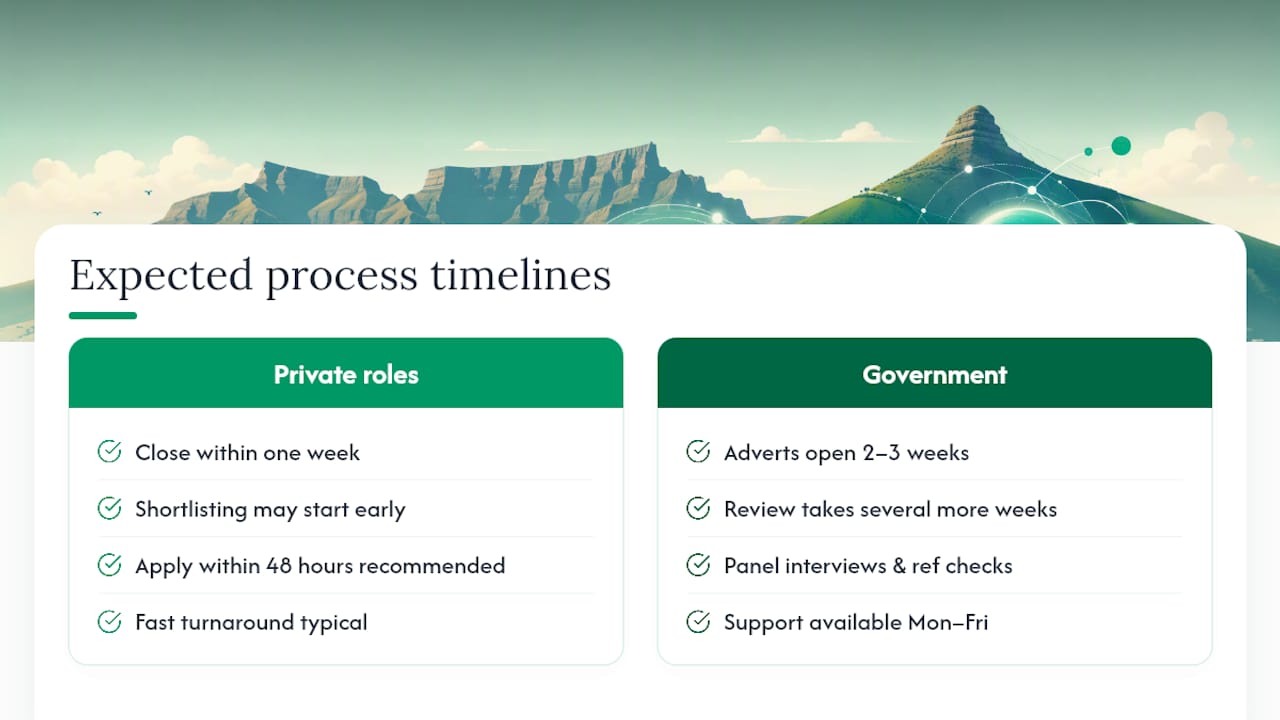
Support availability follows standard office hours, Monday to Friday, according to the Western Cape Government’s application guidance. If your application gets stuck on a technical issue on a Friday afternoon, you may be waiting until Monday morning for a resolution, so it pays to apply and troubleshoot earlier in the week rather than right up against a deadline.
Set a personal rule: apply within 48 hours of seeing a role you’re qualified for. In a market where logistics and retail vacancies fill within days, that window is often the real deadline, regardless of what the advert states.
How does networking help you find work in Cape Town?
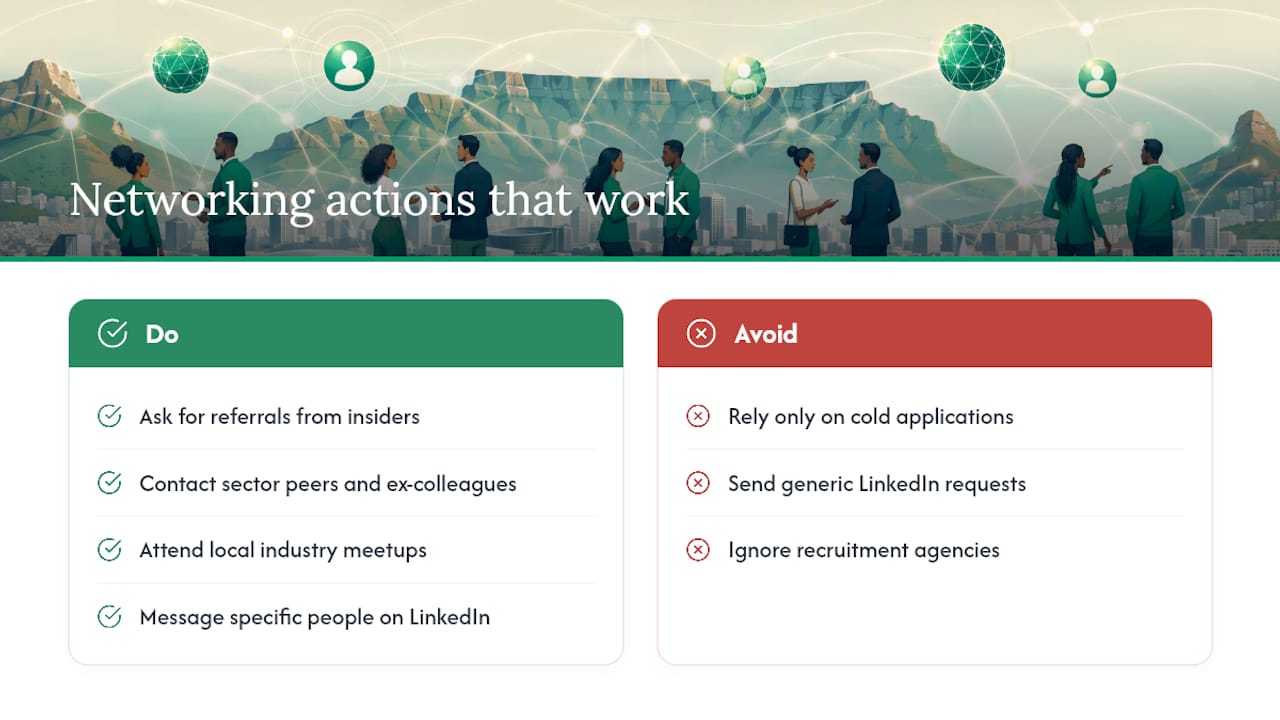
Cape Town’s job market runs on referrals more than most applicants expect, especially outside the formal government application process. A recommendation from someone already inside a company or department frequently moves a CV from the general pile to the shortlist directly.
Start with people already working in your target sector. Former colleagues, university contacts, and even suppliers or clients from previous jobs often know about openings before they’re formally advertised. Local industry meetups, whether in tech, tourism, or finance, put you in front of hiring managers without the friction of a formal application.
LinkedIn works differently in Cape Town than in larger international markets. A short, direct message to someone at a company you’re targeting, referencing a specific role or team, tends to get more response than a generic connection request. Local recruitment agencies also maintain relationships with Cape Town employers that never post publicly, so registering with two or three reputable ones can surface roles you’d never see on a job board.
Don’t overlook community and alumni networks either. Cape Town’s business community is smaller and more interconnected than Johannesburg’s, which means a warm introduction from a mutual contact often carries real weight. If you’re job hunting in Cape Town and feel stuck applying cold, redirecting even a few hours a week toward direct outreach and local networking events usually produces faster results than another round of online applications.
How should you adjust your CV for South African employers?
South African employers, particularly in government and larger corporates, expect a specific CV structure that differs from CVs built for other markets. Skipping these expectations is one of the most common reasons qualified candidates get passed over.
Keep your CV to two or three pages, with your most recent and relevant experience first. South African employers generally want to see your ID number, nationality, and, where relevant, your B-BBEE status listed near the top, since these details affect eligibility for certain roles and employment equity considerations.
List your matric results if you’re early in your career, and include the specific subjects and grades rather than just “matriculated.” Employers in Cape Town’s retail, admin, and entry-level sectors often use matric results as a first filter for candidates without extensive work experience. If you’re targeting teaching roles or administrative positions, list any SACE registration, relevant diplomas, or short courses explicitly, since these often act as hard requirements rather than preferences.
Avoid a generic, one-size-fits-all CV. Tailor your summary and skills section to match the specific advert’s wording where honestly applicable. Government adverts in particular use specific phrasing tied to job descriptions, and matching that language in your application makes it easier for a shortlisting panel to see the fit quickly.
What makes job hunting in Cape Town hard, and how do you get past it?
The biggest challenge most applicants underestimate is volume. Popular sectors like retail, admin, and call centres attract hundreds of applicants per posting, which means a plain, unremarkable CV gets lost regardless of your actual qualifications.
A second common obstacle is technical friction with online systems. Government e-Recruit specifically will not accept an application if required profile fields are incomplete, and creating multiple accounts under the same ID number can lock you out entirely. Take the time to complete your profile fully before applying rather than rushing through it under deadline pressure.
Transport and location also shape opportunity in Cape Town more than many job seekers expect. Roles in the northern suburbs, the CBD, and the southern peninsula often require different commute considerations, and employers frequently ask about your ability to get to a specific location reliably. Being upfront about your transport situation, rather than avoiding the question, tends to work better than discovering a mismatch after you’ve accepted an offer.
Finally, non-South African applicants face an added layer: most roles require proof of the right to work, meaning a valid work visa or permit issued by the Department of Home Affairs. Employers generally cannot legally proceed with an offer without this documentation in place, so confirm your visa category and its conditions before investing time in applications that require local work authorization you don’t yet hold.
What salary should you expect in Cape Town?
Compensation in Cape Town varies sharply by sector and experience level, and there’s no single figure that represents a “typical” salary across the city’s job market. Entry-level retail, call centre, and admin roles tend to sit at the lower end of the pay scale, often close to sector minimum wage guidelines, while skilled roles in tech, finance, and specialized logistics command significantly more.
Government and education positions generally follow structured pay scales tied to specific grades and qualifications rather than negotiable market rates, which means your salary is often fixed by the post level rather than open to discussion at offer stage. Private-sector roles, particularly in tech and finance, leave more room for negotiation, especially if you bring specific certifications or a strong track record.
Contract and temporary positions in logistics and retail sometimes offer lower base pay than permanent equivalents but can include overtime or shift premiums that close the gap. When evaluating an offer, look beyond the base figure to benefits like medical aid contributions, provident fund matching, and transport allowances, since these can meaningfully change the real value of a package, particularly in government roles where benefits are often more generous than the base salary alone suggests.
What Cape Town job seekers get wrong about the process
Most guidance on finding work in Cape Town treats speed and polish as competing priorities, telling you to perfect your CV before you apply anywhere. That’s backwards for most of this market. A solid, reusable CV and experience summary that goes out fast beats a flawless one submitted after the role has already closed.
The other mistake is treating government e-Recruit and private job boards as separate, sequential efforts, when they should run in parallel from day one. Government timelines stretch over weeks; private sector roles can close in days. If you wait to finish one process before starting the other, you lose ground on both.
What tends to work is unglamorous consistency: a complete profile, a ready document folder, and a habit of checking new listings daily rather than in occasional bursts.
— Nkosi
Get Cape Town job alerts sent straight to your phone
Findjobsza gives you a faster route to Cape Town vacancies than scrolling through job boards or waiting on agency callbacks. There’s no sign-up wall and no CV upload required just to browse, so you can see what’s actually available in your suburb and sector within minutes.
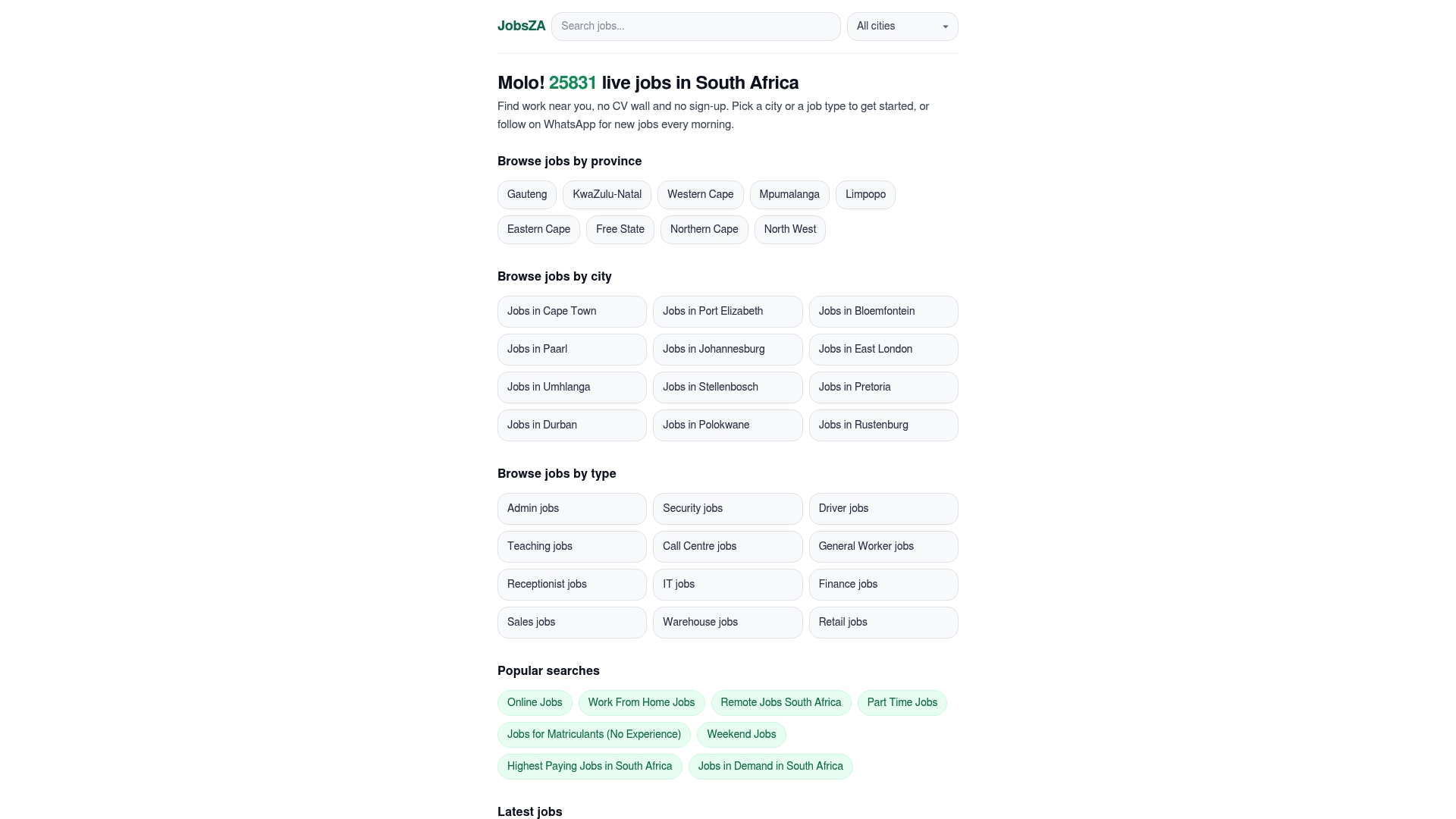
New listings across retail, admin, sales, and beyond get sent daily via WhatsApp opt-in, so you see roles the same morning they’re posted rather than days later when the shortlist is already full. Browse current Cape Town vacancies now, or if you’re just finishing school, check entry-level roles for matriculants with no experience required. Sign up for WhatsApp alerts and let the next opening find you instead of the other way around.
Sources
- How to apply for our jobs
- WCED Online Vacancy application guide
- Public Service Vacancy Circular (PSVC) and Z83 guidance
- Cape Town has biggest metro jobs gain amid employment boom
FAQ
Is it easy to find a job in Cape Town?
Cape Town has the lowest unemployment rate among South Africa’s major metros, under 20% in late 2025, and recently added 113,000 jobs year-on-year, so opportunities are genuinely more available than in most other cities. That said, popular entry-level roles still draw high applicant volumes, so speed and preparation matter.
What is the easiest job to get in Cape Town?
Entry-level roles in retail, call centres, and hospitality tend to have the highest volume of openings and the fastest hiring turnaround, particularly during seasonal peaks. These roles typically require less formal qualification than admin, finance, or tech positions.
What is the minimum salary in Cape Town?
Entry-level pay follows South Africa’s national minimum wage guidelines, with specific sectors like retail and hospitality sometimes governed by additional sectoral determinations. Government and structured private-sector roles generally pay above minimum wage based on post grade and qualifications.
Which jobs are in demand in Cape Town?
Tourism, logistics, tech, finance, and administrative roles show the strongest current demand, driven by the city’s broader employment growth. Retail and sales roles also see consistent high-volume hiring, and platforms like Findjobsza’s Cape Town listings reflect thousands of live vacancies across these sectors at any given time.
Recommended
Start with your city.
24 497 live jobs, filtered by city and suburb. No sign-up wall, no CV upload just to look.