Hire in Days: SA Local Recruitment Ads With WhatsApp & Fair Pay
4 September 202611 min read

Contents13 sections
- 1Table of Contents
- 2What is local recruitment advertising?
- 3Five quick wins to improve your local job ads today
- 4Where to advertise: free vs paid channels in South Africa
- 5How to write a job ad that actually converts
- 6Legal must-haves: Employment Equity Act, Fair Pay Bill, POPIA
- 7Targeting local candidates and measuring what works
- 8A one-week playbook to launch a local job ad
- 9Author perspective: practical lessons from South African hiring
- 10FindJobsZA: a South Africa-focused channel for local hiring
- 11Sources
- 12FAQ
- 13Recommended
Hire in Days: SA Local Recruitment Ads With WhatsApp & Fair Pay
For local recruitment advertising in South Africa, run a targeted multi-channel campaign that leads with a clear job title, an honest salary range, and a mobile-friendly apply route. Post it on a South Africa-specific board, enable a WhatsApp or direct-apply link, and you may see qualified applications within days rather than weeks.
TL;DR:
- Using a clear, searchable job title and disclosing a salary range significantly increases the chances of attracting qualified applicants effectively.
- Posting on one paid portal and one social channel simultaneously, with a mobile-friendly apply link, can deliver noticeable results within days for local hires.
- Channels such as WhatsApp alerts and SMS notifications are highly effective for mobile-first candidates in townships and commuter towns, especially for entry-level roles.
- Focusing on responsive, fast, and honest advertising combined with a week-long test and A/B titling can optimize application quality and reduce time-to-hire.
- Legal compliance requires avoiding discriminatory language, disclosing salary, and ensuring applicant data consent, with regular checks to adhere to South African employment laws.
Table of Contents
- What is local recruitment advertising?
- Five quick wins to improve your local job ads today
- Where to advertise: free vs paid channels in South Africa
- How to write a job ad that actually converts
- Legal must-haves: Employment Equity Act, Fair Pay Bill, POPIA
- Targeting local candidates and measuring what works
- A one-week playbook to launch a local job ad
- Author perspective: practical lessons from South African hiring
- FindJobsZA: a South Africa-focused channel for local hiring
- Sources
- FAQ
What is local recruitment advertising?
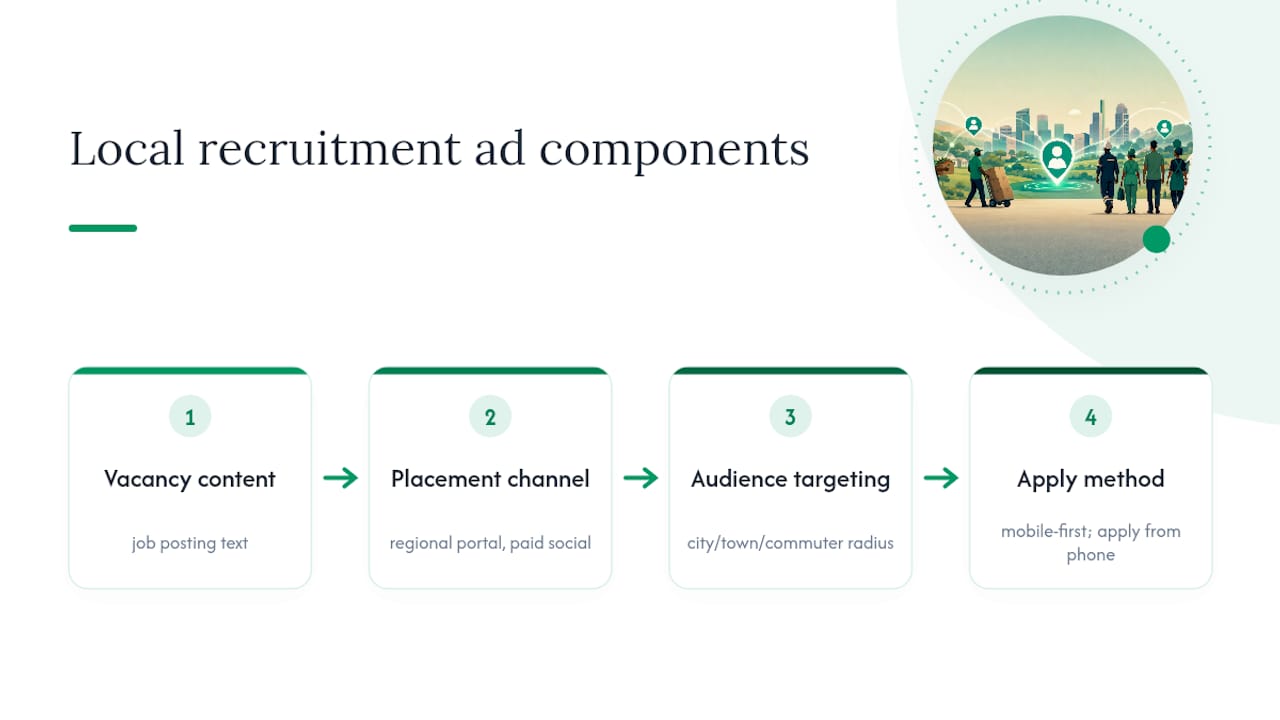
Local recruitment advertising means promoting a specific vacancy to candidates within a defined city, township, or commuter radius, rather than running a generic national campaign. It combines the job posting itself, the channel you place it on, and the targeting settings that decide who actually sees it. For South African employers, that usually means picking a mix of a regional job portal, one paid social channel, and a mobile-first apply method, because most job seekers here search and apply from a phone, not a desktop.
Five quick wins to improve your local job ads today
Small fixes move the needle faster than a full campaign rebuild. Start with these before you touch your budget.
- Use an industry-standard job title with a short, searchable summary line underneath it. Skip internal jargon like “Growth Ninja” and lead with what candidates actually type into search.
- Disclose a salary range and basic benefits. Mention a transport allowance or 13th cheque where relevant. Disclosing salary ranges helps focus on candidates more likely to accept the offer.
- Post on one paid portal and one social channel simultaneously, and enable a WhatsApp or direct-apply link so mobile users don’t have to build a login just to apply.
- Format for scanning. Use bullet points for duties and requirements, and add a one-line company blurb, including your B-BBEE level if it’s relevant to the role or sector.
- Run a 7-day test comparing two versions of your title and salary disclosure, then keep whichever pulls more qualified applications.
Pro Tip: If you only have time for one change this week, add the salary range. Ads with a disclosed range consistently pull higher-quality applicants who are already comfortable with the offer, which cuts your interview-to-hire time.
Where to advertise: free vs paid channels in South Africa
Channel choice depends on the role, the urgency, and how much budget you have. No single channel does everything well, so match the channel to the hiring problem.
- Free channels work for high-volume, entry-level, or awareness-driven roles: community Facebook groups, sector association job boards, and select free posting sites. They’re slow to convert but cost nothing, so they’re worth running alongside a paid channel rather than instead of one.
- Paid channels earn their keep for roles where speed or quality matters: local job portals, LinkedIn and Facebook Ads, and Google Ads for jobs. A multi-channel approach combining portals, social media, and specialist agencies is what actually moves hiring outcomes in the South African market, rather than betting everything on one platform.
- Mobile-first channels convert disproportionately well for local hiring. WhatsApp alerts and SMS notifications reach candidates the moment a role goes live, and for entry-level roles, mobile-first apply flows tend to outperform long-form application portals in many South African localities, simply because fewer steps means fewer drop-offs.
- Niche placements suit specialised or student hires: campus notice boards, industry association listings, and trade publications reach candidates a general portal will miss entirely.
If you’re hiring for volume at the entry level, free channels plus WhatsApp will usually get you there. If you’re filling a technical or senior role, paid social and a specialist portal earn the spend. For a fuller rundown of no-cost options, our guide to free job posting sites in South Africa breaks down the pros and cons of each.
How to write a job ad that actually converts
An effective ad needs eleven fields, and skipping any of them costs you applicants: job title, a short summary, key responsibilities, must-have skills, desirable skills, salary range, benefits, location, working hours, how to apply, and a closing date. Employer guidance is consistent on this point: essential job-ad elements plus non-discriminatory language are what separate ads that attract strong candidates from ads that get ignored.
Local copy details matter more than most employers assume. Use standard, searchable job titles rather than internal branding. Mention transformation credentials or B-BBEE level where it’s relevant to the client or sector. Note transport or shift allowances explicitly, since they often decide whether a candidate applies at all. One underused trick: try a dual-title format, listing the standard title first with a creative internal title in parentheses, like “Marketing Manager (Digital Experience Champion)”. It helps searchability without losing personality.
Ads that mention training, mentorship, or a clear path to promotion see stronger conversion among mid-to-senior applicants, since South African job seekers consistently prioritize development opportunities when comparing offers.
Entry-level template: Title + one-line summary → 3-4 bullet duties → must-have skills → salary range → “Apply via WhatsApp: [number]” → closing date.
Mid-senior template: Title + summary → responsibilities → required and desirable skills → salary range and benefits → “Apply via our careers page: [link]” → closing date.
Keep paragraphs short and duties in bullets. Most applicants read your ad on a phone screen, so long unbroken paragraphs cost you readers before they even reach the salary line. For more worked examples, see our job advert examples for South African roles.
Legal must-haves: Employment Equity Act, Fair Pay Bill, POPIA
Every job ad you publish in South Africa sits inside three legal frameworks, and getting them wrong is expensive to fix after the fact.
The Employment Equity Act requires you to avoid discriminatory language and list only essential requirements for the role. If a physical or certification requirement excludes candidates, it needs to be objectively justified by the job itself, not just convenient. Legal guidance is blunt on this: ageist or exclusionary phrasing needs a genuine operational reason behind it or it shouldn’t appear at all.
The proposed Fair Pay Bill pushes further: it calls for salary range disclosure in job ads and restricts asking candidates for their salary history. POPIA adds a data layer: get consent before collecting or publishing personal information, and tell applicants clearly how their application data will be used and stored.
Before you publish, run this six-point check:
- Job title and duties contain no gendered or exclusionary language
- Salary range is disclosed or a clear reason exists for withholding it
- Only essential, role-justified requirements are listed
- No salary history question anywhere in the application flow
- Applicant consent for data use is stated or linked
- Closing date and how-to-apply instructions are unambiguous
Targeting local candidates and measuring what works
Good targeting starts with segmentation, not just geography. Split your audience by city or radius, experience level, and sector before you touch ad spend.
- Metro hiring can run a tight 15 to 25km radius around the workplace, since candidates expect a manageable commute.
- Township or commuter-catchment hiring often needs a wider radius plus transport-route targeting, because candidates travel further using fixed public transport corridors.
- Sector-specific roles (technical, healthcare, finance) benefit from LinkedIn or niche portal targeting over broad social reach, since combining employer branding with paid digital targeting pulls in candidates already qualified for the role.
Track five KPIs from day one: applications received, cost-per-applicant, interview rate, time-to-hire, and a diversity indicator against your Employment Equity targets.
A one-week playbook to launch a local job ad
Treat the first week as a build-test-adjust cycle, not a single launch-and-wait event.
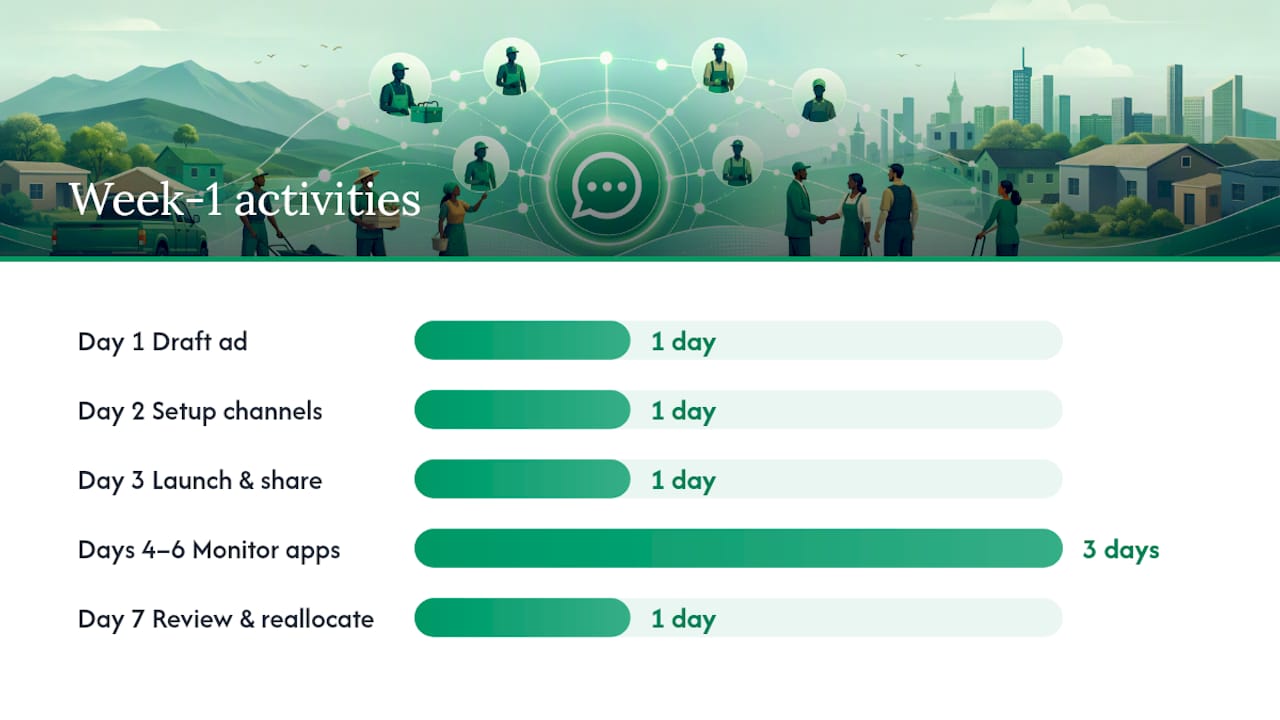
- Day 1: Draft the ad using the essential-fields checklist, confirm the salary range, and run the six-point legal check.
- Day 2: Set up your channels: one paid portal, one social platform, and a WhatsApp or direct-apply link.
- Day 3: Launch the ad and share it in relevant community or association groups for free reach.
- Days 4 to 6: Monitor early applications daily. If click-through is high but applications are low, the apply flow is the problem, not the ad copy.
- Day 7: Review cost-per-applicant and interview rate. Pause any placement that’s producing clicks with no conversions, and shift that budget to the channel performing best.
Run your title and salary A/B test across days 3 to 7, then lock in the winner for week two. If applications are strong but interview no-show rates are high, that’s a sign to add interview-prep resources like Muqabala’s practice tools to your candidate communication before the interview stage.
Pro Tip: Escalate to an agency or paid boost only after your first A/B cycle. Boosting an untested ad just amplifies whatever is already broken about it.
Author perspective: practical lessons from South African hiring
What consistently works in South African hiring isn’t clever copywriting. It’s speed, honesty about pay, and a mobile apply flow that doesn’t ask candidates to jump through hoops. I’ve watched employers lose strong applicants simply because the application form required a desktop browser or a CV upload that failed on a low-end phone.
Certain platforms reflect that reality directly by offering no CV uploads, no sign-ups, and daily WhatsApp alerts that put new listings in front of job seekers the moment they’re posted. That matters more in townships and commuter towns than any agency pitch deck will tell you, because that’s where mobile-first really is the only channel that reaches people reliably.
— Nkosi
FindJobsZA: a South Africa-focused channel for local hiring
Some platforms are built specifically around the local hiring problem this guide covers: candidates who search by city, expect a fast apply flow, and check WhatsApp before they check email. Filtering by city or province means ads can reach people in the exact catchment targeted, without paying for national reach that may not be needed. Daily WhatsApp alerts can put vacancies in front of job seekers the morning they go live, and without CV upload or registration barriers, entry-level and mobile-first candidates are more likely to complete the application process.
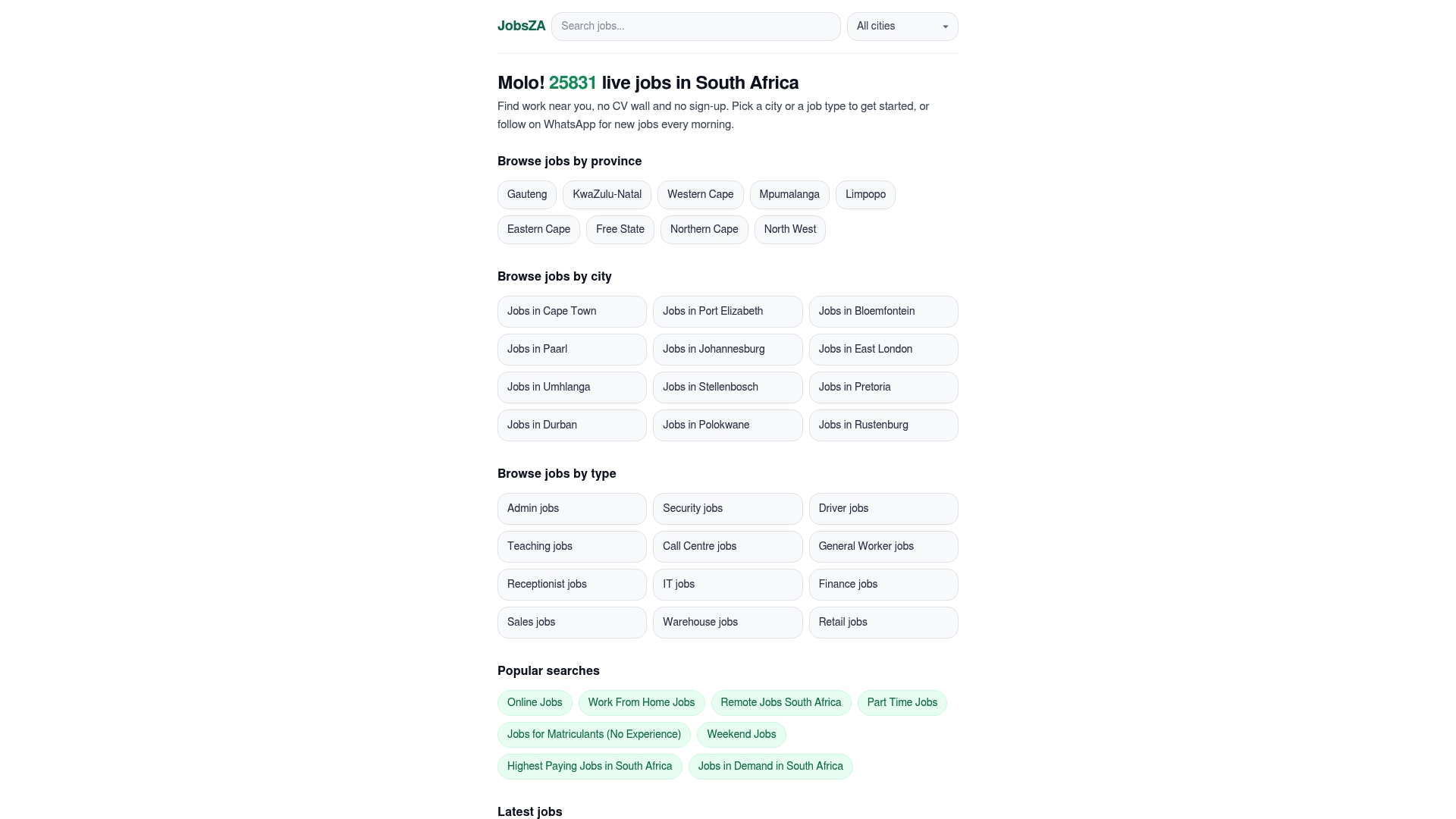
Use a platform listing like this for roles where speed and local volume matter most: retail, hospitality, logistics, entry-level administrative work. Reach for paid social or agency support when you’re filling a specialised or senior role that needs a narrower, more targeted search. If you’re posting a part-time or weekend vacancy, check out our part-time jobs category or browse online job listings to see how a live ad reads before you publish your own.
Sources
For legal detail, read the Employment Equity Act directly. For ad-writing and Fair Pay Bill context, see the employer’s recruitment guide.
FAQ
Where can I advertise jobs for free in South Africa?
Community Facebook groups, sector association boards, and select free job posting sites all work for volume or awareness-driven roles. Our guide to free job posting sites in South Africa covers the full list with trade-offs for each.
How do I send my CV to recruitment agencies?
Most agencies accept CVs through their own online forms or email, but if you’d rather skip CV uploads entirely, platforms like FindJobsZA let candidates browse and apply directly without one.
Who are the biggest advertisers of local jobs in South Africa?
Retail, hospitality, logistics, and healthcare sectors post the highest volume of local vacancies, since these roles depend on fast, location-specific hiring rather than national campaigns.
What are some good recruitment websites in South Africa?
Strong options combine a South Africa-specific portal with paid social reach. FindJobsZA focuses specifically on local, mobile-first hiring with WhatsApp alerts and no CV barrier, which suits entry-level and high-volume roles particularly well.
Recommended
Start with your city.
24 231 live jobs, filtered by city and suburb. No sign-up wall, no CV upload just to look.