AI Plus Human Review: Multilingual Job Ads for SA Recruiters
6 September 202618 min read

Contents18 sections
- 1Table of Contents
- 2What are multilingual job ads and when do they help?
- 3How should you prioritize which jobs to translate first?
- 4A step-by-step workflow for creating, reviewing, and publishing translated ads
- 5Which ATS and careers-site features actually matter?
- 6Getting titles, requirements, and inclusive language right
- 7How do you measure whether the translation is working?
- 8How Findjobsza reduces friction for multilingual reach
- 9Choosing the right languages to target
- 10Cultural localization goes beyond the words on the page
- 11Managing updates and version control across languages
- 12Building a translation memory and glossary that actually gets used
- 13Getting recruiters and hiring managers aligned on the process
- 14Why the “just use AI” shortcut keeps failing recruiters
- 15Reach multilingual candidates without building a translation team
- 16Sources
- 17FAQ
- 18Recommended
AI Plus Human Review: Multilingual Job Ads for SA Recruiters
Yes, publish multilingual job ads when you’re recruiting across language groups, and start today by picking one primary language, translating the job title and the top three requirements, then running an AI draft through a human reviewer before it goes live. The rest is workflow, not guesswork.
TL;DR:
- Prioritize translating high-volume, scarce-skill, or compliance-critical roles, focusing on the job title, responsibilities, application instructions, and salary first.
- Use a source-first, centralized editing process with human review of AI-translated ads to prevent inconsistencies and ensure local compliance and tone.
- Track performance metrics separately for each language to identify which translations drive higher applications and optimize accordingly.
- Build and maintain a glossary and translation memory for consistency and efficiency across multiple postings and languages.
- Focus on quality over quantity by limiting translation efforts to 2–3 languages with dedicated native reviewers, rather than spreading resources thinly across many languages.
Table of Contents
- What are multilingual job ads and when do they help?
- How should you prioritize which jobs to translate first?
- A step-by-step workflow for creating, reviewing, and publishing translated ads
- Which ATS and careers-site features actually matter?
- Getting titles, requirements, and inclusive language right
- How do you measure whether the translation is working?
- How Findjobsza reduces friction for multilingual reach
- Choosing the right languages to target
- Cultural localization goes beyond the words on the page
- Managing updates and version control across languages
- Building a translation memory and glossary that actually gets used
- Getting recruiters and hiring managers aligned on the process
- Why the “just use AI” shortcut keeps failing recruiters
- Reach multilingual candidates without building a translation team
- Sources
- FAQ
What are multilingual job ads and when do they help?
Multilingual job ads are vacancy postings published in two or more languages, either as parallel listings or a single bilingual ad, aimed at reaching candidates who search, read, and apply in their own language. The candidate-experience payoff is real: people apply faster and more confidently to a role they fully understand, and localized titles and benefits have been shown to double application rates in some documented cases.
They earn their cost in a few clear situations:
- High-volume roles where you’re competing for the same limited pool of bilingual or non-English-speaking talent
- Regions or sectors with a known concentration of a specific language group (hospitality, logistics, care work, manufacturing)
- Compliance-sensitive roles where local law requires job information in the local language
The risk sits in literal, word-for-word translation. A machine-translated title that doesn’t match local market conventions, or benefits phrasing that means something different in another language, can quietly kill trust before a candidate reads past line two.
How should you prioritize which jobs to translate first?
Not every requisition deserves a translation budget. Prioritize based on three factors, in this order:
- Volume and urgency. Roles you’re filling repeatedly or under time pressure justify the translation cost fastest.
- Candidate scarcity. If the skill is rare and the local language pool is your only realistic source, translate the whole ad, not just the headline.
- Compliance exposure. Roles where local regulation requires local-language postings move to the front of the queue regardless of volume.
When budget or time is tight, translate four fields first: the job title, the core responsibilities, the application instructions, and salary or pay range where disclosure is expected. Everything else can wait for a second pass.
Bilingual posts, where both languages sit in one listing, work well for smaller markets or when you want one URL to rank for both language searches. Separate language posts work better at scale, since they let you tag, filter, and measure each language independently in your ATS.
A step-by-step workflow for creating, reviewing, and publishing translated ads
Start with intake, not translation. Capture three things before anyone opens a translation tool: which languages the role needs, any legal text that must appear (equal opportunity language, local labor code references), and who owns final sign-off.
From there, follow a draft-clean-edit sequence. Write and bias-check a single source version, usually in English, before translating anything. Recruiting Headlines recommends this centralize-then-translate approach specifically because editing after translation multiplies your version-control headaches across every language you support.
For the translation step itself, the hybrid model wins over either extreme. Fully manual translation is slow and expensive at scale; fully automated machine translation misses compliance nuance and brand voice. Run the source text through AI translation, then route it to a human post-editor who knows the target market.
Before publishing, run through this checklist:
- Native reviewer has read the ad for tone, not just grammar
- Legal fields (benefits, equal opportunity statements, salary disclosure) match local requirements
- Job title maps to how candidates in that market actually search, not a literal translation
- Application instructions work with local phone formats, ID requirements, and document norms
Pro Tip: Keep a simple edit history for each language version. When you update the English source, you need to know instantly which translated versions are now stale.
Tag each posting with its primary language and set a fallback language for candidates who land on the wrong version. That one setting prevents more lost applicants than any copy tweak.
Which ATS and careers-site features actually matter?
Not every applicant tracking system handles multiple languages well, and the gap shows up fast once you’re running more than two language versions of the same role. Look for these features before you commit to a platform:
- Language tags on each posting, so you can filter, report, and A/B test by language instead of guessing
- Editable machine translation, meaning the system generates a draft but lets a human edit it in place, rather than locking you into raw MT output
- Primary and fallback language settings, so a candidate who lands on the wrong URL still sees something readable instead of a 404 or blank page
- Language-aware metadata, so job boards and search engines index each version correctly instead of flagging duplicate content
The common failure point is fields tied to the primary language by default: salary formatting, location strings, and application-button text often silently revert to English even when the job description itself is translated. Some platforms also default new postings to a single “promoted” language, quietly demoting your other versions in search results. Ask a vendor directly how translations are hosted, whether as separate URLs, language parameters, or a single multilingual record, since that decision affects how job boards and aggregators consume the language field later.
Getting titles, requirements, and inclusive language right
Job titles rarely translate word for word into something a candidate would actually search for. “Store Associate” might localize to a completely different conventional title in another market, and if you translate literally instead of mapping to local convention, you lose search visibility and candidate trust in the same move, an effect documented in localization case studies.
A few copy rules pay off across every language version:
- Replace “native speaker” with a specific proficiency descriptor (Pro Tip: “C1-level written and spoken fluency” tells a candidate exactly what to expect from an assessment, while “native speaker” can be both vague and legally risky in several jurisdictions), a fix directly recommended by Translated’s guidance on job description translation.
- Localize benefits phrasing rather than translating it literally. “Health insurance” means something different depending on the market’s baseline coverage, so spell out what’s actually included.
- Watch gendered languages carefully. Spanish, French, and German job titles default to masculine forms unless you use inclusive alternatives or gender-neutral phrasing, which can quietly narrow your applicant pool.
- Keep a running glossary of approved terms, job title mappings, and benefit descriptions so every translator and reviewer pulls from the same source instead of reinventing phrasing each time.
How do you measure whether the translation is working?
Track four metrics by language, not just in aggregate: applications per view, application-to-interview conversion, time-to-fill, and offer-accept rate. Localization has a measurable effect on hiring outcomes, and pilot testing language-specific KPIs before scaling a translation program to every role is the difference between guessing and knowing.
Tag every posting in your ATS with its language at creation, not after the fact, so filtering and reporting don’t require manual cleanup later. Then run small tests instead of assuming:
- Compare a literal-title version against a locally mapped title, same role, same market
- Run a bilingual single-post version against two separate single-language posts
- Test raw machine translation against the same ad after human post-edit
One consistent signal across localization case studies: ads with mapped titles and localized benefits phrasing consistently outperform literal translations on application volume. Measure by language before you decide where to expand.
How Findjobsza reduces friction for multilingual reach
The model of some job platforms removes two of the biggest drop-off points in any job search, in any language: no CV upload and no account sign-up required to browse or apply. That matters even more for candidates reading a translated ad, since every extra form field is another place a translation gap can confuse someone.
Pair that low-friction structure with real-time WhatsApp alerts some platforms send every morning, and a localized posting can reach candidates the same day it goes live, not after they happen to revisit a careers page. If you’re testing which languages actually convert, our teaching jobs category and our job advert examples guide both show the kind of concise, locally phrased posting structure that survives translation without losing clarity.
Choosing the right languages to target
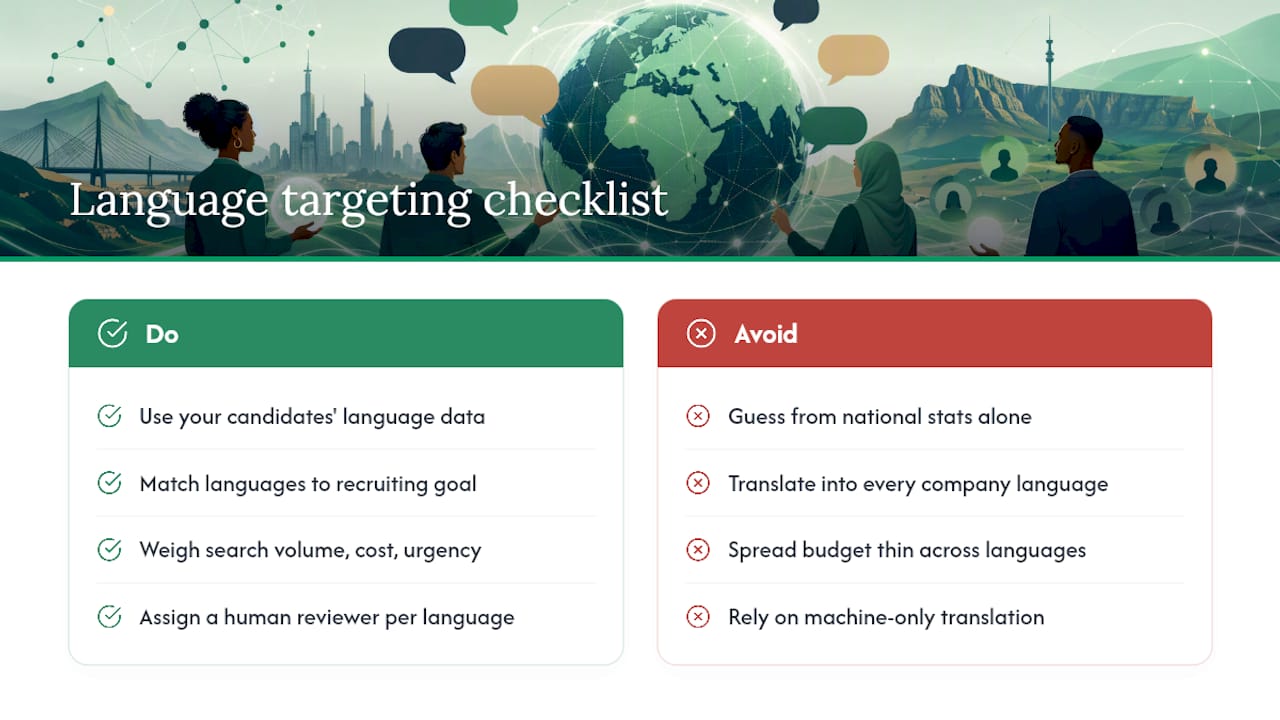
Start with candidate demographics, not assumptions. Pull the language data you already have: applicant self-reported language preferences, geographic clusters in your candidate database, and which language versions of past postings actually converted. Guessing at languages based on national statistics alone often misses the specific labor pool available for a given role.
Match language choice to the recruiting goal, not just the region. A role targeting recent graduates in a bilingual university system needs different language coverage than a manufacturing role drawing from a specific migrant labor community. If you’re filling entry-level or high-turnover roles, the language decision often follows the workforce that already fills similar roles nearby, which your own hiring data will show faster than any general market report.
Weigh three factors together before locking in a language list: how many qualified candidates actually search in that language, how much the translation and review cost per posting, and how urgently the role needs to fill. A rare-skill role with a small but concentrated language-specific candidate pool justifies full translation even at low volume. A high-volume, low-skill role might justify translation only if the local labor market is genuinely multilingual, not because it looks good on paper.
Resist the instinct to translate into every language your company operates in “just in case.” Spreading a fixed translation and review budget across six languages usually produces worse quality in all six than doing three properly. Pick languages where you can commit to a human reviewer for each one, not just a machine translation pass, since that reviewer step is what actually protects your response rate.
Cultural localization goes beyond the words on the page
Translation gets the language right; cultural localization gets the expectations right, and the two aren’t the same job. A perfectly translated job ad can still feel foreign to a candidate if the structure, tone, or expected information doesn’t match what job seekers in that market are used to seeing.
Some markets expect a formal, credential-heavy tone in job postings, with degree requirements and years of experience stated explicitly up front. Others respond better to a conversational tone that leads with company culture before listing requirements. Get the register wrong and even a grammatically flawless translation can read as either stiff or unprofessional to a local candidate.
Application expectations shift by market too. Some candidate pools expect to see a salary range as standard practice; others rarely see one and won’t be put off by its absence. Some markets expect a phone number for informal follow-up; others expect everything routed through a formal online application with no informal contact at all. Copying your English-market application flow into a translated ad without checking these norms creates friction you won’t see until conversion rates already show it.
Even benefit framing carries cultural weight. A benefit that reads as generous in one market, like flexible remote work, can read as a red flag in another market where in-person presence signals stability and commitment. The fix isn’t more translation vocabulary. It’s a native reviewer with actual recruiting experience in that market, someone who can flag “this is technically correct but nobody would phrase it this way” before the ad goes live, not after applications stall.
Managing updates and version control across languages
Every translated job ad creates a dependency: when the English source changes, every other language version becomes stale the moment you save the edit. Without a system to track that, you end up with candidates applying to outdated salary figures or requirements in one language while the corrected version sits live in another.
The fix starts with a single rule: edit the source language first, always, and treat every translated version as downstream of that source. Recruiting Headlines’ guidance on centralizing edits before translation exists precisely to prevent the alternative, where five language versions of the same role drift into five slightly different job ads over a few weeks of small edits.
Practically, that means logging a short edit history against each posting: what changed in the source, when, and which translated versions still need updating. A spreadsheet works for a handful of roles; an ATS with language tagging handles it automatically once you’re running a real multilingual program across dozens of open requisitions.
Assign clear ownership too. Someone needs to be responsible for noticing when a source ad changes and triggering the retranslation, rather than relying on translators to check back periodically. A simple ownership matrix, mapping who edits the source, who translates, who reviews, and who publishes, removes the ambiguity that causes stale versions to sit live for weeks.
Set a review cadence independent of edits as well. Salary bands shift, legal requirements change, and a translated ad that was accurate six months ago may now be quietly non-compliant in a market where labor law moved and nobody updated the local-language version to match.
Building a translation memory and glossary that actually gets used
A glossary sounds like overhead until the second time two translators render the same job title two different ways in the same market. Translation memory tools store previously translated segments so identical or near-identical phrases get consistent renderings automatically, rather than reinvented ad hoc by whoever happens to be translating that week.
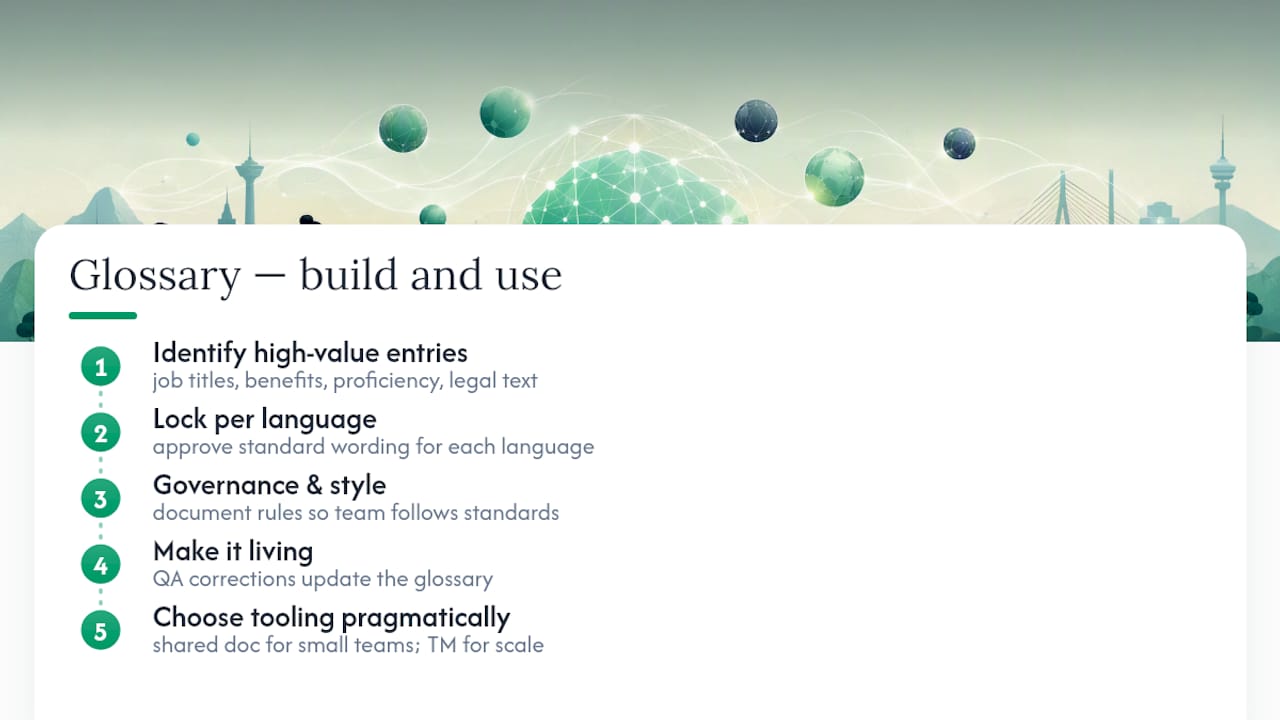
For job ads specifically, the highest-value entries in a glossary aren’t full sentences. They’re the recurring building blocks: job title mappings, standard benefit descriptions, proficiency-level phrasing, and legally required statements. Lock those down once, per language, and every future posting in that language pulls from the same approved wording instead of starting from a blank page.
The governance layer matters as much as the tool. iSmartRecruit’s guidance on multilingual recruitment points to glossaries and style guides as core trust signals precisely because they turn subjective wording choices into a documented standard anyone on the team can follow, including a new hire who’s never translated a job ad before.
Keep the glossary living, not static. Every time a native reviewer corrects a phrase during QA, that correction should update the glossary, not just the one ad it appeared in. Otherwise you’re paying the same correction cost every single time that phrase comes up again in a future posting.
Practically, this doesn’t require expensive software to start. A shared document with approved job titles, benefit phrasing, and legal statements per language covers most small teams’ needs. Larger recruiting operations running dozens of roles across multiple languages benefit from dedicated translation memory tools that flag inconsistencies automatically, but the discipline behind the glossary matters more than the tool that stores it.
Getting recruiters and hiring managers aligned on the process
The workflow only holds up if everyone touching a job ad understands their role in it, and that includes hiring managers who often edit postings after the fact without realizing a translated version exists downstream. A hiring manager who tweaks a salary figure directly in the ATS, unaware that three translated versions now need updating too, breaks the whole system in one click.
Start training with the ownership model itself: who edits the source, who translates, who reviews, and who has final publish authority. Written down as a simple RACI, this removes the ambiguity that causes most multilingual programs to quietly decay after the first few months, once the initial enthusiasm for “doing this properly” fades and people revert to old habits.
Recruiters need specific guidance on what NOT to do: never edit a translated version directly without routing the change back through the source language first, and never approve a machine-translated ad without a human reviewer’s sign-off, regardless of how fluent the recruiter personally feels in that language. Fluency isn’t the same as knowing local recruiting conventions.
Hiring managers need a shorter, simpler briefing: flag any changes to the source ad immediately, and understand that a “quick edit” to one language version, done outside the process, creates inconsistency across every other version of that same role.
Run this training as a short, recurring session rather than a one-time onboarding item, since the team publishing job ads changes over time and the glossary and process both evolve. A quarterly refresh, tied to whatever the glossary or style guide has added since the last session, keeps the whole team working from the same standard instead of drifting back toward individual habits.
Why the “just use AI” shortcut keeps failing recruiters
The biggest misconception in multilingual recruiting right now is that AI translation alone solves the problem. It doesn’t, and the failure mode is consistent: teams get fast, cheap translations that read fine on the surface but miss the local hiring convention, the legal nuance, or the tonal register that actually drives applications. Speed without a human reviewer just moves the risk downstream to the candidate experience.
The conventional advice, “translate everything, publish everywhere,” also falls short. Spreading a fixed budget across too many languages produces mediocre quality everywhere instead of strong quality where it counts. I’d rather see a recruiting team commit to two languages done properly, with a real native reviewer and a maintained glossary, than five languages running on raw machine output with nobody checking the result.
What should come first, before any tooling decision, is the source document itself. A biased, unclear, or poorly structured English job ad translates into five biased, unclear ads instead of one. Fix the source, build the glossary, then scale the languages. That order matters more than which translation tool you pick.
— Nkosi
Reach multilingual candidates without building a translation team
Some job platforms give a direct route to candidates without the overhead of building out a full localization pipeline yourself. Employers posting on these platforms reach job seekers browsing by city, province, and job type, with no CV upload or account sign-up required on the candidate side, which can help a well-localized ad convert faster because nothing else stands between the reading and the applying.
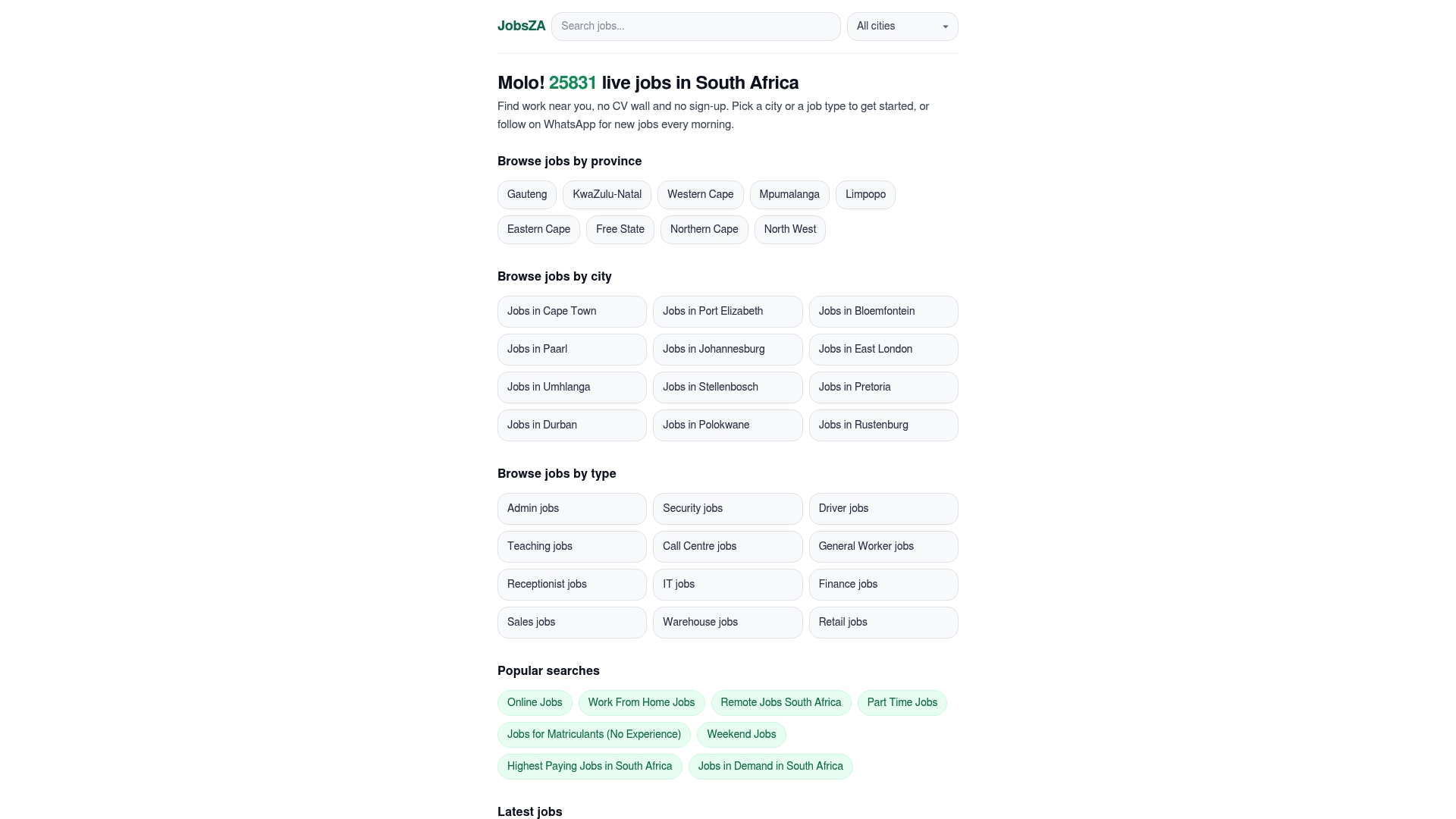
If you’re recruiting for digital or remote-friendly roles where language targeting matters most, our online jobs category is a practical place to publish a localized posting and see how it performs against your existing English-only listings. Pair that listing with daily WhatsApp alerts some platforms offer, and candidates may see your translated opening the same morning it goes live, not days later after a stale search. Post your next multilingual vacancy through a job platform offering such services and compare the response against your usual channel before committing further translation budget.
Sources
- Multilanguage job ads and localization that works - WinTech Learning Hub
- 5 reasons generic AI tools can’t create great job ads
- Recruitment agency translation: job descriptions that attract the right candidates - Translated
FAQ
Should every job ad be translated into multiple languages?
No. Prioritize roles with high volume, scarce candidate pools, or legal requirements for local-language postings, and translate the title, responsibilities, and application instructions first.
What’s the difference between machine translation and human review for job ads?
Machine translation moves fast and handles volume, but it misses local compliance language and brand tone, so pairing it with a human post-editor catches errors that automated tools consistently miss.
How do I know if my multilingual job ads are working?
Track applications per view, conversion rate, and time-to-fill by language in your ATS, and compare literal translations against locally mapped titles to see which performs better.
Should I replace “native speaker” in job postings?
Yes. Use a specific proficiency descriptor like “C1-level fluency” instead, since it’s both clearer for candidates and safer under most local employment law.
Can I post multilingual job ads on Findjobsza?
Yes. Findjobsza’s category pages, including online jobs, support localized postings, and the platform’s WhatsApp alerts help translated ads reach candidates the same day they’re published.
Is a bilingual single post better than two separate language posts?
Bilingual posts work well for smaller markets and shared URLs, while separate posts scale better because they let you tag and measure each language independently.
Recommended
Start with your city.
24 231 live jobs, filtered by city and suburb. No sign-up wall, no CV upload just to look.