Programmatic job advertising: the 2026 South Africa guide
13 August 202627 min read

Contents20 sections
- 1Key takeaways
- 2Table of Contents
- 3What does programmatic job advertising actually mean?
- 4How does programmatic job advertising work end to end?
- 5Why programmatic job advertising outperforms manual posting
- 6Where do programmatic job ads appear, and which South African publishers matter?
- 7How to choose a programmatic job advertising platform
- 8Programmatic job advertising platforms: South Africa shortlist
- 9Pricing models and campaign timelines for South African recruiters
- 10Campaign setup and optimisation best practices
- 11Why a blended programmatic and local-board strategy works best in South Africa
- 12How the featured platforms were evaluated
- 13Legal and compliance checklist for South African job advertising
- 14Programmatic job advertising in practice: South African campaign examples
- 15Common challenges in programmatic job advertising and how to fix them
- 16Programmatic job advertising trends and the South Africa outlook for 2026
- 17Findjobsza gives your programmatic campaigns a direct local inventory layer
- 18Sources
- 19FAQ
- 20Recommended
Programmatic job advertising: the 2026 South Africa guide
Programmatic job advertising automatically distributes and optimises your job ads so your budget follows applicants, not placements. For South African recruiters, that translates to three immediate gains: lower cost-per-apply, faster coverage for hard-to-fill roles, and measurable ROI tied directly to your ATS data. According to DirectEmployers Association, meaningful cost-per-apply improvements typically appear within a few weeks to two months once ATS integration is in place.
Before you brief a vendor, check these three things first:
- ATS integration: confirm the platform can ingest your ATS feed via XML or API and map apply events back to hires.
- Target CPA: set a cost-per-apply ceiling before launch so the algorithm has a performance signal to optimise toward.
- Campaign pacing rules: agree on daily spend caps and a minimum learning window so the platform has enough data to bid intelligently.
Key takeaways
Programmatic job advertising delivers measurable cost-per-apply improvements within 30–60 days when ATS integration is in place and conversion tracking is correctly configured.
| Point | Details |
|---|---|
| Integrate your ATS first | Feed quality and apply-event tracking are the foundation; without them, the algorithm cannot optimise toward hires. |
| Set a target CPA before launch | Give the algorithm a performance signal to work toward; adjust after the first 14 days based on real data. |
| Run a blended channel strategy | Combine programmatic distribution with direct listings on South African boards for both volume and local depth. |
| Insist on source-of-hire reporting | Cost-per-apply by publisher is the metric that tells you where to scale and where to cut. |
| Findjobsza complements programmatic reach | City-level listings and daily WhatsApp alerts give South African employers direct local candidate access alongside global distribution. |
Table of Contents
- What does programmatic job advertising actually mean?
- How does programmatic job advertising work end to end?
- Why programmatic job advertising outperforms manual posting
- Where do programmatic job ads appear, and which South African publishers matter?
- How to choose a programmatic job advertising platform
- Programmatic job advertising platforms: South Africa shortlist
- Pricing models and campaign timelines for South African recruiters
- Campaign setup and optimisation best practices
- Why a blended programmatic and local-board strategy works best in South Africa
- How the featured platforms were evaluated
- Legal and compliance checklist for South African job advertising
- Programmatic job advertising in practice: South African campaign examples
- Common challenges in programmatic job advertising and how to fix them
- Programmatic job advertising trends and the South Africa outlook for 2026
- Findjobsza gives your programmatic campaigns a direct local inventory layer
- Sources
- FAQ
What does programmatic job advertising actually mean?
Programmatic job advertising is the automated buying, placement, and optimisation of job ads across multiple channels simultaneously. Instead of manually posting to individual boards and paying a flat fee regardless of results, you connect your jobs feed to a platform that bids for placements in real time and shifts budget toward the channels producing qualified applicants.
It is not a job board. It is an optimisation layer that sits above job boards and publisher networks. As Joveo explains, the platform connects your ATS feed to a publisher network, uses real-time bidding to place ads, and reallocates budget dynamically based on performance signals.
Key terms you will see on every vendor page:
- DSP (Demand-Side Platform): the software layer that places bids on ad inventory across publishers on your behalf.
- RTB (Real-Time Bidding): the auction mechanism where bids are placed in milliseconds each time a candidate loads a page. Wikipedia’s DSP entry covers the underlying ad-tech mechanics in detail.
- Feed: the XML or API export from your ATS that tells the platform what jobs to advertise, including title, location, and description.
- CPA (Cost-Per-Apply): what you pay each time a candidate submits an application. The metric that matters most.
- CPH (Cost-Per-Hire): the downstream metric that closes the loop between advertising spend and actual hiring outcomes.
- CPC (Cost-Per-Click): a common pricing unit, but optimising for clicks alone produces low-quality traffic.
- Managed service: a vendor model where a campaign team runs optimisation on your behalf.
- Self-serve DSP: a platform where your team controls bidding, budgets, and targeting directly.
The critical distinction from flat-fee posting: a flat post charges you whether it generates one application or a hundred. Programmatic shifts spend in real time toward the placements that produce applications, which is why JobTarget notes that organisations using it report measurable reductions in cost per hire and time-to-fill compared with manual posting.
How does programmatic job advertising work end to end?
The campaign lifecycle has five stages, and understanding each one helps you ask better questions of vendors.
Stage 1: Feed ingestion. Your ATS exports a structured feed of live jobs. The platform ingests it, normalises job titles and locations, and maps each role to the right publisher categories.
Stage 2: Rules and budgets. You set daily spend caps, target CPA thresholds, and any exclusion rules (e.g., exclude certain geographies or publisher categories). These rules govern how the algorithm bids.
Stage 3: Real-time bidding and placement. The DSP bids for impressions across its publisher network in milliseconds. Winning bids place your job ad in front of a candidate who matches your targeting criteria.
Stage 4: Apply tracking. A tracking pixel or redirect on your application page fires a conversion event back to the platform when a candidate applies. This is the feedback signal the algorithm needs.
Stage 5: Automated budget reallocation. The platform compares CPA across channels and shifts spend toward the publishers delivering applications at or below your target cost. Channels that produce clicks but no applies lose budget.
Technical touchpoints to prepare for:
- ATS feed export (XML or API) with job title, location, description, and apply URL
- Tracking pixel or UTM parameters on the application confirmation page
- Conversion mapping that ties a completed application to the originating ad placement
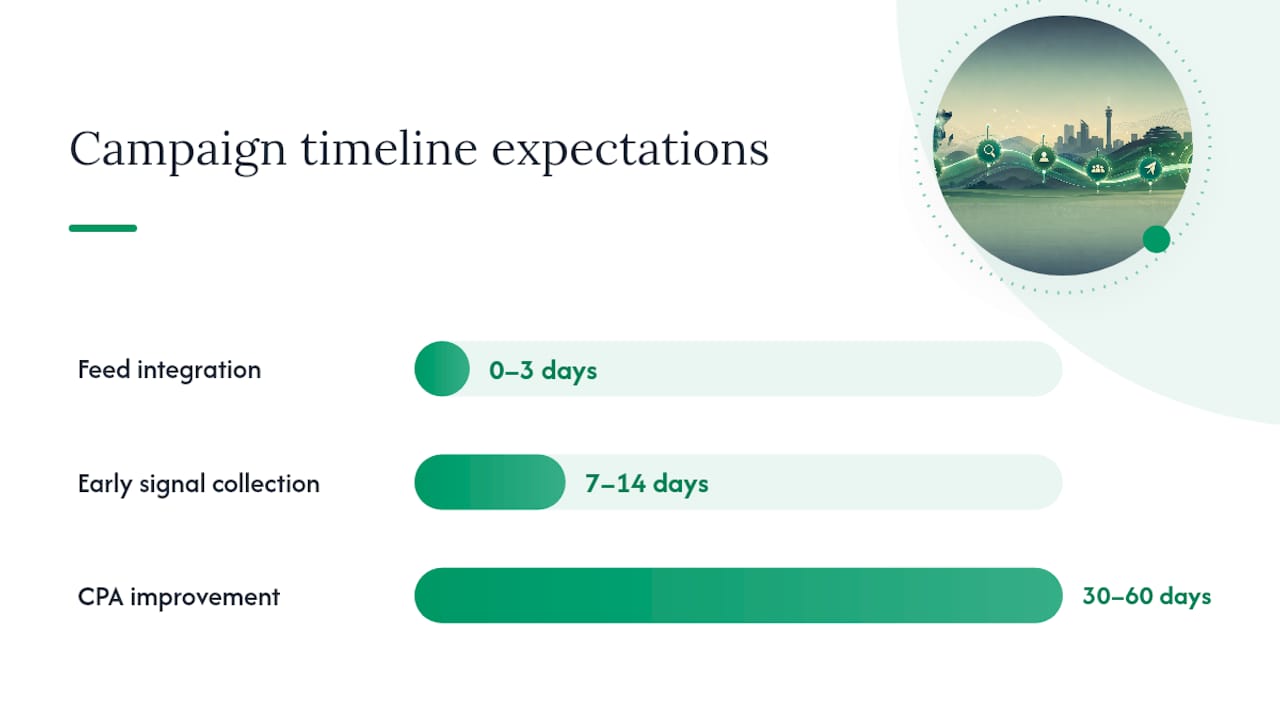
Timeline expectations:
- Days 0–3: feed integration and job data normalisation. DirectEmployers notes this technical setup commonly takes about a week before algorithms can bid effectively.
- Days 7–14: early signal collection. The algorithm begins identifying which publishers and placements produce applies.
- Days 30–60: meaningful CPA improvement. Budget reallocation compounds as the algorithm accumulates enough conversion data to bid with confidence.
Statistic callout: Early apply signals appear within the first two weeks, but reliable cost-per-apply benchmarks typically require 30–60 days of campaign data to stabilise.
Why programmatic job advertising outperforms manual posting
The core recruiter-facing benefits are cost control, scale, targeting precision, and reporting transparency. Manual posting gives you none of the first three at the same time.
Cost control. CPA and CPH targets cap what you spend per outcome, not per placement. A campaign that is burning budget on a low-converting publisher gets reallocated automatically, without a recruiter having to notice and intervene.
Scale. A single feed can distribute to hundreds of publishers simultaneously. For a retailer hiring 200 store associates across Gauteng, the Western Cape, and KwaZulu-Natal, that reach would take weeks to replicate manually.
Targeting. Programmatic reaches both active job seekers (on job boards) and passive candidates (via social and display inventory). You can layer in geo radius, job category, seniority, and behavioural signals depending on the platform.
Reporting transparency. Every channel, placement, and spend allocation is visible. You can see exactly which publisher produced which application, which is something a flat-fee post never shows you.
Where it tends to outperform manual posting most clearly:
- High-volume retail or hospitality hiring across multiple locations
- Multi-site healthcare roles where speed-to-fill is critical
- Niche technical roles (IT, engineering) where passive candidate reach matters
One caveat worth stating plainly: programmatic optimises outcomes only when your feed data and conversion tracking are accurate. A feed with inconsistent job titles or a broken apply-tracking pixel produces garbage signals, and the algorithm optimises toward garbage.
Where do programmatic job ads appear, and which South African publishers matter?
Programmatic does not replace job boards. It distributes to them and can surface your jobs across many channels simultaneously, as Hyring’s programmatic glossary makes clear. The publisher network is the inventory; the DSP is the buying layer.
Channel categories and their South Africa relevance:
- Job boards and aggregators: Indeed South Africa, CareerJunction, and PNet are the three highest-intent local destinations. Candidates on these platforms are actively searching, so CPA tends to be lower here than on social or display.
- Social networks: LinkedIn for professional and white-collar roles; Meta (Facebook and Instagram) for broader demographic reach, local awareness campaigns, and retargeting passive candidates who visited your careers page.
- Display networks: Google Display Network reaches passive candidates across publisher sites. Useful for retargeting and brand-awareness campaigns, less effective as a primary apply-generation channel.
- Niche local boards: Findjobsza covers South African cities and job categories with daily-updated listings and WhatsApp job alerts, giving employers direct local inventory without requiring candidates to register or upload a CV.
- Publisher networks: global programmatic platforms like Appcast, Joveo, and Pandologic aggregate hundreds of publisher sites, including local ones, into a single buying interface.
Quick channel comparison for South African campaigns:
- Indeed South Africa: high candidate intent, strong volume for generalist roles, well-suited to CPA buying.
- CareerJunction: local sector verticals and metro reach, particularly strong for mid-level professional roles.
- PNet: established local user base, trusted brand, good for certain industry verticals.
- LinkedIn: best for professional roles; audience targeting by job title, industry, and seniority is precise, but CPC tends to run higher than job boards.
- Meta: mass reach and creative formats for awareness and retargeting; works well for entry-level, shift, and location-based roles.
- Google Display Network: broad passive reach; most effective as a retargeting layer rather than a primary acquisition channel.
Pro Tip: Run Indeed South Africa, CareerJunction, or PNet as your primary apply-generation channels, and use Meta or Google Display Network for retargeting candidates who clicked but did not apply. That combination typically produces a lower blended CPA than either channel alone.
How to choose a programmatic job advertising platform
The vendor market ranges from self-serve DSPs to fully managed outsourced services. Easy notes that platforms vary significantly by service model, and the right choice depends on your team’s capacity to manage campaigns internally.
Vendor evaluation checklist:
- ATS integration: does the platform support your specific ATS via XML or API? Can it map apply events back to hires?
- Reporting granularity: does it report cost-per-apply and cost-per-hire by channel, not just total clicks?
- Service model: self-serve, managed, or hybrid? Match this to your team’s bandwidth.
- Contract flexibility: monthly or annual? Is there a minimum spend commitment?
- Local publisher access: does the platform’s network include South African job boards (Indeed SA, CareerJunction, PNet)?
- POPIA compliance: how does the platform handle candidate data? Where is it stored? Who has access?
- Creative and targeting options: can you segment by geo radius, job category, seniority, or behavioural signals?
- Support: is there a local or regional account team, or is support entirely remote?
Questions to ask every vendor in your shortlist:
- Which South African publishers are in your network?
- How do you handle feed updates when a job closes or a new role opens?
- What is the minimum budget to run a meaningful test campaign?
- Can you show me a sample report with source-of-hire breakdowns?
- How do you handle POPIA data subject requests?
Pro Tip: Insist on source-of-hire linking before committing budget. A vendor that can only report clicks, not applies by source, cannot close the feedback loop the algorithm needs. If they cannot show you a cost-per-apply breakdown by publisher, the campaign cannot self-optimise.
Programmatic job advertising platforms: South Africa shortlist
The table below compares the 14 platforms and channels most relevant to South African hiring teams. Findjobsza leads as the local inventory complement; the remaining entries follow in their category order.
| Platform | Best for | Pricing model | Targeting & audience data | Channels & inventory | Reporting & analytics | Local SA presence / support | Service model |
|---|---|---|---|---|---|---|---|
| Findjobsza | Employers wanting direct local inventory and city-level candidate reach across SA | Job posting fee | City, province, job category, sector | SA city and category pages, WhatsApp job alerts | Daily listing updates, direct apply tracking | SA-focused platform | Self-serve listing |
| Joveo | Enterprises needing AI-driven, high-scale optimisation across many publishers | CPC / CPA | Skill, behaviour, geo, retargeting | Job aggregators, social, display, publisher networks | Real-time dashboards, job-level CPA tracking | Remote/global | Managed + self-serve DSP |
| Appcast | High-volume hiring programmes prioritising performance-based buying | CPA / CPC | Behavioural, geo, job category | Large publisher marketplace, aggregators | Performance dashboards, CPA by source | Remote/global | Managed service |
| Wonderkind | Employers seeking behavioural targeting and personalised candidate journeys | CPC / CPM | Behavioural, interest, retargeting | Social, display, publisher networks | Campaign analytics, candidate journey reporting | Remote/global | Managed service |
| Recruitics | Agencies and TA teams needing managed campaigns and analytics | Managed-service fee | Geo, job category, audience segments | Multi-channel, job boards, social | Campaign analytics, CPA tracking | Remote/global | Managed service |
| Professional and white-collar roles where audience signals matter | CPC / CPM | Job title, industry, seniority, skills | LinkedIn feed, Recruiter, sponsored jobs | Campaign manager, apply tracking | Regional support | Self-serve + managed | |
| Meta (Facebook/Instagram) | Broad demographic reach, local awareness, retargeting | CPC / CPM | Demographics, interests, behaviour, geo | Facebook, Instagram, Audience Network | Ads Manager, pixel-based conversion tracking | Regional support | Self-serve |
| Google Display Network | Broad-reach and retargeting across the open web | CPM / CPC | Contextual, behavioural, retargeting | Display, YouTube, publisher sites | Google Ads reporting, conversion tracking | Regional support | Self-serve |
| Indeed (South Africa) | High-volume generalist roles with strong local intent | CPC / sponsored | Job category, location, keyword | Indeed SA job board | Employer dashboard, apply analytics | SA audience | Self-serve + managed |
| CareerJunction | Local specialist and general hiring in SA metros | CPC / flat listing | Sector, location, seniority | CareerJunction SA job board | Listing analytics | SA-based | Self-serve |
| PNet | Employers needing established local board coverage | Flat listing / CPC | Industry, location | PNet SA job board | Listing performance reports | SA-based | Self-serve |
| Pandologic | Teams wanting automated channel optimisation across many publishers | CPA / CPC | Geo, job category, behavioural | Publisher networks, aggregators, job boards | Automated reporting, CPA by channel | Remote/global | Automated managed |
| Adway | Employers using social recruiting and employer branding alongside programmatic | Not publicly listed | Social, behavioural, employer brand audiences | Social networks, display | Campaign reporting | Remote/global | Managed service |
| Talentify | Teams seeking AI-assisted candidate engagement alongside distribution | Not publicly listed | AI-driven, behavioural, geo | Publisher networks, job boards | Engagement analytics | Remote/global | Managed service |
A few notes on the shortlist:
Joveo and Appcast are the two platforms most commonly cited in enterprise programmatic recruitment. Both operate large publisher marketplaces and offer real-time job-level optimisation, which makes them well-suited to high-volume hiring programmes. The difference is emphasis: Joveo leans into AI-driven optimisation at the job level, while Appcast’s strength is its publisher marketplace scale and performance-based buying models.
Pandologic takes an automation-first approach to publisher selection, automatically reallocating spend across channels without manual intervention. That suits teams with limited campaign management bandwidth but requires trusting the algorithm’s channel choices.
Wonderkind’s focus on behavioural targeting and personalised ad formats makes it a better fit for employer branding campaigns than pure volume-apply programmes. If your brief is to reach passive candidates with a compelling creative message, it belongs on the shortlist. For raw apply volume, Appcast or Joveo will typically outperform it.
For South African employers, Indeed SA, CareerJunction, and PNet remain the highest-intent local destinations. Pairing any of the global programmatic platforms with direct listings on these boards, and on Findjobsza for city-level reach, gives you both algorithmic optimisation and local inventory depth.
Pricing models and campaign timelines for South African recruiters
Pricing models explained:
- CPC (Cost-Per-Click): you pay each time a candidate clicks your ad. Common on LinkedIn, Meta, and Google. Risk: clicks do not equal applications.
- CPA (Cost-Per-Apply): you pay only when a candidate submits an application. The most recruiter-friendly model because spend is tied directly to outcomes.
- CPM (Cost-Per-Thousand Impressions): you pay for visibility, not actions. Useful for brand-awareness campaigns but not for apply-generation.
- Managed-service fee: a flat or percentage-of-spend fee covering campaign management, reporting, and optimisation. Common with Recruitics, Appcast, and Wonderkind.
- Minimums and retainers: most managed-service platforms require a minimum monthly spend, often in the range of several thousand rand, before they will take on a campaign.
Budget allocation heuristic: Easy.jobs recommends a 70/20/10 split: 70% of budget to proven channels producing reliable CPAs, 20% to programmatic testing across new publishers, and 10% to experimental sources.
Timeline expectations:
- Week 1: feed integration, job data normalisation, pixel placement. Budget this as technical setup time, not campaign time.
- Weeks 2–4: initial learning window. The algorithm collects apply signals and begins shifting budget. CPAs will be variable.
- Days 30–60: reliable CPA signals emerge. This is when you can make confident decisions about channel allocation and budget scaling.
Set daily spend caps during the learning window. A campaign without a cap can exhaust a monthly budget in days before the algorithm has enough data to spend it efficiently.
Campaign setup and optimisation best practices
Pre-launch checklist:
- Export your ATS feed and confirm it includes job title, location (city and province), description, apply URL, and job category.
- Normalise job titles: “Sr. Software Dev” and “Senior Software Developer” are the same role. Inconsistent titles confuse the algorithm and split your data.
- Set location radius correctly. A Johannesburg role with a 50 km radius will pull in Pretoria candidates; tighten or widen deliberately.
- Place the conversion tracking pixel on the application confirmation page, not the job detail page.
- Map at least one conversion event (application submitted) before going live.
Ongoing optimisation sequence:
- Confirm data flow: check that apply events are firing correctly in your platform’s reporting within the first 48 hours.
- Set target CPA: agree on a cost-per-apply ceiling before the algorithm has enough data to hit it. Adjust after the first 14 days based on actual signals.
- Monitor channel CPA weekly: identify which publishers are delivering applications at or below target and which are burning budget on clicks.
- Reallocate budget: shift spend from underperforming channels to those with the lowest CPA. Most platforms do this automatically, but a weekly manual review catches edge cases.
- Refine targeting and creative: test different job titles in ad copy, adjust geo radius, and try different creative formats on social channels.
Measuring quality, not just volume: track time-to-interview and interview-to-offer ratios by source. A channel that produces 50 applications but zero interviews is worse than one producing 10 applications with five interviews. Feed this data back into your CPA targets by channel.
Why a blended programmatic and local-board strategy works best in South Africa
Reach Digital, a South African digital marketing agency for recruitment, recommends pairing programmatic for immediate applicant pipeline with long-term SEO and employer branding to reduce cost-per-lead over time. The logic is straightforward: programmatic delivers volume now, but organic visibility on local boards and search compounds over months and costs nothing per click once established.
In South Africa specifically, a few factors make the blended approach more important than in markets like the US or UK:
Local board depth matters. Indeed SA, CareerJunction, and PNet have built candidate databases over years. A programmatic platform that does not include these boards in its network is missing the highest-intent local inventory. Before signing with any global platform, confirm which South African publishers are in its network.
City-plus-specialism targeting is underused. Most South African programmatic campaigns target by province. Candidates in Cape Town searching for IT roles in South Africa or admin jobs in Johannesburg are running city-level searches. Platforms that can target at city and job-category level simultaneously will outperform province-only targeting for these candidates.
POPIA considerations for programmatic campaigns: the Protection of Personal Information Act governs how candidate data collected through tracking pixels and apply forms is stored and processed. Practically, this means:
- Your tracking pixel must not collect data beyond what is necessary for conversion measurement.
- Candidates must be informed how their data is used (your privacy policy must cover programmatic tracking).
- Any candidate data shared with a third-party platform must be covered by a data processing agreement.
- Data subject access and deletion requests apply to data held by your programmatic vendor, not only your ATS.
Language and geo targeting: South Africa’s 11 official languages and significant urban-rural divide mean that a single national campaign often underperforms compared with city-specific campaigns with locally relevant copy. Afrikaans-speaking candidates in the Western Cape respond differently to ad copy than Zulu-speaking candidates in KwaZulu-Natal. Where your platform allows creative variation by geo, use it.
How the featured platforms were evaluated
The platforms and channels in this guide were assessed against eight dimensions that matter to South African hiring teams: best-fit buyer profile, pricing model, targeting and audience data capabilities, channel and publisher inventory (with specific attention to South African board access), reporting and analytics depth, ATS and CRM integration options, local presence or support in South Africa, and service model.
Pricing transparency was weighted heavily because South African recruiters frequently work with limited budgets and need to know minimum spend thresholds before entering vendor conversations. Platforms where pricing is not publicly listed are noted as such; the absence of a public price is itself a useful signal about the sales process you should expect.
South African publisher access was treated as a standalone criterion rather than folded into general channel coverage, because a global programmatic platform with no South African board inventory is materially less useful for local hiring than its global reach suggests.
No performance benchmarks were invented or extrapolated. Where industry sources cite typical CPA improvement ranges, those figures are attributed to their source and linked directly.
Legal and compliance checklist for South African job advertising
POPIA is the headline compliance requirement, but it is not the only one. South African job ads and recruitment campaigns must also comply with the following:
Employment Equity Act (EEA): job ads may not unfairly discriminate on grounds including race, gender, disability, religion, or age. Programmatic targeting that effectively excludes protected groups through demographic filters may constitute indirect discrimination. Review your audience targeting settings against EEA requirements before launch.
Basic Conditions of Employment Act (BCEA): job ads that specify hours, pay, or conditions must reflect what the role will actually offer. Misleading ads that attract applications for roles with materially different conditions create legal exposure.
Consumer Protection Act (CPA): candidates are consumers in the context of job advertising. Ads must not be misleading about the nature of the role, the employer, or the application process.
POPIA practical checklist:
- Appoint an Information Officer and register with the Information Regulator if you have not already done so.
- Ensure your careers page and application form include a POPIA-compliant privacy notice.
- Confirm your programmatic vendor has signed a data processing agreement with you.
- Establish a process for handling data subject access and deletion requests that covers data held by third-party platforms.
- Do not retain candidate data longer than necessary for the recruitment purpose.
Sector-specific rules: certain industries (financial services, healthcare, security) have additional fit-and-proper or registration requirements that must be reflected in job ads. A programmatic campaign that distributes ads at scale across hundreds of publishers amplifies any compliance error in the original ad copy. Get the ad copy right before distributing it programmatically.
This section covers general compliance considerations and is not legal advice. Confirm current requirements with a qualified South African employment law practitioner.
Programmatic job advertising in practice: South African campaign examples
High-volume retail hiring across multiple provinces: a national retailer running a seasonal hiring push across Gauteng, the Western Cape, and KwaZulu-Natal used a programmatic platform to distribute to Indeed SA, CareerJunction, and a social retargeting layer on Meta simultaneously. By setting a target CPA and letting the algorithm reallocate budget daily, the campaign maintained consistent application volume across all three provinces without a recruiter manually adjusting spend per board. The operational saving was in campaign management time, not just cost-per-apply.
Niche IT role in Cape Town: a technology company hiring a senior data engineer used LinkedIn’s programmatic sponsored job placement alongside a direct listing on Findjobsza’s IT jobs category. LinkedIn’s seniority and skills targeting reached passive candidates who were not actively browsing job boards. The local listing on Findjobsza captured active candidates searching by city and job type. The two channels produced different candidate profiles, which gave the hiring manager a broader shortlist than either channel alone would have generated.

Entry-level and matriculant hiring: employers hiring at entry level, where candidate volume matters more than seniority targeting, tend to find that Meta and local job boards outperform LinkedIn on CPA. A programmatic campaign that weights Meta for awareness and retargeting, with Indeed SA or Findjobsza for intent-based apply capture, typically produces the lowest blended CPA for this segment.
These examples illustrate a consistent pattern: the channel mix that works depends on the role level, the geography, and whether you are trying to reach active or passive candidates. No single platform wins across all three dimensions simultaneously.
Common challenges in programmatic job advertising and how to fix them
Challenge 1: Optimising for clicks instead of applies. This is the most common and most expensive mistake. A campaign optimised for CPC will find the cheapest clicks, which are often accidental or low-intent. DirectEmployers is explicit that the correct feedback loop uses apply and hire signals, not click signals. Fix: set your conversion event to application submitted, not job detail page view.
Challenge 2: Broken or missing tracking. If your apply-tracking pixel is not firing, the algorithm has no feedback signal and cannot optimise. It will spend budget evenly or by default rules rather than by performance. Fix: test your pixel before launch using your platform’s tag verification tool. Check it again after any careers site update.
Challenge 3: Poor feed quality. Inconsistent job titles, missing locations, or outdated listings in your feed produce poor targeting and wasted spend. Fix: audit your ATS feed before integration. Standardise job titles, confirm every listing has a valid apply URL, and set up automatic feed refresh so closed roles are removed within hours.
Challenge 4: Insufficient budget for the learning window. A campaign with a R500 daily cap across 20 publishers will generate so few impressions per publisher that the algorithm cannot collect meaningful apply signals. Fix: concentrate budget on two or three channels during the learning window, then expand once you have reliable CPA data.
Challenge 5: No source-of-hire reporting. If your ATS does not tag inbound applications by source, you cannot close the feedback loop between programmatic spend and hiring outcomes. Fix: implement UTM parameters or source codes on every apply URL in your feed, and confirm your ATS captures and stores them.
Challenge 6: Ignoring local publisher gaps. Global programmatic platforms do not always include South African job boards in their default publisher networks. Fix: ask every vendor specifically which South African publishers are in their network before signing. If Indeed SA, CareerJunction, or PNet are absent, supplement with direct listings.
Programmatic job advertising trends and the South Africa outlook for 2026
AI-driven job-level optimisation is becoming standard. Platforms like Joveo now optimise at the individual job level, rather than the campaign level, shifting budget between roles based on which specific positions are converting. For South African employers with large, varied job inventories, this means the algorithm can prioritise a hard-to-fill role in Durban over an easy-to-fill role in Johannesburg without manual intervention.
WhatsApp as a candidate engagement channel is growing. South Africa has one of the highest WhatsApp penetration rates in the world. Platforms and job boards that deliver job alerts via WhatsApp, as Findjobsza does, are tapping into a candidate behaviour that email-based alerts cannot match in this market. Expect more programmatic vendors to explore WhatsApp integration for South African campaigns.
Performance-based buying is replacing flat-fee posting at scale. The shift from flat-fee board listings to CPA-based programmatic buying is accelerating among enterprise employers in South Africa. Smaller employers are following as platforms lower minimum spend thresholds and simplify self-serve interfaces.
Data privacy enforcement is tightening. The Information Regulator is becoming more active in enforcing POPIA. Programmatic campaigns that rely on third-party tracking pixels and behavioural data will face increasing scrutiny. Vendors that offer first-party data strategies and POPIA-compliant data processing agreements will have a competitive advantage in the South African market.
Employer branding and programmatic are converging. Platforms like Adway and Wonderkind are blending programmatic distribution with employer brand creative, targeting passive candidates with content-led ads rather than pure job listings. For South African employers competing for scarce skills in IT, engineering, and healthcare, this approach is worth testing alongside traditional apply-generation campaigns.
The most common mistake recruiters make in the first 90 days
Most recruiters who adopt programmatic job advertising for the first time make the same error: they treat it like a faster version of manual posting and measure success by click volume. The algorithm will give you exactly what you optimise for. If you optimise for clicks, you will get clicks. Many of them will never become applications.
The first 90 days should be spent on three things only. Get the ATS integration right so apply events flow back to the platform cleanly. Set a target cost-per-apply before you launch, even if it is a rough estimate, because the algorithm needs a signal to work toward. Run weekly reviews of channel CPA during the learning window, not monthly, because a channel that is burning budget on clicks will exhaust your test budget before you notice if you only check once a month.
The recruiters who get the most from programmatic in the first quarter are the ones who treat it as a data problem, not a media-buying problem. The platform handles the buying. Your job is to make sure the data flowing in and out of it is clean, complete, and connected to actual hiring outcomes.
Findjobsza gives your programmatic campaigns a direct local inventory layer
Global programmatic platforms distribute your jobs across hundreds of publishers, but they do not always reach the South African candidates who are actively searching by city and job type right now. Findjobsza fills that gap directly.
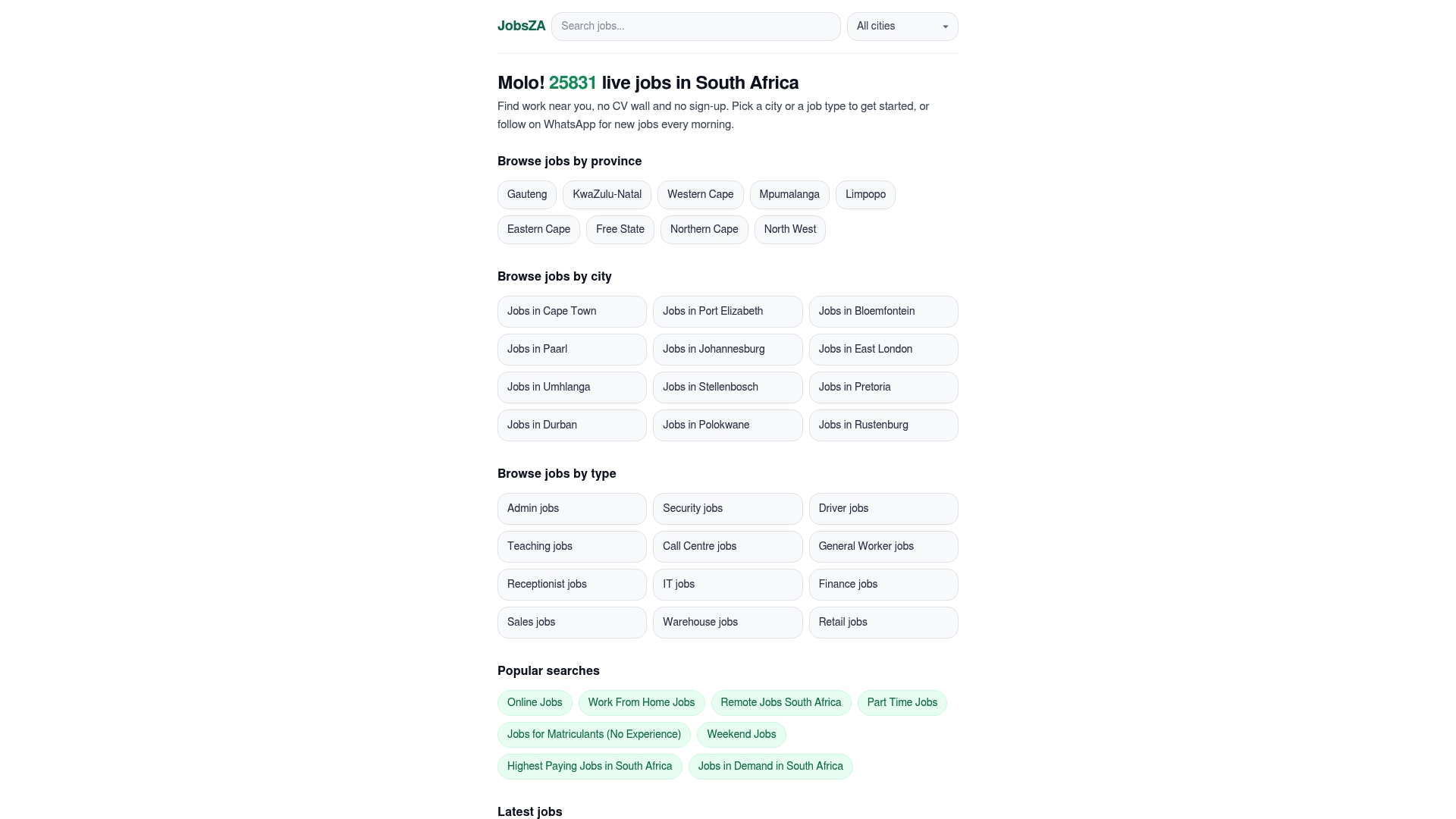
Employers posting on Findjobsza get city-level and category-level inventory across South Africa, with no CV upload or registration barrier for candidates. That means a shorter path from ad impression to application. Daily WhatsApp job alerts push your listings to active candidates every morning, reaching a segment that email-based platforms consistently miss in the South African market. Whether you are hiring for high-demand roles at scale or filling sales positions across multiple cities, Findjobsza gives your programmatic spend a local inventory complement that global platforms cannot replicate on their own. Post your vacancy on Findjobsza today and put your role in front of South African candidates who are actively looking.
Sources
- What Is Programmatic Job Advertising? A Guide for Recruiters Getting Started • DirectEmployers Association
- What Is Programmatic Job Advertising? | JobTarget
- What Is Programmatic Job Advertising and How Does It Work? • Joveo
- Easy
- Reach Digital: digital marketing agency for recruitment agencies in SA
FAQ
What is programmatic job advertising?
Programmatic job advertising is the automated buying, placement, and optimisation of job ads across multiple channels, using algorithms to shift budget toward the publishers producing qualified applicants. It replaces manual flat-fee posting with a performance-driven model tied to cost-per-apply or cost-per-hire.
How is programmatic different from posting directly to a job board?
A direct job board post charges a flat fee regardless of results and appears on one site only. Programmatic distributes your listing across many publishers simultaneously and reallocates budget in real time based on which channels are producing applications, not just clicks.
Is programmatic job advertising difficult to set up?
The main technical requirement is an ATS feed export and a tracking pixel on your application confirmation page. Initial setup typically takes about a week, after which the platform handles distribution and optimisation automatically. Managed-service vendors handle the technical setup on your behalf.
What are examples of programmatic job advertising in South Africa?
A national retailer distributing seasonal hiring ads across Indeed SA, CareerJunction, and Meta simultaneously via a programmatic platform is one example. A technology company combining LinkedIn’s programmatic sponsored placements with a direct listing on Findjobsza for city-level IT candidate reach is another.
How long before a programmatic campaign shows results?
Early apply signals typically appear within the first two weeks. Reliable cost-per-apply benchmarks, where the algorithm has enough data to bid confidently, generally stabilise between 30 and 60 days after launch.
Recommended
Start with your city.
19 529 live jobs, filtered by city and suburb. No sign-up wall, no CV upload just to look.