Remote hiring South Africa: employer and job seeker guide
19 August 202618 min read

Contents18 sections
- 1Key Takeaways
- 2Table of Contents
- 3How do you hire remote staff in South Africa step by step?
- 4What South African laws apply to remote work contracts?
- 5Who handles PAYE, UIF and SDL for remote workers?
- 6Does hiring remotely create a permanent establishment risk?
- 7How do you onboard remote staff to reduce turnover?
- 8Where do South African job seekers find legitimate remote roles?
- 9How long does remote hiring take from posting to onboarding?
- 10What does hiring a remote worker cost in South Africa?
- 11How do you vet remote candidates before hiring them?
- 12What should a remote work contract include?
- 13How should contractors negotiate pay and payment terms?
- 14Why this guide focuses on South African remote hiring
- 15Find or post remote roles without the admin headache
- 16Sources
- 17FAQ
- 18Recommended
Remote hiring South Africa: employer and job seeker guide
Yes, you can hire remote employees or contractors in South Africa, but you need to pick the right engagement model first and then meet the statutory obligations that come with it. That means UIF and SDL contributions where they apply, correct PAYE treatment, a contract that actually addresses remote work, and POPIA-compliant data handling.
Run through this before you post a job or sign anything:
- Engagement model: contractor, employee, or Employer of Record (EOR) — each carries different tax and labour exposure.
- Contract clause: spell out place of work, hours, equipment, and data security explicitly.
- UIF and SDL: employers contribute 1% of gross compensation to UIF, and 1% of payroll to SDL if annual payroll exceeds R500,000.
- PAYE and PE risk: foreign employers may need to register with SARS depending on where work is actually performed.
- POPIA: device and data controls for anyone handling personal information remotely.
- CCMA timelines: dismissal disputes must be referred within 30 days.
If you’re job hunting, check which category the role falls into, ask who withholds your tax, get hours and reimbursement terms in writing, and price yourself realistically in ZAR or USD before you negotiate.
Key Takeaways
Remote hiring in South Africa is legal and workable, but it demands the right engagement model, statutory payroll compliance, and a contract that actually addresses remote-specific risks.
| Point | Details |
|---|---|
| Pick the engagement model first | Contractor, employee, or EOR each carry different PAYE, UIF and misclassification risk. |
| Add remote-specific contract clauses | Cover place of work, hours, equipment ownership and POPIA data security explicitly. |
| Confirm payroll triggers early | UIF at 1% of gross pay and SDL at 1% of payroll above R500,000 annual payroll apply once you’re an employer. |
| Assess PE risk for foreign hires | A 50% time threshold plus a commercial reason for the worker’s presence can create permanent establishment exposure. |
| Structure onboarding, not just access | A documented 30/60/90 day plan reduces early remote-hire turnover. |
| Source locally for faster fills | FindJobsZA’s remote listings and daily WhatsApp alerts connect employers and job seekers without CV uploads or sign-ups. |
This article is general information, not a substitute for advice from a qualified lawyer. Consult a qualified legal professional about your own circumstances before acting on anything here.
Table of Contents
- How do you hire remote staff in South Africa step by step?
- What South African laws apply to remote work contracts?
- Who handles PAYE, UIF and SDL for remote workers?
- Does hiring remotely create a permanent establishment risk?
- How do you onboard remote staff to reduce turnover?
- Where do South African job seekers find legitimate remote roles?
- How long does remote hiring take from posting to onboarding?
- What does hiring a remote worker cost in South Africa?
- How do you vet remote candidates before hiring them?
- What should a remote work contract include?
- How should contractors negotiate pay and payment terms?
- Why this guide focuses on South African remote hiring
- Find or post remote roles without the admin headache
- Sources
- FAQ
How do you hire remote staff in South Africa step by step?
Start with the job description, and be specific about it. A vague “remote administrator” posting attracts a flood of unqualified applications; a posting that states the exact hours, time zone overlap, tools used, and reporting structure filters candidates before you ever open a CV.
Interviews for remote roles need one extra stage most employers skip: a written task or short async assignment. Remote work lives or dies on written communication, so testing it before hiring beats discovering the gap three weeks in.
Once you’ve picked a candidate, the contract stage is where most South African employers get sloppy. A generic employment template written for an office job doesn’t address remote work at all — no clause on where work happens, what equipment the company provides versus what the worker supplies, or how data gets handled on a home network. That gap becomes a real problem the day something goes wrong, whether it’s a stolen laptop or a POPIA breach.
Onboarding should start before day one: send login credentials, a device policy, and a 30-day plan in advance so the first morning isn’t spent hunting for passwords. Remote hiring works better as an operating system than a one-off event — structured onboarding, clear ownership, and a standing weekly check-in cut down the friction that kills remote teams in month two.
Employers sourcing candidates can post directly to FindJobsZA’s remote jobs listings rather than running a generic ad and hoping the right people find it.
What South African laws apply to remote work contracts?
There’s no standalone remote-work statute in South Africa. Remote arrangements fall under the same frameworks that govern any employment relationship: the Basic Conditions of Employment Act (BCEA), the Labour Relations Act (LRA), the Compensation for Occupational Injuries and Diseases Act (COIDA), the Occupational Health and Safety Act (OHSA), and the Protection of Personal Information Act (POPIA).
Because none of these were written with home offices in mind, the practical fix is to bolt remote-specific clauses onto a standard contract rather than assume the base template covers you. Legal guidance on this point is consistent: employers should document the remote arrangement, run a basic risk assessment, and update data-security policy rather than leave it implied.
At minimum, a remote-work clause should cover:
- Place of work and whether the employer can require occasional office attendance.
- Working hours, overtime treatment, and how availability is measured across time zones.
- Who owns and maintains equipment, and what happens to it at termination.
- Data security expectations: VPN use, device encryption, and handling of client information under POPIA.
- OHSA-relevant provisions, since a home workstation injury can still trigger a COIDA claim.
By 2026, HR guidance increasingly recommends formal letters of authority for home working, mandatory VPNs, and device encryption as standard practice rather than best-in-class extras. Skipping these isn’t illegal on its own, but it leaves employers exposed if a dispute or data incident ever reaches the CCMA or the Information Regulator.
Who handles PAYE, UIF and SDL for remote workers?
For a standard South African employer with a locally registered entity, payroll obligations don’t change just because staff work from home. You still withhold PAYE, contribute 1% of gross compensation to UIF, and pay SDL at 1% of payroll if your annual payroll tops R500,000.
Where it gets complicated is foreign employers hiring South African-based remote staff directly, without a local entity. SARS guidance flags that these employers may need to register as an employer for PAYE purposes once they have staff physically working from South Africa. The trigger isn’t where the company is incorporated. It’s whether the presence in South Africa amounts to a taxable footprint.
Non-resident employers should get advice before assuming they’re outside the system, because PAYE and UIF/SDL liability can follow from a permanent establishment or representative employer relationship, not just from local incorporation.
On the worker side, SARS has also tightened home-office expense deductions. To claim them, part of the home must be used regularly and exclusively for trade purposes, not just occasionally after hours. Casual claims that a spare bedroom “doubles as an office” rarely survive scrutiny anymore.
Many foreign employers sidestep the registration question entirely by using an Employer of Record, which handles local payroll and statutory reporting on their behalf. That solves the mechanics quickly, though it doesn’t fully remove exposure if the hiring company still directs day-to-day work, since South African authorities can still look through to who actually controls the employment relationship.
Does hiring remotely create a permanent establishment risk?
It can, and this is the compliance question foreign employers underestimate most. A permanent establishment (PE) is a tax concept: it means your company has enough of a footprint in South Africa that SARS treats part of your business as operating here, triggering registration and PAYE withholding obligations.
Updated OECD commentary from 2025 sharpened the test considerably. The current guidance points to a 50% threshold: if someone works from South Africa for at least half their total working time over a 12-month period, and there’s a commercial reason tied to their presence, that can indicate a PE.
The “commercial reason” element matters more than the time threshold alone. If an employee happens to live in South Africa and works remotely for personal reasons, unconnected to any business decision by the employer, that’s generally lower risk. If the company specifically chose to place someone in South Africa to serve local clients or run local operations, the commercial link strengthens the PE case considerably. Tax authorities and courts look for that link between presence and business activity rather than treating remote work as automatically risky.
None of this is a clean yes or no test. Foreign employers with even one South Africa-based remote hire should get a specific assessment rather than relying on general assumptions about “just one remote worker” being safe. The cost of getting it wrong is retrospective PAYE liability, which is far more expensive than the advice would have been.
How do you onboard remote staff to reduce turnover?
The first 30 days set the tone for whether a remote hire sticks around. Employers who treat day one as “here’s your login, good luck” see higher early attrition than those who structure it deliberately.

Days 1 to 30: focus on clarity, not output. New hires need a documented workflow, a named point of contact for questions, and a realistic first-month goal that doesn’t assume they already know internal shorthand. Weekly check-ins during this stretch catch confusion before it becomes resignation.
Days 30 to 90: shift toward ownership. By day 60, a remote employee should own at least one full process end to end. By day 90, review performance against the original job description, not against vague impressions, and address gaps directly rather than letting them drift into a slow disengagement.
Pro Tip: Put the 30/60/90 milestones in writing before the employee’s first day, not after. A documented plan removes the guesswork that makes new remote hires anxious in week two, when they can’t just walk over and ask someone.
Retention in remote setups tends to fail for structural reasons, not effort. Structured onboarding, clear role ownership, and a standing weekly check-in reduce the friction that causes most early remote-hire turnover far more reliably than perks or higher pay alone.
Where do South African job seekers find legitimate remote roles?
Dedicated job boards focused on the South African market tend to outperform generic global platforms for local job seekers, mainly because they filter out roles that expect US or European time-zone availability without saying so upfront. FindJobsZA’s online jobs section lists remote and flexible roles across sectors without requiring a CV upload or account creation, which removes a real barrier for anyone who’s tired of re-entering the same information on five different platforms.
For contractors specifically, freelance marketplaces and direct outreach through LinkedIn both work, but they demand more vetting effort on the job seeker’s side. A posting that promises R15,000 a week for “simple data entry” with no interview process is a red flag, not a lucky break.
Application tips that actually move the needle:
- Tailor your first line to the specific role, not a generic cover paragraph.
- Confirm the time zone expectations before applying, not after an offer.
- Ask directly whether the role is contractor or employee status; the tax and rights implications differ enormously.
- Check jobs in demand for sectors currently hiring at volume, since applying into a growing category beats competing for scarce roles in a shrinking one.
Enabling daily alerts, rather than checking a site sporadically, matters more than most job seekers realize. Remote roles with flexible hours or entry-level access get applicants fast, and being first to apply within the first few hours often beats having the stronger CV three days later.
How long does remote hiring take from posting to onboarding?
A realistic South African remote hiring timeline runs four to six weeks for a standard role, longer for senior or specialized positions. Posting and initial screening typically take a week to ten days, assuming the job description is specific enough to filter properly. Interviews, including any written task stage, add another one to two weeks.
Contract negotiation and drafting is where delays creep in, particularly if the employer is retrofitting a generic template with remote-specific clauses for the first time. Budget three to five business days here if the contract already has a remote-work template ready; budget two weeks if it’s being built from scratch with legal input.
Onboarding itself, from signed contract to a fully functioning remote employee, usually takes one to two weeks for equipment setup, access provisioning, and initial training. Foreign employers assessing PE risk or PAYE registration should add time here too, since that assessment ideally happens before the hire starts, not after.
Contractor engagements move faster, often two to three weeks total, since there’s no PE assessment and typically a lighter contract. That speed is exactly why misclassification is tempting and exactly why it’s risky: a genuinely employee-like arrangement dressed up as a contractor role to save time can trigger retrospective reclassification and back-payroll liability later.
What does hiring a remote worker cost in South Africa?
Costs split into four buckets: recruitment, legal, payroll, and technology. None of them are trivial, and skipping any one usually costs more later.
Recruitment cost depends heavily on channel. Posting directly to a South African job board costs far less than agency placement fees, which commonly run to a percentage of first-year salary. For volume hiring, direct-post platforms scale better than per-placement agency models.
Legal cost is mostly a one-time investment: getting a remote-work clause and data-security language drafted properly once, then reusing that template, beats paying for ad hoc legal review on every new hire.
Foreign employers who need to register locally or use an EOR should factor in that service fee, which typically runs as a percentage of payroll or a flat monthly charge per employee.
Technology cost covers laptops, VPN licenses, collaboration tools, and any device encryption software required for POPIA compliance. Employers who supply equipment outright avoid disputes over ownership at termination, which is worth the upfront spend.
The employers who underestimate total cost most often forget one line item: time. A poorly onboarded remote hire who leaves within three months costs more in lost productivity and re-hiring than the original recruitment fee ever did.
How do you vet remote candidates before hiring them?
Standard interview questions don’t test what remote work actually requires. Someone can interview brilliantly in person and still fall apart when left unsupervised with a deadline and no office structure around them.
Ask candidates to walk through how they managed a specific remote or hybrid project, not a hypothetical. Vague answers about “staying organized” without a concrete example are a weak signal. Ask what tools they used to track their own output, since candidates who can’t name a system usually don’t have one.
Red flags worth taking seriously:
- Reluctance to commit to a specific time-zone overlap window.
- No verifiable history of remote or freelance work when the role demands independence.
- Overpromising availability (“I can work any hours you need”) without asking about actual expectations first.
- Refusing a short paid test task, particularly for contractor roles where trust has to be built before a long engagement.
For contractor engagements specifically, ask directly whether they work with multiple clients and control their own schedule and tools. That’s not just a competence question, it protects the employer against the dominant impression test that South African labour law uses to reclassify contractors as employees when the relationship looks too much like exclusive employment.
What should a remote work contract include?
For employers, the essential clauses are place of work, working hours and overtime treatment, equipment ownership and return conditions, data security obligations under POPIA, and a clear statement of which statutory frameworks apply (UIF, SDL, COIDA where relevant).
A workable clause structure looks like this:
| Clause area | What it should specify |
|---|---|
| Place of work | Primary work location, whether occasional office attendance can be required, and notice period for any change. |
| Equipment | Who provides devices, maintenance responsibility, and return obligations at termination. |
| Data security | VPN and encryption requirements, handling of client data, and consequences of a breach. |
| Hours and availability | Core overlap hours, overtime rules, and how time is tracked or reported. |
| Termination | Notice period, and reference to CCMA dispute timelines where applicable. |
For contractors, the priority flips slightly: payment terms and timing matter more than equipment clauses, since contractors typically supply their own tools. A contractor agreement should specify deliverables rather than hours, explicitly state that the contractor controls their own schedule and methods, and avoid language that implies supervision or exclusivity, since that language is exactly what triggers reclassification risk under the dominant impression test.
Both sides benefit from a short dispute resolution clause referencing the CCMA process and its 30-day referral window, so nobody’s surprised by the timeline if a disagreement escalates.
How should contractors negotiate pay and payment terms?
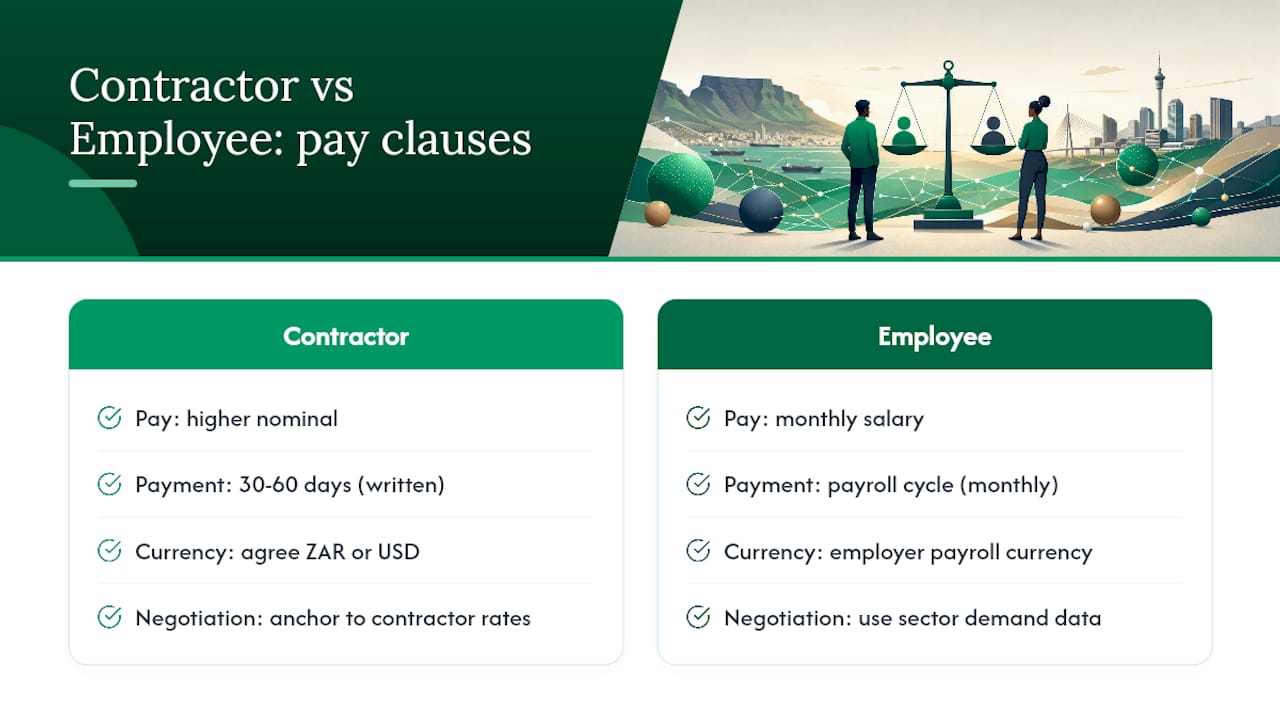
Setting realistic pay expectations starts with knowing which category you’re negotiating in. Contractor rates in South Africa run higher on paper than equivalent employee salaries, because contractors absorb their own tax, benefits, and downtime between projects. Comparing a contractor day rate directly to an employee’s monthly salary without adjusting for that gap leads to underpricing.
Ask about payment terms before you start work, not after the first invoice is late. Thirty-day payment terms are standard for South African contractor work, but some employers stretch to 45 or 60 days without saying so upfront. Get it in writing, along with what currency you’ll be paid in if the employer is based outside South Africa, since ZAR and USD invoicing carry different tax and conversion implications.
For salary negotiation as a remote employee, use demand data by sector to anchor your number rather than guessing. A role in a sector with genuine hiring pressure gives you more room to negotiate than one where supply of candidates outstrips demand.
Don’t skip the clause conversation just because you’re eager to start. Ask specifically who withholds PAYE, whether UIF applies to your arrangement, and what happens if the engagement ends early. If a dispute ever needs to go to the CCMA, you have 30 days from the dismissal or dispute date to refer it, and that clock doesn’t wait for you to figure out your rights after the fact.
Why this guide focuses on South African remote hiring
FindJobsZA was built around one problem: South African job seekers were tired of generic global platforms that ignored local hiring realities. The daily WhatsApp alerts and city-based listings exist because that’s what actually gets South Africans hired, and this guide reflects the same local-first approach.
Find or post remote roles without the admin headache
If you’re an employer, the checklist above solves the legal and payroll side. Finding the right candidate is the other half, and that’s where a generic job board slows you down with CV uploads, account creation, and applicants who never bothered reading the role details. FindJobsZA skips all of that: post a role and reach South African candidates who browse by city and job type directly, no sign-up wall in the way.
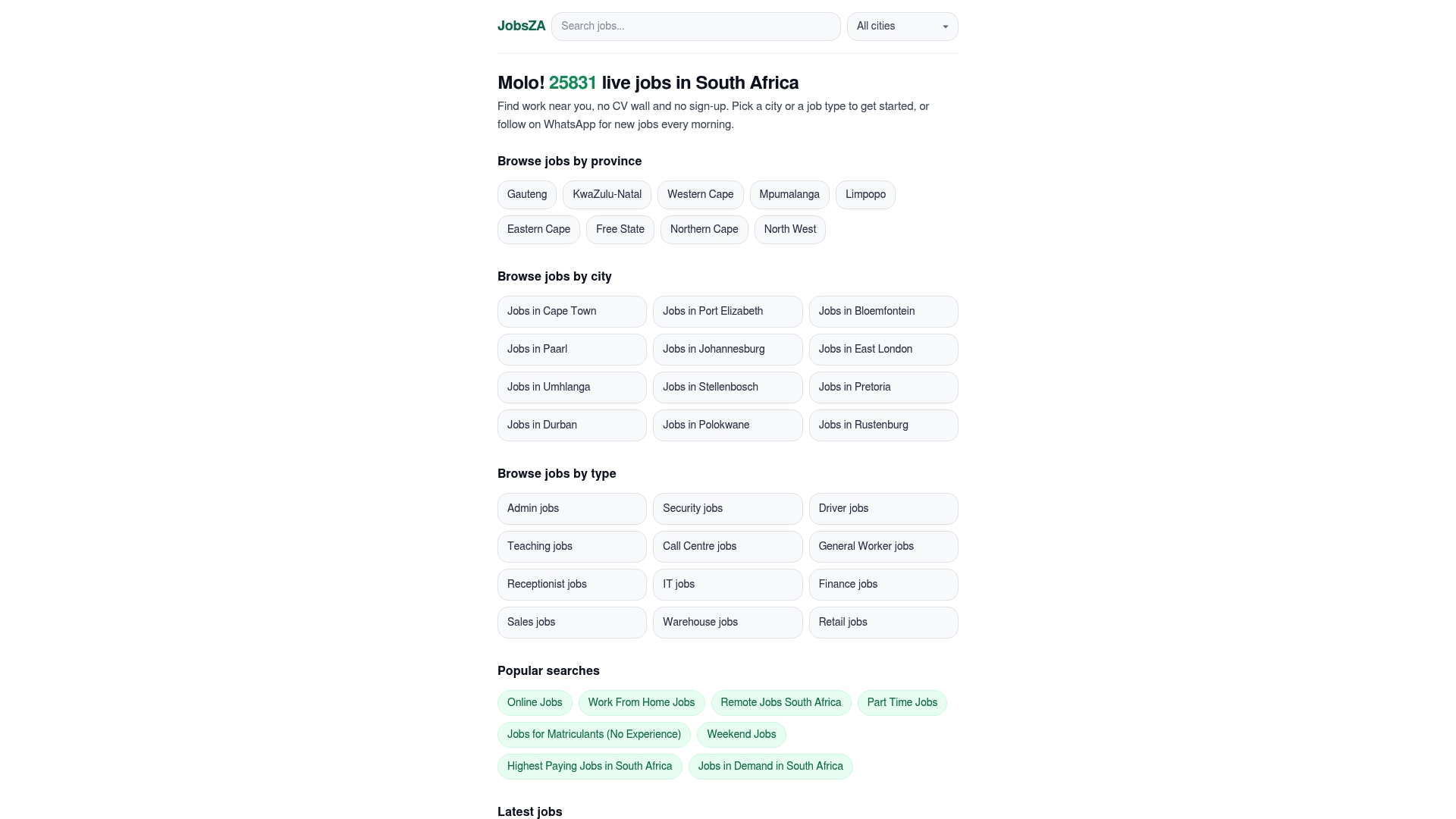
For job seekers and contractors, the advantage runs the other direction. You don’t need to build a profile or upload a CV to browse remote jobs or part-time remote listings on FindJobsZA. Enable the WhatsApp alerts and new remote and online listings land in your chat every morning, which matters when the first applicants are usually the ones who get the interview. Browse the online jobs section now and set up your daily alert before the next batch of listings goes live.
Sources
FAQ
How do I get a remote job in South Africa?
Focus on South Africa-specific job boards that list genuine remote roles by sector, tailor your application to the exact role, and confirm time-zone and payment terms before accepting. FindJobsZA’s online jobs listings update daily via WhatsApp alerts, which helps you apply early.
Can you legally work remotely in South Africa?
Yes. Remote work is governed by existing frameworks like the BCEA rather than a separate remote-work law, so the contract itself needs to spell out place of work, hours, and equipment terms.
How do I get hired for a remote job?
Employers look for candidates who can demonstrate independent work habits, so lead with concrete examples of remote or self-managed projects rather than general claims about being “organized,” and be ready to complete a short test task if asked.
Can foreign companies legally hire South African remote workers?
Yes, but foreign employers may need to register with SARS for PAYE purposes if their presence in South Africa meets permanent establishment criteria, including a 50% time threshold combined with a commercial reason for the worker’s location.
Is it realistic to earn a steady daily income from online work in South Africa?
Earnings vary widely by sector and skill level, and legitimate remote and freelance roles pay based on the work delivered rather than a fixed guaranteed daily rate; treat any offer promising a fixed high daily amount for minimal effort as a red flag rather than a realistic expectation.
Recommended
Start with your city.
19 517 live jobs, filtered by city and suburb. No sign-up wall, no CV upload just to look.