Occupation First Remote Job Search: South Africans Get WhatsApp Alerts
1 September 202613 min read

Contents16 sections
- 1Table of Contents
- 2Where to search for remote jobs: boards, career pages and alerts
- 3How do I search for remote jobs the right way?
- 4What should your CV and profile actually show recruiters?
- 5What are the legal and tax basics for working remotely from South Africa?
- 6How do you vet a remote listing and avoid scams?
- 7Which occupations commonly offer remote roles?
- 8How do you prepare for a remote job interview?
- 9How do you build a network when you work remotely?
- 10How do you prove you can work independently and stay disciplined?
- 11What challenges come up when you start a remote job, and how do you prepare?
- 12Author perspective: what actually moves the needle
- 13Start your remote job search on FindJobsZA today
- 14Sources
- 15FAQ
- 16Recommended
Occupation First Remote Job Search: South Africans Get WhatsApp Alerts
Yes, you can find remote work, but the effective method is occupation-first: pick specific roles that produce digital output, then hunt through the right channels instead of scrolling generic listings. Pick one or two target occupations today, set up alerts on a couple of platforms including FindJobsZA’s remote listings, and start applying within the week.
TL;DR:
- Most remote roles in South Africa are tagged “remote” but may exclude local applicants if labeled “US only” or “EMEA,” so verify the location qualifiers carefully.
- Combining occupation-specific keywords with precise location and time zone details improves filtering accuracy and reduces irrelevant applications.
- Listing specific software skills and quantifiable achievements on your CV signals independence and practical remote work experience to recruiters.
- Understanding your employment status as a contractor or employee influences tax obligations and visa requirements, so clarify this before accepting a job offer.
- Frequent filtering, timely alerts, and direct application to targeted roles increase the chances of landing remote work, especially on platforms like FindJobsZA.
Table of Contents
- Where to search for remote jobs: boards, career pages and alerts
- How do I search for remote jobs the right way?
- What should your CV and profile actually show recruiters?
- What are the legal and tax basics for working remotely from South Africa?
- How do you vet a remote listing and avoid scams?
- Which occupations commonly offer remote roles?
- How do you prepare for a remote job interview?
- How do you build a network when you work remotely?
- How do you prove you can work independently and stay disciplined?
- What challenges come up when you start a remote job, and how do you prepare?
- Author perspective: what actually moves the needle
- Start your remote job search on FindJobsZA today
- Sources
- FAQ
Where to search for remote jobs: boards, career pages and alerts
Roughly 17.6% of LinkedIn job listings in South Africa are now tagged remote, according to Remitly’s data reported by IOL. That is not a small niche. It means one in every six postings you scroll past on a major platform could be a work-from-home role, if you know how to filter for it.
Four channel types cover most of what is out there:
- Global job boards with remote filters (LinkedIn, Indeed) let you tick “remote” and set a country or region, though the filter quality varies and some listings marked remote are actually hybrid.
- South African job boards aggregate local and remote-friendly listings by city or category, which matters when you want roles that understand South African time zones and banking.
- Company career pages often list remote roles before they hit third-party boards, especially at firms that hire globally distributed teams.
- Niche aggregators and WhatsApp alerts push new listings to you the moment they go live, which matters because remote roles get flooded with applicants fast.
Watch the wording closely. “Remote (US only)” or “Remote, EMEA” quietly excludes South African applicants, while “Remote, global” or “Remote, anywhere” does not. FindJobsZA’s approach of sending daily WhatsApp job updates solves the speed problem directly: you see new postings the same morning they go up, without refreshing five tabs before breakfast.
How do I search for remote jobs the right way?
Most job seekers search too broadly (“remote jobs South Africa”) and drown in irrelevant results. A tighter method works better.
- Choose two or three target occupations that produce a digital deliverable. Copywriting, bookkeeping, customer support, and front-end development all fit. A physiotherapist’s job, however skilled, rarely does.
- Combine role plus remote keyword plus location qualifier. Try “remote bookkeeper Africa timezone” or “customer support work from home South Africa” instead of just “remote jobs.”
- Read the contract type before you apply. “Contract” or “freelance” roles pay per project or hour with no benefits; “full-time remote” usually means PAYE-style employment or a foreign payroll arrangement.
- Set alerts and triage them daily. Sort new listings into apply-now, maybe-later, and skip, so you are not rereading the same posting three times.
Pro Tip: Search using the employer’s likely time zone rather than just “South Africa.” A US company advertising “remote, US Eastern hours” is telling you exactly what schedule to expect, and that detail rarely shows up in the job title.
Pnet’s mid-2026 data shows remote vacancies climbed 28% in the first half of the year compared to the same period in 2025, with growth spreading well past IT. That spread is exactly why occupation-first beats keyword-first: the roles are out there, but they are scattered across categories that didn’t used to advertise remote work at all.
What should your CV and profile actually show recruiters?
Generic claims like “strong communicator” or “self-motivated” tell a hiring manager nothing. What convinces a remote employer is evidence you can operate without supervision, using the tools they already run on.
Name the software you use and what you did with it:
- “Managed client tickets in Zendesk, closing 40+ per week within SLA” beats “excellent customer service skills.”
- “Ran monthly reconciliations in Xero for three client accounts” beats “strong bookkeeping ability.”
- “Coordinated a five-person team across time zones using Asana and Slack” beats “great team player.”
- “Hosted weekly client check-ins over Zoom and Google Meet” signals comfort with the actual mechanics of remote collaboration.
Pnet’s recruiter guidance makes the same point: list the tools and describe the output, not the personality trait. Include a work-sample link or a short portfolio wherever the role allows it. A one-line metric (“reduced average response time from six hours to ninety minutes”) does more for your application than an entire paragraph of soft-skill adjectives, because it gives the recruiter something to verify.
What are the legal and tax basics for working remotely from South Africa?
Before you sign anything, find out whether you’ll be classified as a contractor or an employee. The distinction changes your tax position, your access to benefits, and sometimes your visa eligibility.
- Contractor status usually means you invoice the employer directly and handle your own SARS registration and provisional tax; there’s no PAYE deducted at source.
- Employee status with a foreign company can trigger permanent-establishment questions for the employer and different withholding rules for you.
- The Remote Work Visitor Visa carries specific requirements and an income threshold set by the Department of Home Affairs, and it is worth checking current criteria before assuming you qualify.
- Ask any prospective foreign employer directly whether they’ll run local payroll or expect contractor invoices. As MJ Kotze Inc’s guidance on South African work visas notes, this single question determines your PAYE obligations and can affect visa eligibility down the line.
None of this is exotic, but it is easy to overlook when you’re excited about a job offer. A short consultation with a tax practitioner or immigration lawyer before you sign is cheaper than untangling a compliance mess a year later.
How do you vet a remote listing and avoid scams?
Remote postings attract more scam attempts than local ones, mostly because verifying a distant employer is harder. Run every serious listing through a quick checklist before you apply.
- Confirm the deliverables and payment terms are specific. Vague postings (“earn $500/week, no experience needed”) are a red flag; legitimate roles describe actual tasks and a clear pay structure.
- Verify the employer exists. Check their website, LinkedIn company page, and any reviews before sending personal documents.
- Never pay upfront for equipment, training, or “processing.” A real employer does not charge you to hire you.
- Tailor your application. A two-sentence cover note referencing the specific role, plus a relevant sample, outperforms a generic template every time.
- Negotiate the practical details early. Ask about equipment provision, expected working hours across time zones, currency of payment, and payment method before you accept.
Which occupations commonly offer remote roles?
IT remains the anchor category, but it’s no longer the whole story. Pnet’s analysis found remote vacancies up 41% over two years, with meaningful growth in finance, sales, admin, and marketing alongside the expected tech roles.
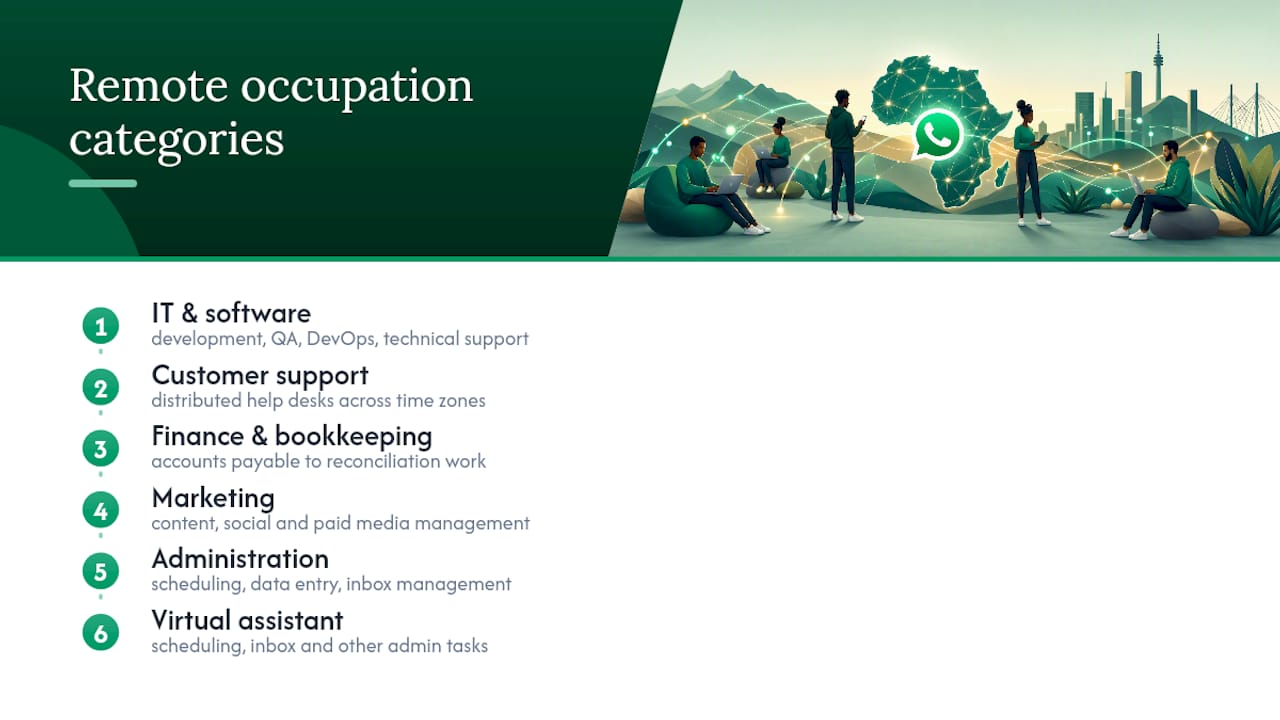
IT and software covers development, QA, DevOps, and technical support, historically the easiest remote category to break into because output is entirely digital. Customer support has scaled fast as companies build distributed help desks across time zones, often using Zendesk or Intercom. Finance and bookkeeping roles, from accounts payable to reconciliation work, translate well to remote because the deliverable is a spreadsheet or a report, not a physical presence.
Marketing roles, particularly content, social media, and paid media management, suit remote work because campaigns run through dashboards accessible from anywhere. Administrative and virtual assistant roles round out the list. Scheduling, data entry, and inbox management require reliability more than location.
Browse IT-specific listings or admin vacancies to see how many of these roles are already advertised as remote or hybrid right now.
How do you prepare for a remote job interview?
Remote interviews test something in-person interviews rarely touch directly: whether you can communicate clearly without body language filling the gaps.
Test your setup at least a day ahead. Confirm your camera, microphone, and internet connection work, and choose a quiet, well-lit space. Nothing undercuts a strong answer faster than a frozen screen or garbled audio five minutes into the call.
Prepare specific stories, not generalities. When asked how you handle ambiguity or manage your time, answer with a real example, project, deadline, outcome, rather than an abstract description of your work style. Interviewers hiring remotely are listening for concrete proof you can self-manage, because they won’t be watching over your shoulder.
Ask about their remote operating rhythm. Questions like “how often does the team check in?” or “what tools do you use for async updates?” show you’ve thought about how the job actually runs day to day, and the answers tell you whether the culture fits how you work best.
How do you build a network when you work remotely?
Isolation is the most underrated risk of remote work, and it starts before you even land the job. Building a network deliberately, rather than waiting for it to happen, pays off in both job leads and day-to-day sanity.
Join occupation-specific online communities, Slack groups, subreddits, or Discord servers built around your field, where people share leads and answer technical questions in real time. Many hiring managers post openings in these spaces before they hit a public board.
Stay active on LinkedIn with genuine commentary rather than generic likes. Commenting thoughtfully on posts from people in your target companies builds visibility slowly but consistently. Attend virtual meetups or webinars in your industry when you can. A single well-timed question in a Q&A session has led to more than one freelance contract.
Reach out directly to people doing the job you want. A short, specific message asking one clear question gets answered far more often than a vague “can we connect.”
How do you prove you can work independently and stay disciplined?
Employers hiring remotely can’t watch you work, so they look for signals that you don’t need watching.
Structure your day visibly where you can. If a role allows it, share a quick daily or weekly update summarizing what you completed, even before anyone asks for one. It builds trust fast and gives you a paper trail if questions ever come up.
Hit deadlines without reminders. Missing a soft deadline once is forgivable; missing it twice with no communication tells a manager they’ll need to chase you, which is exactly what remote employers are trying to avoid when they screen candidates.
Over-communicate rather than under-communicate, especially in the first month. A quick message saying “stuck on X, trying Y next” reads as competence, not weakness. Silence, on the other hand, reads as a problem waiting to surface.
What challenges come up when you start a remote job, and how do you prepare?
The first few weeks of a remote job expose gaps that never show up in the interview. Knowing them ahead of time softens the landing.
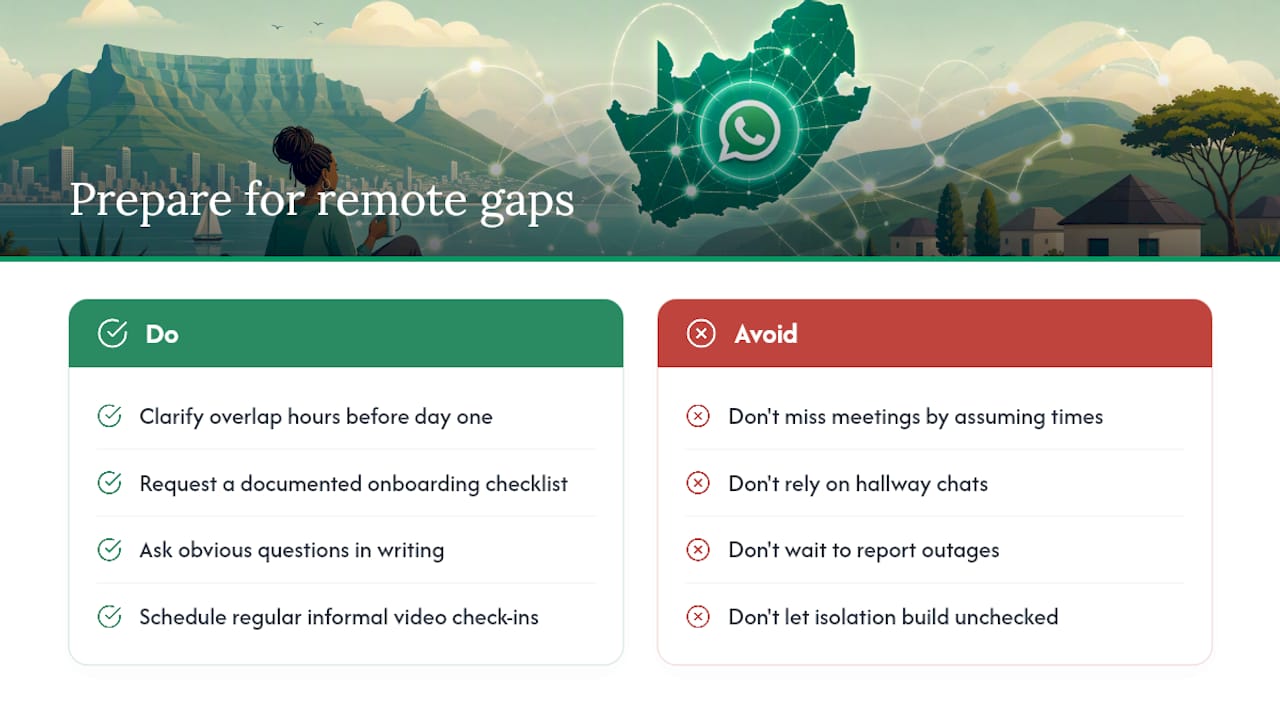
Time zone friction is common when your employer sits several hours ahead or behind you. Clarify overlap hours before your first day, not after you’ve missed three morning meetings.
Onboarding without a physical office can feel disorienting. Ask for a documented onboarding checklist and don’t hesitate to ask “obvious” questions in writing, since there’s no hallway conversation to catch what you missed.
Isolation creeps in faster than people expect, even for naturally independent workers. Building in regular video check ins, even informal ones, helps more than most new hires assume going in. News24’s reporting on overseas hiring trends notes that South Africans are increasingly competing for these roles against a global applicant pool, which means the polish you bring in your first month matters more than it might at a local job.
Equipment and connectivity gaps are a real risk during load-shedding or fibre outages. Have a backup plan, a mobile hotspot, a co-working space nearby, before you need it in a crisis.
Author perspective: what actually moves the needle
Most remote job search advice treats every listing the same. It shouldn’t. The occupation-first method works because it filters out noise before you waste an application on a role that was never going to consider a South African applicant anyway. FindJobsZA’s remote jobs category exists precisely for that filtering: browse by city or category with no CV upload and no sign-up wall standing between you and the actual listing, and let the daily WhatsApp alert do the tedious scanning for you.
— Nkosi
Start your remote job search on FindJobsZA today
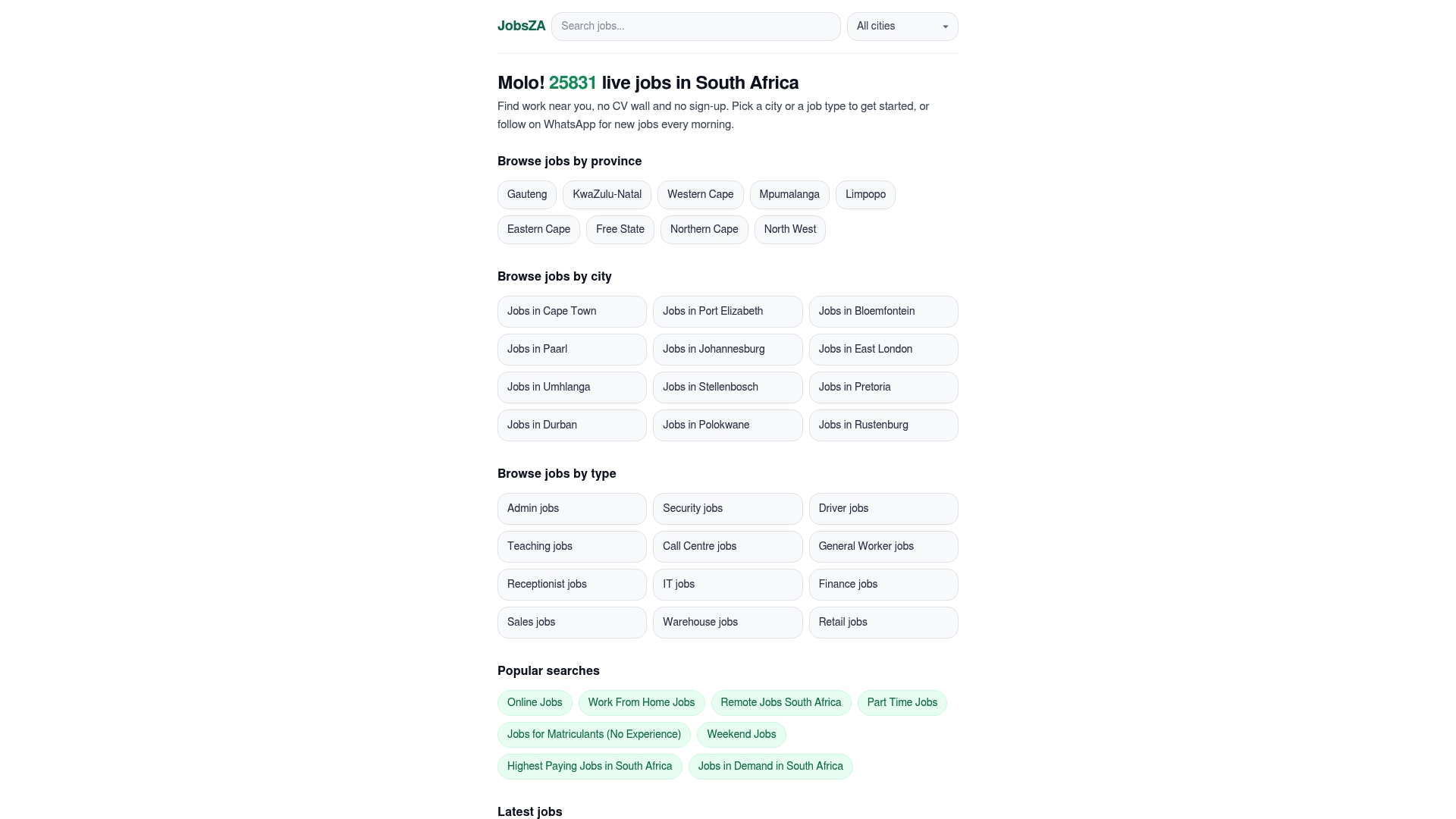
FindJobsZA cuts out the two biggest frictions in a remote job search: forced sign-ups and endless CV re-uploads for every application. You browse the remote jobs category by city or type, see what’s genuinely open to South African applicants, and apply directly.
The daily WhatsApp alert means you’re not the fortieth applicant by the time you see a posting, you’re often one of the first. If IT isn’t your lane, the online jobs category covers a wider spread of remote-friendly roles across finance, admin, and marketing. Set up your alerts now and let tomorrow morning’s listings come to you instead of the other way around.
Sources
- Remote jobs surge in South Africa, but Africa ranking tells another story
- Pnet July 2026: Remote work goes mainstream in South Africa
- South African work visas: An employer’s guide 2026 | MJ Kotze Inc
- How do I obtain work permit
FAQ
What is the easiest remote job to get hired for?
Customer support and virtual assistant roles tend to have the lowest barrier to entry since they need reliability and basic software skills more than specialized credentials, though entry-level admin roles come close.
Can I work remotely from South Africa?
Yes. Remote vacancies advertised to South African candidates have grown substantially, with Pnet reporting a 28% increase in the first half of 2026 compared to the same period a year earlier.
Which site can I use to get remote jobs?
FindJobsZA’s remote jobs category lists current remote and work-from-home vacancies by city and type with no sign-up required, alongside global boards like LinkedIn and company career pages.
Can I work remotely for a US company from South Africa?
Yes, and it’s increasingly common, but clarify upfront whether you’ll be treated as a contractor or an employee, since that determines your tax obligations and whether visa rules like the Remote Work Visitor Visa apply to your situation.
Recommended
Start with your city.
24 646 live jobs, filtered by city and suburb. No sign-up wall, no CV upload just to look.