R35,000 vs R70,000–R90,000: Remote Work Salary Benchmarks for South Africa
31 August 202612 min read

Contents11 sections
- 1Table of Contents
- 2What determines your remote work salary
- 3Remote salary ranges by role and experience level
- 4How currency and contract type change your take-home pay
- 5Where to find remote roles and how to read the listing
- 6Negotiating better remote pay
- 7Why this guide holds up and how Findjobsza fits in
- 8The best remote pay right now goes to specific, provable skills
- 9Sources
- 10FAQ
- 11Recommended
R35,000 vs R70,000–R90,000: Remote Work Salary Benchmarks for South Africa
Remote pay in South Africa varies widely, generally starting from modest monthly amounts for entry-level administrative and support roles up to significantly higher figures for senior software, cloud, and product positions paid by international employers. The single biggest swing factor is who pays you: a local company on ZAR payroll, or a US or European employer paying in USD, GBP, or EUR. Skill level matters almost as much. The role-by-role bands below show where you likely sit and what it takes to move up.
TL;DR:
- International employers pay remote South Africans significantly more, often in USD or EUR, resulting in higher gross salaries compared to local pay, especially at senior or specialized levels.
- Benefits such as medical aid, retirement, and paid leave are typically included in local roles but usually absent in foreign contractor agreements, requiring South Africans to budget for these themselves.
- Certain skills like cloud infrastructure, cybersecurity, senior software development, and product management command the highest premiums due to global demand and scarcity.
- Salary ranges can vary by 40 percent for the same role based on the hiring company’s location, currency, and whether the position is contract or permanent.
- To maximize remote pay, South Africans should benchmark roles across multiple sources, focus on documenting results, and negotiate total compensation including currency and benefits protections.
Table of Contents
- What determines your remote work salary
- Remote salary ranges by role and experience level
- How currency and contract type change your take-home pay
- Where to find remote roles and how to read the listing
- Negotiating better remote pay
- Why this guide holds up and how Findjobsza fits in
- The best remote pay right now goes to specific, provable skills
- Sources
- FAQ
What determines your remote work salary
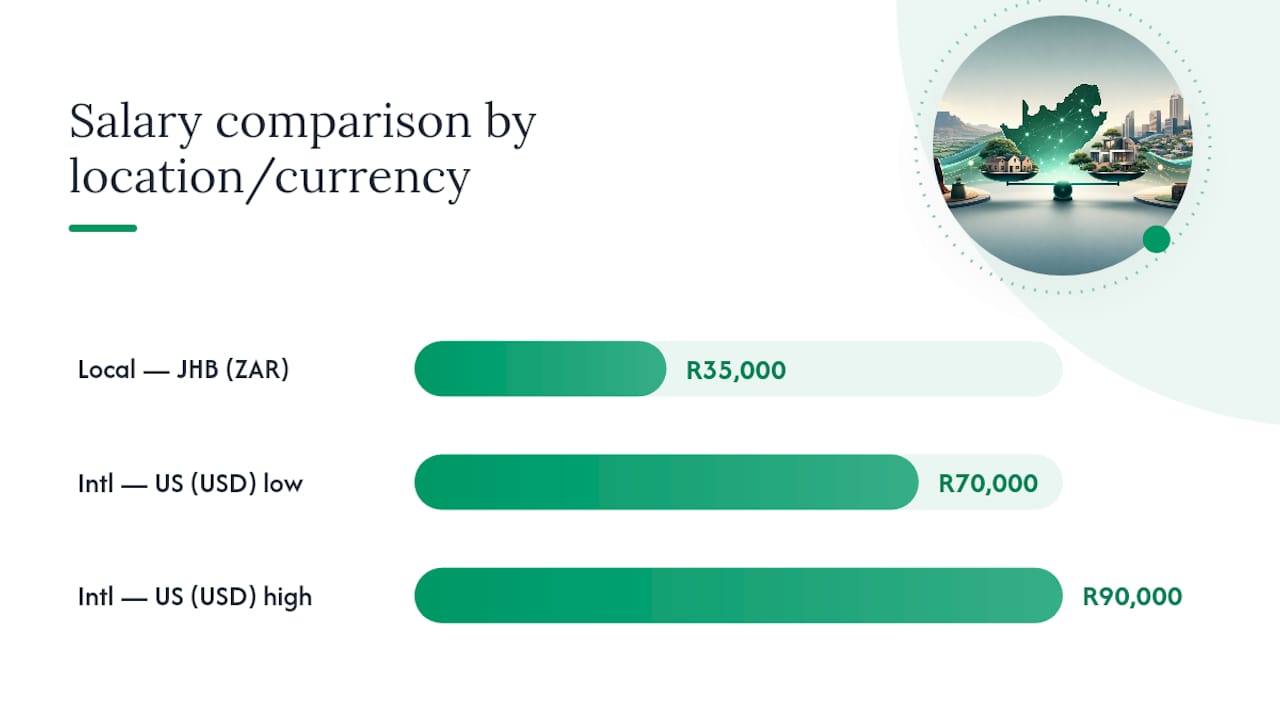
The employer’s location and currency drive more variance in remote pay than almost anything else. A backend developer earning R35,000 a month from a Johannesburg fintech might pull in the equivalent of R70,000 to R90,000 from a US SaaS company paying in dollars, according to Hirezar’s remote job salary guide for South Africa. That gap exists because international employers benchmark pay against their own labor market, not South Africa’s, and the exchange rate does the rest.
Contract type changes the picture again. A permanent local role usually comes with medical aid contributions, retirement fund matching, and paid leave baked into the offer. A contractor agreement with a foreign company rarely includes any of that. The headline number looks bigger, but you’re covering your own benefits, so the real comparison has to account for what’s missing, not just the gross figure.
Experience and specialization create their own premium on top of the currency effect. A junior developer and a senior cloud architect might both work for the same international employer, yet the pay gap between them often runs three to four times wider than it would in a typical local role, because global demand for scarce skills pushes senior technical pay up faster than junior pay.
Where the biggest premiums show up right now:
- Cloud and DevOps (AWS, Azure, Kubernetes experience) command some of the highest remote rates, since global demand for infrastructure skills outstrips supply.
- Cybersecurity specialists, especially those with cloud security or compliance experience, see similar demand-driven premiums.
- Senior software engineering, particularly in backend systems and platform work, pays well above general development roles.
- Product management with a track record of shipping features for international teams draws strong offers, since it’s a harder skill to hire for locally.
- Digital marketing specialists with paid media or SEO expertise increasingly command international rates too, as Pnet’s 2026 report found remote growth spreading well beyond IT into marketing, finance, and sales.
One thing that trips people up: earning in foreign currency doesn’t exempt you from South African tax obligations. If you’re a tax resident, you generally still owe tax on worldwide income, and contractors are usually required to register as provisional taxpayers with SARS. It’s worth getting proper advice on your specific situation before you sign anything, since the details depend on residency status and how the contract is structured.
Remote salary ranges by role and experience level
These monthly ZAR ranges come from a mix of local job-posting data and international remote listings, so read them as a realistic spread rather than a single fixed number. Where a figure reflects a role commonly paid in USD by a foreign employer, that’s flagged in the notes.
| Role | Junior (monthly ZAR) | Mid-level (monthly ZAR) | Senior (monthly ZAR) | Notes |
|---|---|---|---|---|
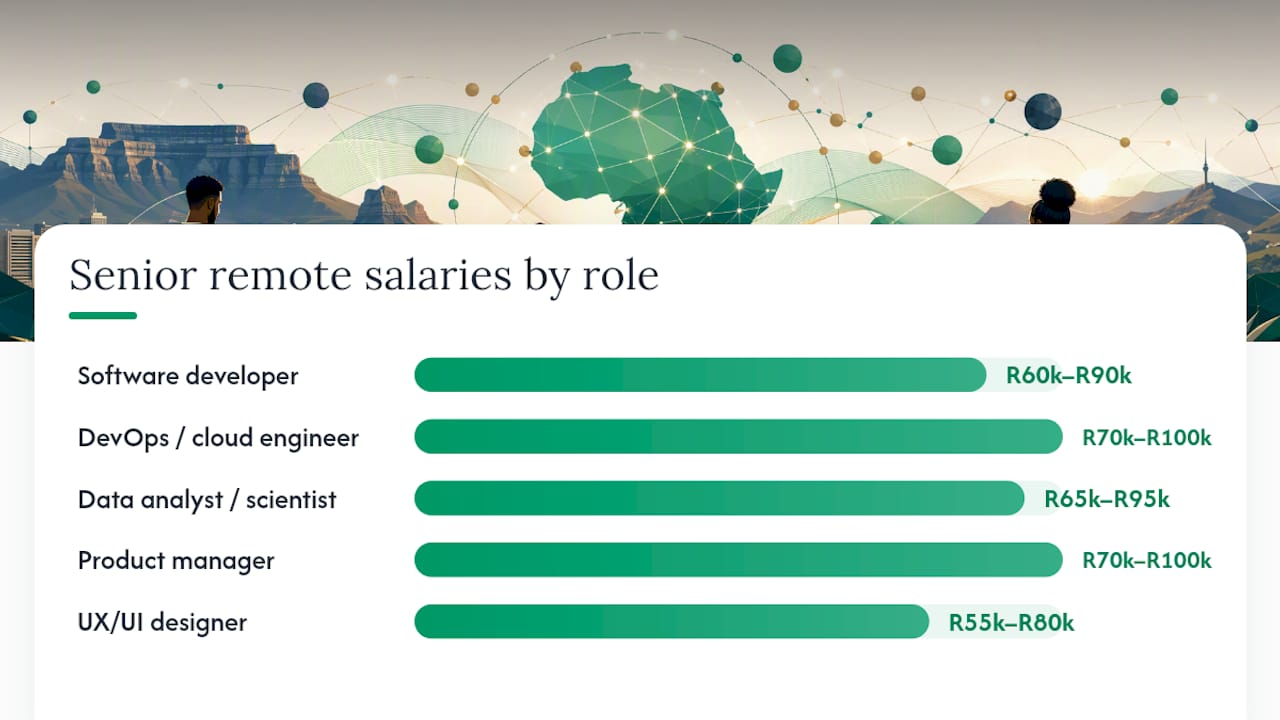
| Software developer | R18,000–R30,000 | R35,000 | R60,000–R90,000 | Senior figures often reflect USD-paying international employers |
| DevOps / cloud engineer | R25,000–R38,000 | R45,000–R65,000 | R70,000–R100,000 | Strong premium for AWS/Azure certifications |
| Data analyst / data scientist | R20,000–R32,000 | R38,000–R58,000 | R65,000–R95,000 | Wider range when working with international teams |
| Product manager | R25,000–R38,000 | R45,000–R65,000 | R70,000–R100,000 | Senior roles often USD-denominated |
| UX/UI designer | R18,000–R28,000 | R32,000–R48,000 | R55,000–R80,000 | Portfolio quality drives most of the spread |
| Digital marketing specialist | R14,000–R22,000 | R25,000–R40,000 | R45,000–R65,000 | Paid ads and SEO skills push toward the top end |
| SEO specialist | R13,000–R20,000 | R23,000–R35,000 | R40,000–R55,000 | Agency and in-house roles vary significantly |
| Paid ads / PPC specialist | R14,000–R22,000 | R26,000–R40,000 | R42,000–R60,000 | Performance track record matters more than tenure |
| Sales (remote, commission-heavy) | R10,000–R18,000 base | R18,000–R28,000 base | R25,000–R40,000 base | Commission often doubles base pay; check remote sales listings for structure |
| Customer support | R8,000–R14,000 | R15,000–R22,000 | R23,000–R32,000 | Multilingual and technical support roles trend higher |
| Virtual assistant | R7,000–R12,000 | R13,000–R18,000 | R19,000–R26,000 | Often paid hourly by international clients |
These bands are midpoints, and Sentinel Staffing’s 2026 payscale report notes that real offers often swing 10 to 15 percent above or below depending on industry, company size, and benefits included. Self-reported figures from platforms like Arc sometimes run higher than posting-derived data because they skew toward developers already placed with international clients, so treat any single source as one data point rather than gospel.
Aggregated listings from Himalayas show similar dispersion. Two people with the same job title and similar experience can land 40 percent apart in pay purely based on who’s hiring, which is exactly why checking multiple sources before you negotiate matters more than memorizing one number.
How currency and contract type change your take-home pay
A $3,000 monthly offer from a US employer sounds enormous until you actually convert it. At an example rate of R18.50 to the dollar, that’s roughly R55,500 gross, before you’ve accounted for anything the offer doesn’t include.
Pro Tip: Before you compare a foreign offer to a local one, add back what’s missing. Medical aid, retirement contributions, and paid leave can easily be worth R8,000 to R15,000 a month in a local package. A USD offer that looks 40 percent higher might only be 20 percent better once you price those in.
Contractor arrangements shift more of the financial planning onto you:
- No employer medical aid contribution, so budget your own cover into your rate.
- No retirement fund matching, which means a private retirement annuity comes out of gross pay, not on top of it.
- No paid leave. Unpaid time off is real lost income, so factor an annual buffer into your day rate.
- Provisional tax registration with SARS is typically required once you’re earning as a contractor rather than an employee.
For receiving payments, Wise and Payoneer are widely used by South African remote workers because they generally beat traditional bank wire fees on currency conversion, while some employers use an Employer of Record service like Deel to handle payroll and benefits formally, according to Hirezar’s guide on USD-paying remote jobs. Whichever method you choose, check the actual conversion spread before assuming the advertised rate is what lands in your account.
Where to find remote roles and how to read the listing
Finding the right listing takes less time once you know what to filter for and what a posting’s fine print actually tells you.
- Start with a dedicated remote category rather than scrolling general listings. Findjobsza’s remote jobs section tags roles by city, sector, and type, so you’re not wading through on-site postings by accident.
- Check the currency field first. A listing quoting pay in USD or GBP is almost always an international employer; ZAR figures usually mean a local company, even if the role is remote-friendly.
- Look for timezone language. Phrases like “core hours 2pm to 6pm SAST” or “must overlap with EST” tell you whether you’re dealing with a US, UK, or Europe-based team, which affects both your schedule and your likely pay band.
- Note contractor versus permanent status. This single detail changes whether benefits are included and whether tax withholding is handled for you.
- Ask before accepting: what currency you’re paid in, whether there’s a benefits allowance, and how often pay gets reviewed against inflation or exchange-rate shifts.
For entry-level or part-time options, the work-from-home category tends to surface roles with lower experience barriers.
Negotiating better remote pay
Most people undersell themselves in remote negotiations because they lead with years of experience instead of outcomes. International employers respond better to concrete results: a portfolio piece, a metric you improved, a system you built. Lead with that.
Ask directly for currency protection where you can. If you’re paid in ZAR by a company billing international clients in USD, a clause tying periodic review to exchange-rate movement or inflation protects you from quietly losing value over a year of Rand depreciation.
Pro Tip: If you’re pricing contractor work, calculate both an hourly and a monthly-equivalent rate before you quote anything. A day rate that looks generous can work out worse than a salaried offer once you subtract unpaid gaps between contracts.
A few negotiation habits worth building:
- Bring specific, quantified results to the conversation, not a general pitch about your skills.
- Document your internet reliability and backup power setup. Employers increasingly screen for this given load-shedding’s impact on remote reliability, and showing you’ve solved for it removes a real hiring objection.
- If you’re in sales, ask specifically how commission is structured and capped. A resource like AI-driven sales coaching can help sharpen the call performance that variable pay actually rewards.
- Prefer monthly salary over day rate when the work is steady and ongoing; day rates only pay off when you can consistently fill your calendar.
Why this guide holds up and how Findjobsza fits in
These benchmarks pull from job-market data and salary reporting rather than guesswork, cross-checked against multiple sources so no single dataset skews the picture. Recruitment analysts tracking the shift note that remote hiring in South Africa is increasingly skill-based rather than location-based, which is exactly why the role-level detail matters more than a single national average ever could.
Findjobsza was built around a simple frustration: job boards that make you register, upload a CV, and wade through irrelevant listings before finding anything real. There’s no sign-up here. You browse by city, sector, or job type directly, and if you want new listings without checking the site daily, WhatsApp alerts land every morning. The remote jobs section tags salary information where employers disclose it, which is the fastest way to see current bands rather than relying on averages alone.
The best remote pay right now goes to specific, provable skills
The clearest pattern in remote hiring isn’t really about “remote” at all. It’s about which skills international employers are short of, and cloud infrastructure, security, and senior product work sit at the top of that list right now. Generalists get generalist pay regardless of where they sit; specialists get paid for scarcity, and that scarcity is what international employers are willing to pay a currency premium for.
What surprises people is how much of the pay gap comes down to documentation, not talent. Two developers with similar skills can land wildly different offers because one showed up with a portfolio of measurable outcomes and a clear story about reliability, and the other showed up with a CV.
A short checklist worth working through before you apply anywhere:
- Benchmark your role against at least two sources, not one.
- Build or update a results-focused portfolio, even a simple one.
- Set up Wise or Payoneer before you need it, not after an offer lands.
- Apply through roles that explicitly tag currency and timezone, not vague “remote” listings.
- Negotiate total compensation, not just the headline number.
— Nkosi
Sources
- Pnet job market report for July 2026: remote work goes mainstream (Bizcommunity)
- Software engineer salary in South Africa (Arc)
- Remote employee salary snapshots (Himalayas)
FAQ
Can I work remotely for a US company from South Africa?
Yes. Many US companies hire South African contractors and employees directly, usually paying in USD via services like Wise, Payoneer, or an Employer of Record such as Deel.
Can I work remotely from South Africa in general?
Yes, and demand has grown fast. Pnet reported a 28% increase in remote vacancies in the first half of 2026 compared to the same period in 2025, with growth spreading into finance, marketing, sales, and admin roles beyond IT.
How can I work online and get paid in South Africa?
Register with international payment platforms like Wise or Payoneer before applying, since most foreign employers expect you to have a receiving method ready. If you’re contracting rather than employed, you’ll typically need to register as a provisional taxpayer with SARS.
How do I make R500 a day working remotely from home?
R500 a day is achievable through freelance work in virtual assistance, customer support, or entry-level digital marketing, particularly when paid by an international client at foreign-currency rates. Check listings on platforms like Findjobsza’s online jobs category for current freelance and part-time rates in your field.
Recommended
Start with your city.
24 497 live jobs, filtered by city and suburb. No sign-up wall, no CV upload just to look.