Skills based hiring in South Africa: a practical guide
29 July 202614 min read

Contents16 sections
- 1Table of Contents
- 2What does skills based hiring actually mean?
- 3Why skills based hiring matters in South Africa right now
- 4How South African employers can implement skills based hiring
- 5How jobseekers can show skills without a CV
- 6Which assessment methods actually predict job success?
- 7How to measure success and stay compliant
- 8Common pitfalls and how to avoid them
- 9Two quick checklists to get started
- 10How Findjobsza supports skills-first applications in South Africa
- 11Key takeaways
- 12Why this shift is overdue in South Africa
- 13Start posting and applying on Findjobsza today
- 14Useful sources and further reading
- 15FAQ
- 16Recommended
Skills based hiring in South Africa: a practical guide
Skills based hiring prioritises what a person can do over where they studied — and for South African employers, it offers a practical path to meeting B-BBEE and Employment Equity Act goals while opening doors for jobseekers who don’t have a traditional CV. The approach replaces degree filters with assessed capability: work samples, structured tasks, and role-specific tests that reveal whether someone can actually do the job. Employers can start small, running an 8–12 week pilot on one role type. Jobseekers can apply on Findjobsza right now with a two-line pitch and one work sample, no CV or sign-up needed.
Table of Contents
- What does skills based hiring actually mean?
- Why skills based hiring matters in South Africa right now
- How South African employers can implement skills based hiring
- How jobseekers can show skills without a CV
- Which assessment methods actually predict job success?
- How to measure success and stay compliant
- Common pitfalls and how to avoid them
- Two quick checklists to get started
- How Findjobsza supports skills-first applications in South Africa
- Key takeaways
- Why this shift is overdue in South Africa
- Start posting and applying on Findjobsza today
- Useful sources and further reading
- FAQ
What does skills based hiring actually mean?
Competency-based recruitment shifts the hiring filter from credentials to evidence. Instead of screening for a degree or a specific number of years on a CV, you define the outcomes the role must deliver, map the skills required to hit those outcomes, and then assess candidates directly against those skills.
The difference in practice is significant. A credential-based process asks: Does this person have a BCom? A skills-first process asks: Can this person reconcile a set of accounts under time pressure? One is a proxy. The other is the actual test.
“Just because someone has a degree does not necessarily mean they possess the capabilities to excel in a role. And on the flip side, there are thousands of talented young people with the right attitude and potential who never even get through the door because they do not tick that box.” — Genevieve Pretorius, ATI
The typical flow looks like this: source broadly (remove degree gates) → assess with role-specific tasks → validate with structured scoring → onboard with a development plan built in from day one.
Why skills based hiring matters in South Africa right now
South Africa’s unemployment rate reached 34.4 percent in 2021, with more than 60 percent of those unemployed aged 18–35. Yet critical skills shortages persist across IT, finance, and administration simultaneously. That contradiction is partly a matching problem: rigid credential filters exclude capable people who simply took a different path.
Two policy frameworks make this more than a talent strategy. The B-BBEE scorecard and the Employment Equity Act both reward measurable progress on workforce transformation. Removing degree requirements widens candidate pools in ways that make transformation objectives more practical to hit and easier to report on.
Sector adoption is uneven but accelerating. Tech and digital roles led the shift, with portfolios and mini-projects replacing interview-only screening. Finance and admin are following. Entry-level roles are now a major growth area, particularly for employers willing to hire at 60–70% of required skills and upskill the rest.
The barrier is cultural, not technical. HR experts describe a persistent say–do gap: organisations publicly commit to skills-first hiring while their applicant tracking systems still filter on degree fields. Even well-intentioned teams keep automated credential gates running because nobody has redesigned the workflow.
“Too many companies still use qualifications as a shortcut for screening. It is old-school thinking.” — Genevieve Pretorius, ATI
How South African employers can implement skills based hiring
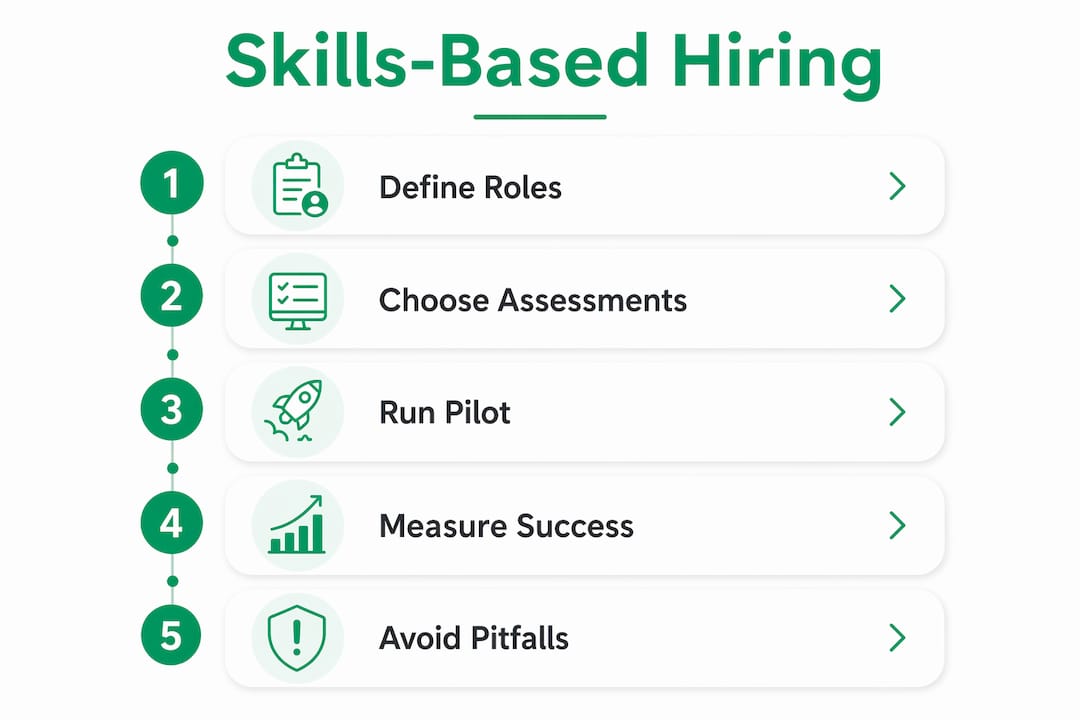
Step 1: redefine roles as outcomes
Write a one-page role map before you touch the job advert. List three to five outcomes the person must deliver in their first 90 days, then map the technical and behavioural skills each outcome requires. This document drives everything else: the advert, the assessment, and the onboarding plan.
Before (credential-based): “BCom degree required. Minimum 3 years’ experience in accounts payable.”

After (skills-focused): “Process 150+ supplier invoices weekly with less than 0.5% error rate. Comfortable with Xero or similar. Able to flag discrepancies and escalate clearly.”
Step 2: choose your assessment mix
| Assessment type | Predictive value | Practical for volume? | Cost to run |
|---|---|---|---|
| Work sample / practical task | High | Yes | Low |
| Structured interview with scorecard | High | Yes | Low |
| Short paid trial (1–3 days) | Very high | Limited | Medium |
| Psychometric / aptitude test | Moderate | Yes | Medium |
| Unstructured interview | Low | Yes | Low |
Work samples and structured tasks are the most reliable predictors of on-the-job performance. Unstructured interviews feel efficient but introduce the most bias.
Step 3: run a pilot
A focused pilot on one role type is lower risk than a full process overhaul.
- Pick a role with clear, measurable outputs (admin, sales, IT support).
- Design a 45–60 minute practical task with a scoring rubric.
- Recruit a cohort of 10–15 candidates assessed purely on task performance.
- Track 90-day performance, retention, and manager satisfaction.
- Report results to leadership with a recommendation to scale or adjust.
Pro Tip: Map your existing workforce before hiring externally. Internal redeployment often surfaces candidates who already know the business and can hit productivity faster than external hires.
How jobseekers can show skills without a CV
You don’t need a formal CV to demonstrate capability. What you need is evidence: something a hiring manager can look at and say, “Yes, this person can do the work.”
Build a simple evidence pack:
- One-line project descriptions: what you did, what tool or method you used, what the outcome was.
- Screenshots, links, or photos of completed work (a spreadsheet, a social media post, a repaired item, a customer message you handled).
- Short courses or badges from platforms like Coursera, Google, or Umuzi — even a free certificate counts.
- Volunteer work or community projects described in outcome terms, not job-title terms.
Sector-specific quick tips:
- Admin: Share a sample schedule, a formatted document, or a data entry exercise you completed.
- Sales: Describe a situation where you persuaded someone — a customer, a colleague, a supplier — and what happened.
- IT: Link to a GitHub repo, a completed course project, or a screenshot of a system you configured.
- Security: Note any relevant training, a PSIRA registration number, or a short description of an incident you handled correctly.
Pro Tip: When applying via WhatsApp or a short form, lead with your pitch in two sentences: what you can do and one result you’ve achieved. Then add one link or attachment as proof. Keep it under 100 words.
Findjobsza lets you browse admin jobs and apply directly without uploading a CV, which means your two-line pitch and one sample are all you need to get in front of an employer.
Which assessment methods actually predict job success?
Ranked by predictive validity for South African hiring contexts:
- Work samples — the candidate completes a real task from the role. Highest signal, lowest bias.
- Structured interviews — every candidate answers the same questions, scored against the same rubric. Removes the “likability” variable.
- Short paid trials — one to three days of actual work. Expensive to run at volume but near-perfect signal for senior or specialist roles.
- Psychometrics and aptitude tests — useful for roles requiring specific cognitive profiles; less useful as a standalone filter.
- Unstructured interviews — lowest predictive validity; rely on gut feel and are the most common source of bias.
Running a 1-hour practical task:
- Write a brief that mirrors a real work scenario (not a trick question).
- Set a clear time limit and consistent instructions for every candidate.
- Score on a rubric with three to five criteria, each rated 1–4.
- Have two scorers review independently, then align.
Pro Tip: For IT roles, a short coding or troubleshooting task beats any interview question. For sales roles, a role-play scenario with a standardised brief reveals more in 15 minutes than an hour of conversation.
How to measure success and stay compliant
Track these metrics from the first pilot cohort:
| Metric | What to measure | Reporting cadence |
|---|---|---|
| Time-to-hire | Days from advert to offer | Per cohort |
| Quality-of-hire | 90-day manager performance rating | 90 days post-start |
| Diversity mix | EE category breakdown of hires | Per cohort |
| Retention rate | % still employed at 6 months | 6-month mark |
| Redeployment rate | Internal fills vs. external hires | Quarterly |
For B-BBEE and Employment Equity reporting, keep a record of every assessment used, the scoring rubric, and the outcome for each candidate. Consistent, documented assessments are your legal defence if a hiring decision is challenged.
One compliance note: regulated professions — nursing, engineering, law — still require formal qualifications regardless of skills-first philosophy. For all other roles, documented assessments and scorecards are sufficient.
Common pitfalls and how to avoid them
The say–do gap is the most common failure mode. An organisation announces a skills-first policy, then nothing changes in the actual screening workflow because the ATS still filters on degree fields and hiring managers still default to CV-reading.
Common failures and fixes:
- Reverting to degree filters: Audit your ATS settings. Remove mandatory qualification fields from application forms.
- Unstructured interviews creeping back in: Make the scorecard non-optional. If a manager can’t score it, the interview didn’t happen.
- Poor onboarding for non-traditional hires: Skills-first hires need structured support — a buddy, a 30-60-90 day plan, and a manager who knows how to coach for potential, not pedigree.
- Tokenism: One skills-based hire in a credential-heavy team changes nothing. Pilot at cohort level, not individual level.
Pro Tip: Embed a short learning sprint (two to four hours per week) into the first 90 days for every skills-first hire. Continuous development built into daily work, not a one-off induction session, is what determines whether these hires stay.
Two quick checklists to get started
A: employer pilot launch checklist
- [ ] Role map completed (outcomes + skills, not job title + degree)
- [ ] Job advert rewritten to skills-and-outcome language
- [ ] Practical assessment task designed with scoring rubric
- [ ] Pilot cohort size set (10–15 candidates recommended)
- [ ] Two independent scorers assigned
- [ ] Stakeholder sign-off from HR and line manager
- [ ] 90-day performance tracking set up
- [ ] Reporting metrics agreed (time-to-hire, quality-of-hire, diversity mix)
B: jobseeker skills evidence pack checklist
- Write a two-sentence pitch: what you can do + one result.
- Select two to three work samples (screenshots, links, documents, or descriptions).
- Add any short courses, badges, or certificates — even free ones count.
- Include a contact method: WhatsApp number or a direct link.
- Get one reference or testimonial, even from a community project or volunteer role.
- Test your pitch by reading it aloud. If it takes more than 30 seconds, shorten it.
Browse jobs in demand on Findjobsza to match your evidence pack to active roles before you apply.
How Findjobsza supports skills-first applications in South Africa
Findjobsza is built for exactly this kind of hiring. No CV uploads. No registration. No friction between a capable person and a live job listing.
Platform features:
- Browse by city, province, or job type — no account needed.
- WhatsApp job alerts delivered every morning with new listings.
- Simple apply options: send a WhatsApp message or click a direct apply link.
- Listings across full-time, part-time, freelance, and entry-level roles.
For employers — posting a skills-focused listing:
- Go to Findjobsza and select your role category.
- Write your advert in outcome language: “We need someone who can X and deliver Y.”
- State what evidence you want: a short task, a portfolio link, or a two-line pitch via WhatsApp.
- Receive direct applications without sifting through irrelevant CVs.
For jobseekers — applying without a CV:
- Find a role on Findjobsza that matches your skills.
- Prepare your two-sentence pitch and one work sample.
- Apply via the WhatsApp link or direct apply button.
- Findjobsza surfaces local matches by city and job type, so your application reaches the right employer.
Findjobsza is particularly useful for matriculants and early-career applicants who have skills but no formal work history to put on a CV.
Key takeaways
Skills based hiring works in South Africa when employers replace credential filters with documented assessments, and when jobseekers lead with evidence rather than qualifications.
| Point | Details |
|---|---|
| Replace credential filters | Remove degree gates from your ATS and rewrite adverts around outcomes and skills. |
| Use work samples first | Practical tasks and structured interviews predict performance better than CVs or unstructured interviews. |
| Pilot before scaling | Run an 8–12 week cohort of 10–15 candidates, track 90-day performance, then decide. |
| Jobseekers: lead with evidence | A two-sentence pitch plus one work sample is enough to apply on Findjobsza without a CV. |
| Findjobsza removes the barriers | Browse and apply by city or job type with no sign-up, no CV upload, and WhatsApp alerts daily. |
Why this shift is overdue in South Africa
South Africa keeps having the same conversation about youth unemployment and skills shortages, then defaulting to the same credential filters that created the problem. The say–do gap isn’t a mystery. It’s a process design failure, and it’s fixable.
What strikes me most about the evidence is how low the barrier to entry actually is for employers. You don’t need a new HR system or a six-month transformation programme. You need a role map, a one-hour practical task, and a scoring rubric. That’s a morning’s work. The organisations that have made this shift report faster productivity from new hires, lower turnover, and a candidate pool that looks more like the country they operate in.
Findjobsza fits into this because the platform removes the friction that kills skills-first hiring before it starts: no CV gate, no registration wall, no process that rewards people for having the right document rather than the right capability. For a matriculant in Soweto or a self-taught developer in Durban, that matters.
The employers who move first on this won’t just meet their Employment Equity targets. They’ll find people their competitors missed.
Start posting and applying on Findjobsza today
Findjobsza gives South African employers a faster, simpler way to reach skilled candidates without the CV pile. Post a skills-focused listing in minutes: write your outcome-based advert, state what evidence you want, and receive direct WhatsApp applications from candidates who can actually do the work. No sign-up required on either side.
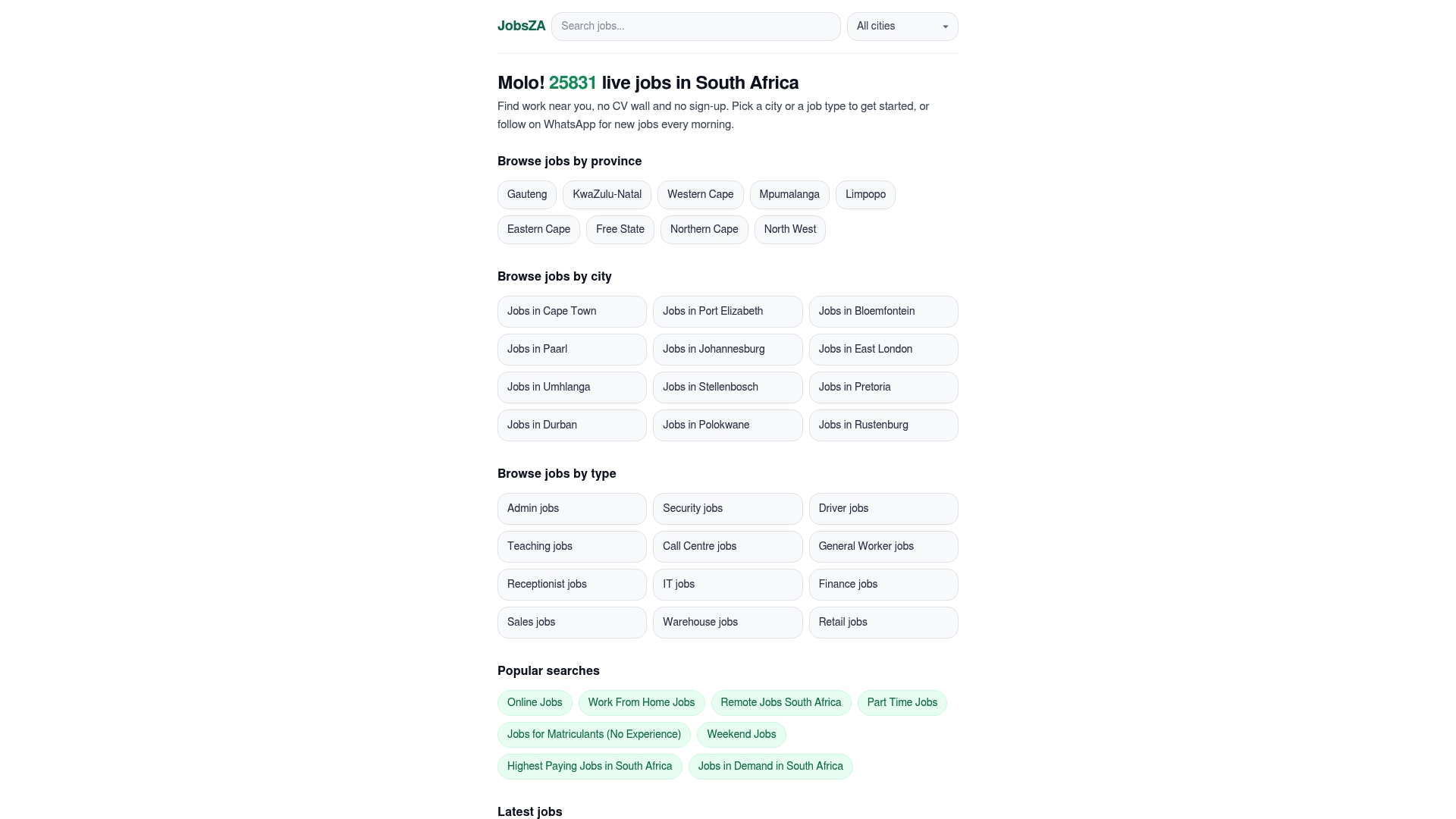
For jobseekers, the path is just as direct. Browse part-time and full-time roles across every major South African city, apply with a two-line pitch and one work sample, and get matched to local opportunities through daily WhatsApp alerts. Your skills are the application. Check in-demand roles on Findjobsza and apply today.
Useful sources and further reading
- Employment Equity Act — the primary legislation governing transformation targets and non-discrimination in South African hiring.
- B-BBEE Commission — official guidance on scorecard elements and how hiring practices affect transformation ratings.
- Harambee Youth Employment Accelerator — J-PAL research on skills-based matching for entry-level roles in South Africa, with evidence on what types of information improve firm-worker matches.
- HR Future — practical guidance on structured assessments and agility-focused hiring for South African HR teams.
- Bizcommunity / SAP insight — analysis of the say–do gap and why tech talent shortages are forcing the issue.
- Findjobsza — browse live South African vacancies by city or job type and apply without a CV or sign-up.
FAQ
What is skills based hiring?
Skills based hiring is a recruitment approach that assesses candidates on demonstrated capability — work samples, practical tasks, and structured interviews — rather than degrees or years of experience listed on a CV.
How does skills based hiring support B-BBEE and Employment Equity goals?
Removing degree requirements widens the candidate pool to include non-traditional talent, making transformation targets more measurable and achievable without compromising on role performance.
What assessment methods work best for South African employers?
Work samples and structured interviews with scoring rubrics are the highest-value methods. Short paid trials give the clearest signal for specialist roles, while unstructured interviews have the lowest predictive validity and the highest bias risk.
Can I apply for jobs on Findjobsza without a CV?
Yes. Findjobsza requires no CV upload and no registration. Apply with a two-line pitch and one work sample via WhatsApp or a direct apply link.
Which sectors in South Africa are adopting skills based hiring fastest?
IT and digital roles led adoption, followed by finance and administration. Entry-level positions across most sectors are now a major growth area for competency-based recruitment.
Recommended
Start with your city.
21 464 live jobs, filtered by city and suburb. No sign-up wall, no CV upload just to look.