Cost-Effective Hiring in South Africa: Free Tools and Smart Habits
29 October 202615 min read

Contents14 sections
- 1TL;DR
- 2Table of Contents
- 3What cost-effective hiring really costs
- 4Free public services that already exist
- 5Where to look for vacancies without wasting data
- 6Perspective: why we removed the CV upload and the sign-up
- 7What the law says about fees
- 8Spotting scams that cost you money
- 9A low-cost job search routine
- 10For employers: lower hiring cost without lower quality
- 11Find your next role on FindJobsZA
- 12FAQ
- 13Sources
- 14Recommended
Cost-Effective Hiring in South Africa: Free Tools and Smart Habits
Cost-effective hiring in South Africa means getting a good match for the least money, data and time, on both sides of the table. For job seekers, it means never paying to be considered and keeping the cost of applying low. For employers, it means reaching local candidates without a long, expensive process. This guide covers the free services that exist, the law on fees, a low-cost routine that works, and how to spot offers that are really scams.
TL;DR
- Job seekers should never pay for employment services. The Department of Employment and Labour says the Employment Services Act prohibits charging a work seeker a fee.
- Applying costs real money: a 2023 survey found respondents spent almost R1 500 on transport, data and applications. Data-free and no-sign-up tools cut that.
- Free state services such as ESSA, Labour Centres and SA Youth cover registration, matching, CV help and interview advice.
- Local, city-level searches and morning alerts save time and data compared with scrolling broad feeds.
- Any request for an upfront fee, “background check” payment or “shortlisting” charge is a red flag.
Table of Contents
- What cost-effective hiring really costs
- Free public services that already exist
- Where to look for vacancies without wasting data
- Perspective: why we removed the CV upload and the sign-up
- What the law says about fees
- Spotting scams that cost you money
- A low-cost job search routine
- For employers: lower hiring cost without lower quality
- Find your next role on FindJobsZA
- FAQ
- Sources
What cost-effective hiring really costs
Hiring has a price even when nobody sends an invoice. A candidate pays in taxi fares, mobile data, printing and travel to interviews. An employer pays in advert fees, hours spent screening unsuitable applications, and the cost of a wrong hire.
For the candidate, the number is not small. A 2023 Youth Capital survey found that respondents spent almost R1 500 on transport, data and applications while looking for work, as reported in a City of Cape Town statement on its Jobs Connect platform. That is a serious sum for someone without income.
For the employer, cost-effective hiring is less about the cheapest advert and more about fewer wasted steps. A role posted where local people actually look, with a clear title and a clear location, brings fewer irrelevant applicants. Our own advice on writing job titles goes into that in detail, because the title is usually the first filter a candidate applies.
The rest of this article works through the savings in order: free public services, data costs, the legal line on fees, a repeatable search routine, and the scams that exploit people who cannot afford to lose money.
Free public services that already exist
South Africa has a state job-matching system that costs the work seeker nothing. It is worth using alongside any private board, because it adds a human referral on top of a listing.
ESSA and Labour Centres
The Employment Services system of South Africa, known as ESSA, is a computerised job-matching system run by the Department of Employment and Labour. According to the Department’s guide to finding a job, you register your contact details, skills, qualifications and work experience, either at a Labour Centre or online. Employers list their opportunities, and employment officials refer eligible job seekers to them. The matching service and employment counselling, including CV-writing and interview advice, are free.
The Department also lists work-seeker services that include psychometric assessments and employability programmes such as CV-writing and interview preparation. If you have never had a formal interview, that preparation alone can save you several failed attempts.
Not everyone can afford a computer at home. In 2022, the Department described how Employment Centres inside Labour Centres offer self-help kiosks giving access to its online services, including ESSA. Go in person with your ID, your qualifications and your latest CV, and ask what is available at your branch.

Youth-focused free tools
If you are between 15 and 34 and either South African or holding a Refugee ID, the SA Youth network lists job, volunteer, learnership, bursary and work-experience opportunities. Its mobi-site is free and data-free for young South Africans, and it has a toll-free line on 0800 727272 for anyone who needs advice or support.
Students looking for something that fits around lectures can start with our list of student job ideas, which sets out twelve options by how flexible the hours are.
Local government platforms
In Cape Town, the City’s Jobs Connect platform offers free registration, assessments and applications, and is data-free for MTN and Vodacom users as of 2026, according to the City’s announcement. If you live elsewhere, check your municipality’s and province’s own career pages, which the Western Cape Government also points to in its list of online resources for finding a job.
Where to look for vacancies without wasting data
The Western Cape Government’s list of online resources names a mix of national job sites, classifieds and social platforms, plus the DPSA Public Service Vacancy Circular for government posts and municipal and provincial career pages. It also recommends building a professional LinkedIn profile. That is a good map of the landscape, but it is also a lot of tabs on a prepaid data bundle.
A cheaper approach is to narrow the search before you start:
- Pick a city or province. A search for “admin jobs” across the whole country returns thousands of listings you cannot travel to. Our guide to searching jobs by province shows how to cut that down in three steps.
- Pick one or two job types. Browsing by category is faster than reading every ad.
- Check once a day, at a fixed time. New listings are the ones with the fewest applicants. Checking at random times wastes data on pages you have already read.
- Apply only where the requirements fit. Ten targeted applications beat fifty blind ones, both in results and in cost.
For reference, here is what a local search looks like on our site. Retail workers can look at retail jobs in Germiston or retail jobs in Alberton. Someone with warehouse or driving experience can check logistics jobs in Johannesburg or logistics jobs in East London. Office workers in the capital can browse admin jobs in Pretoria. Vacancy counts change daily, so open the page for the current number rather than relying on a figure in an article.
Perspective: why we removed the CV upload and the sign-up
We built FindJobsZA around one observation: most of the friction in a South African job search is not the job, it is the process around it. Create an account, upload a CV, verify an email, confirm a phone number, then do it again on the next site. Every step costs data and patience, and every extra form is another place where someone can collect your personal details.
So we do it differently. You browse by city, province or job type with no CV upload and no registration. You can have new listings sent to you on WhatsApp every morning, so you do not have to hunt for them. And because we are a local site, a search for Centurion or Jeffreys Bay shows you roles in Centurion or Jeffreys Bay.
That also answers a concern we hear a lot: job seekers worry about giving a CV to a stranger on a public group or a doubtful aggregator. If you do not have to hand over a CV to browse, there is simply less to lose. You decide which employer deserves your documents, after you have seen the role and the company.
Our advice is the same whichever site you use. Spend your money on getting to interviews, not on getting noticed. Everything that helps you get noticed should be free.
— Nkosi
What the law says about fees
The rules here are clear and worth knowing by heart, because scammers rely on people not knowing them.
On 5 February 2024, the Department of Employment and Labour stated that the Employment Services Act prohibits anyone from charging a work seeker a fee for employment services. The same statement says a private employment agency may not deduct placement-related amounts from an employee’s pay. It adds that the Department’s own Public Employment Services, which cover registering work seekers, matching them with vacancies and facilitating placements, must be provided free of charge. If you want a plain-language walk-through of the same principle in another sector, see this explanation of what agency fees are allowed.
Recruitment companies that offer permanent placement or temporary employment services also have to be registered. A Department publication says registration is branch-specific and that an application for registration is not the same as being registered. Before you give an agency your ID number and CV, ask for its registration details and confirm them with the Department.
The practical rule is short: a legitimate service gets paid by the employer, never by you.

Spotting scams that cost you money
A scam is the least cost-effective hiring outcome there is. You lose money and often personal information as well. Government departments have published specific examples.
- Upfront “background check” fees. On 11 July 2023 the Department of Health warned the public about messages demanding a refundable R250 background-check fee. It stated that government never charges a job-application or handling fee and told recipients not to pay.
- Paying to be shortlisted. For Project 20 000, the Department of Employment and Labour said on 17 March 2025 that applying was entirely free, that no agents or representatives had been appointed, and that requests for payment to be shortlisted or employed were scams.
- Requests for personal details too early. The Department’s February 2024 advice is not to pay recruitment-related fees or share personal information with unverified parties.
Social media is where many of these offers circulate. Our guide to hiring on Facebook in South Africa shows what a real post looks like and what a fake one gives away.
A quick check before you reply
| Question | Safe answer | Warning sign |
|---|---|---|
| Who pays? | The employer | You are asked for a fee of any size |
| Is there an interview? | Yes, phone, video or in person | Hired without speaking to anyone |
| Is the company traceable? | Named employer, real address and contact details | Only a WhatsApp number or a free email address |
| What do they ask for? | A CV and relevant qualifications | ID copy, bank details or a photo of your card before any offer |
| Is it a recruiter? | Registered with the Department | Cannot or will not give registration details |
Checking a remote job
Remote roles attract scammers because there is no office to visit. Apply the same table, then add three habits. Search the company name together with the word “scam”. Confirm the job is on the company’s own careers page, not only in a message sent to you. And never buy equipment, software or “training” before a signed contract exists. If any of these checks fails, walk away: a real remote employer can absorb the cost of onboarding you, and it is not your job to fund it.
A low-cost job search routine
Here is a plan that uses free services and keeps your data spend under control. Our job search checklist for South Africa expands each step.
- Prepare one strong CV once. Use the free CV advice from a Labour Centre if you need help. Keep it as a file on your phone so you never need to pay for printing or typing it again.
- Register on the free state systems. ESSA for general vacancies, and SA Youth if you are 15 to 34.
- Choose your area and categories. Two job types, one or two cities. Anything outside that is a distraction.
- Set up a daily alert. Morning WhatsApp messages mean you read new listings once, on your own schedule.
- Use your network. The Department of Employment and Labour says in its job-finding guide that networking is essential because most jobs are filled through word of mouth rather than advertisements. Tell former colleagues, teachers and neighbours exactly what role you want.
- Track every application. A simple note with the company, date and contact stops you applying twice and helps you follow up.
- Spend on interviews, not on applications. If you have limited money, keep it for the taxi fare to a confirmed interview.
Sectors worth checking first
The volume of vacancies differs by sector and city. Sales, retail, customer service, admin, logistics, driving, human resources and finance are the categories we list most. If you have a matric and customer-facing skills, look at customer service jobs in Centurion or call centre jobs in Bloemfontein. Graduates in education can browse teaching jobs in Cape Town, and those in people management can check human resources jobs in Centurion. Smaller towns have openings too, for example sales jobs in Grabouw, sales jobs in Jeffreys Bay and retail jobs in Louis Trichardt.
For employers: lower hiring cost without lower quality
If you are on the hiring side, the same principles apply in reverse. We cannot quote a universal cost-per-hire, because it depends on the role and the route, so use these levers instead.
- Advertise locally. A role in Brits should reach people in and around Brits. Candidates who can reach you cheaply are also more likely to stay.
- Write the advert as a filter. Give the exact job title, the town, the hours, the pay basis and the minimum requirements. A clear advert means fewer unsuitable CVs to read.
- Use free public matching. ESSA lets employers list opportunities, and officials refer eligible job seekers, at no charge to the work seeker.
- Never pass costs to the candidate. Charging work seekers is prohibited, and so are placement-related deductions from pay by private employment agencies. Using an unregistered agency also exposes your business.
- Judge the hire by the result. The cheapest process is not the one with the lowest advert fee, it is the one where the person is still doing well months later.
Employers who want to reach job seekers across South Africa’s cities and categories can post vacancies with us, and candidates then browse and apply directly with no sign-up barrier.
Find your next role on FindJobsZA
FindJobsZA is built for people who cannot afford a wasted search. You can browse by city, province or job type, apply directly without uploading a CV or creating an account, and get new listings on WhatsApp every morning. It costs job seekers nothing.
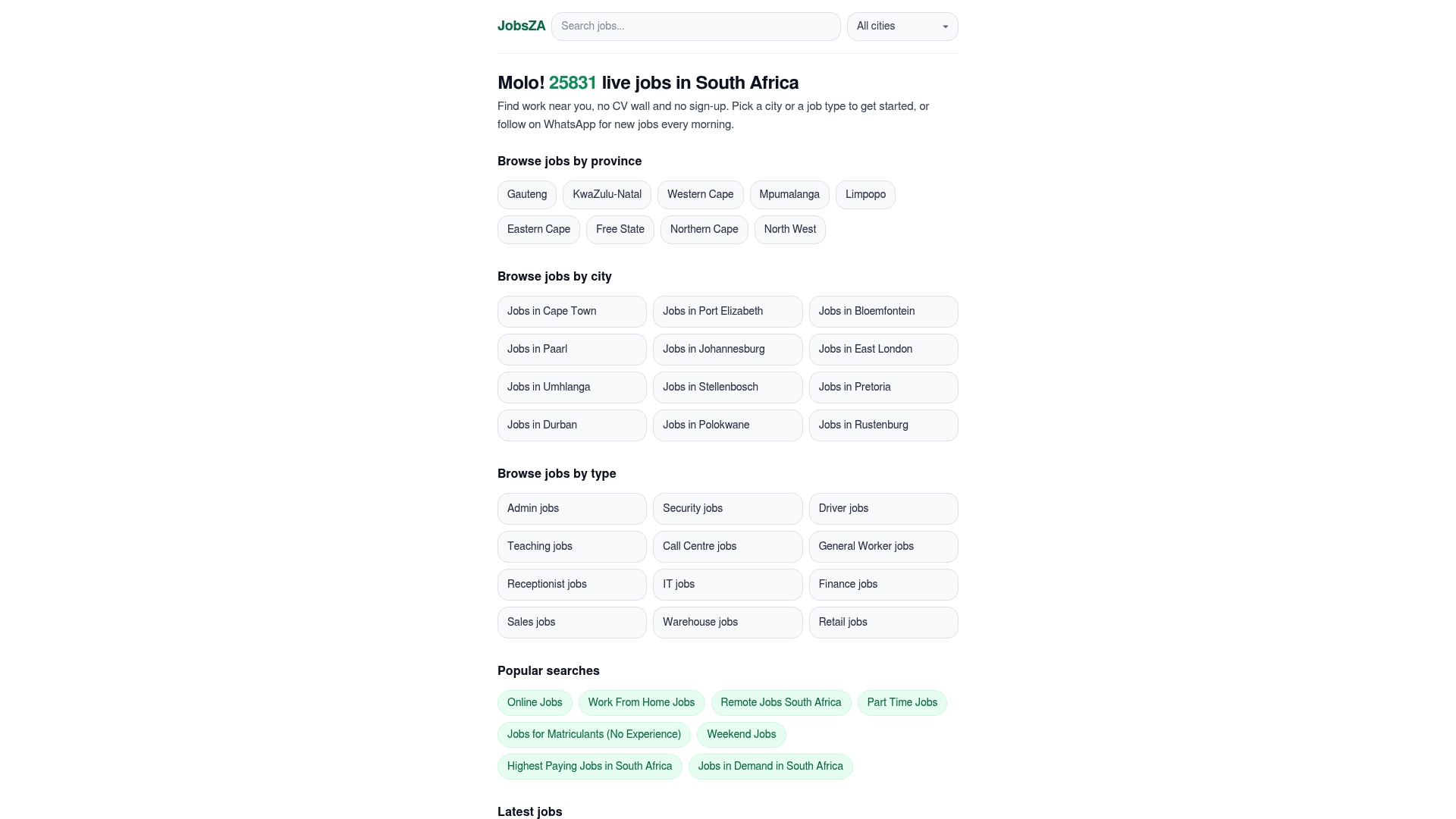
Start on the FindJobsZA homepage, pick your category, and narrow it to your city. If you are in Cape Town, the Cape Town listings are a good place to see how local pages work.
FAQ
Is it legal for a recruiter to charge me a fee?
No. The Department of Employment and Labour says the Employment Services Act prohibits anyone from charging a work seeker a fee for employment services. A private agency also may not deduct placement-related amounts from your pay. If someone asks you for money, report it to the Department.
How do I look for work without spending much on data?
Use data-free tools where they apply: the SA Youth mobi-site for ages 15 to 34, and Jobs Connect for Cape Town residents on MTN and Vodacom. Beyond that, search a single city and category once a day instead of browsing broadly. A morning WhatsApp alert also means you read only what is new.
Do I need to register or upload a CV to see jobs on FindJobsZA?
No. You can browse listings by city, province or job type without creating an account or uploading a CV. Send your CV only when you have found a role and an employer you want to apply to.
How can I tell whether a recruitment agency is genuine?
Ask for its registration details. The Department of Employment and Labour says agencies offering permanent recruitment or temporary employment services must be registered under the Employment Services Act, and registration is branch-specific. An application for registration is not proof that it is registered.
Where can young people find free opportunities?
The SA Youth network lists job, volunteer, learnership, bursary and work-experience opportunities for South Africans aged 15 to 34, as well as people with a Refugee ID. You can also ask a Labour Centre about free CV and interview support.
Sources
- City of Cape Town: Jobs Connect announcement
- Department of Employment and Labour: Finding a job
- Department of Employment and Labour: Public Employment Services
- NYDA: SA Youth Network
- Western Cape Government: Online resources to find a job
- South African Government: Employment and Labour on payment for job opportunities, 5 February 2024
- Department of Employment and Labour: recruitment agency registration
- South African Government: Project 20 000 applicants, 17 March 2025
- South African Government: Health warns public of job scam, 11 July 2023
- AuPairly: Au pair agency fees in South Africa
Recommended
Start with your city.
31 221 live jobs, filtered by city and suburb. No sign-up wall, no CV upload just to look.