Time to fill benchmark: 2026 ranges and how to act on them
17 August 202617 min read

Contents13 sections
- 1Table of Contents
- 2Time to fill benchmark: what the metric actually measures
- 3How to calculate time to fill (formula and worked example)
- 4Time to fill benchmarks by industry and seniority level
- 5What counts as a good time to fill for your organization
- 6Using the benchmark for workforce planning in 2025-26
- 7How to reduce time to fill without sacrificing quality
- 8Building your own defensible time-to-fill benchmark
- 9What experienced recruiters get wrong about speed
- 10Key takeaways for your next hiring-ops meeting
- 11Sources
- 12FAQ
- 13Recommended
Time to fill benchmark: 2026 ranges and how to act on them
Time to fill measures the calendar days between opening a requisition and a candidate accepting the offer. The current headline benchmark sits at a global median of roughly 38 days, though most organizations should expect a working range closer to 30-50 days depending on industry, seniority, and how tight the local labor market is for a given skill.
- Start and end events matter more than the number itself. SHRM’s benchmarking methodology counts from the day a requisition officially opens to the day a candidate accepts an offer, not the start date.
- The median beats the average for reporting. A single slow executive search can drag your average up by weeks; the median gives hiring managers a more honest picture of typical performance.
- Calculation differences make cross-company comparisons risky. One team’s “time to fill” starts at job posting; another’s starts at approval. Workable’s guidance flags this as the single biggest reason external benchmarks mislead internal planning.
The rest of this guide breaks down the formula, gives you real ranges by industry and seniority, and hands you a prioritized list of tactics that actually shorten the clock, plus a framework for building a benchmark that fits your organization instead of someone else’s.
Table of Contents
- Time to fill benchmark: what the metric actually measures
- How to calculate time to fill (formula and worked example)
- Time to fill benchmarks by industry and seniority level
- What counts as a good time to fill for your organization
- Using the benchmark for workforce planning in 2025-26
- How to reduce time to fill without sacrificing quality
- Building your own defensible time-to-fill benchmark
- What experienced recruiters get wrong about speed
- Key takeaways for your next hiring-ops meeting
- Sources
- FAQ
Time to fill benchmark: what the metric actually measures
Time to fill counts the calendar days from the moment a requisition opens to the moment a candidate accepts your offer. That is the operational definition most benchmarking bodies use, and it is worth memorizing because so many teams quietly redefine it to make their numbers look better.
It is easy to confuse with time to hire, but the two metrics answer different questions. Time to fill is organization-centric: it tells you how long a seat sat empty, which matters for capacity planning, budget forecasting, and telling a hiring manager when their new analyst will actually show up. Time to hire is candidate-centric: it measures how long your process takes from the moment a specific candidate applies to the moment they accept, which tells you about process friction rather than staffing capacity.
HR Dive’s breakdown uses a scenario that makes the distinction click: a role can have a genuinely fast, well-run interview process, say two weeks from application to offer, and still show a long time to fill if the requisition sat unposted for a month while legal reviewed the job description. The candidate experience was fine. The staffing gap was not.
A few measurement choices will quietly wreck your benchmark if you do not standardize them upfront:
- Calendar days vs. business days. Calendar days are the industry default and what most published benchmarks use, so mixing in business-day counts makes your numbers incomparable to everyone else’s.
- Pause rules. If a hiring manager freezes a search for three weeks over the holidays, do those days count? Decide once, document it, and apply it consistently.
- Reopened requisitions. A role that gets filled, has the hire fall through in week two, and gets reposted is not a fresh 0-day clock in most methodologies. Track it as a continuation unless your policy says otherwise.
- Multiple openings on one requisition. If you are filling five identical warehouse roles under one posting, decide whether time to fill closes at the first acceptance or the last, and stay consistent across cohorts.
How to calculate time to fill (formula and worked example)
The formula is simple: time to fill = offer acceptance date minus requisition open date, measured in calendar days. For a cohort of roles, you calculate the average by summing all individual time-to-fill values and dividing by the number of roles, and the median by ordering all values and taking the midpoint.
Here is why both numbers matter. Say you filled five marketing roles this quarter with these times to fill: 22, 28, 31, 35, and 89 days. The average comes out to 41 days, which looks concerning. The median, however, is 31 days, which is a far more honest reflection of what a typical marketing hire actually looked like. That one 89-day outlier, probably a niche specialist role that took months to source, skews the average badly. Recruiterflow’s glossary recommends reporting both figures side by side precisely so hiring managers see the full picture instead of one misleading number.
Before you start tracking, lock in these rules so every cohort is measured the same way:
- Define your start event in writing: requisition approval date, not job-posting date, is the more defensible choice because it captures internal delays too.
- Define your end event: offer acceptance date is the SHRM-recommended standard; some teams use start date instead, which inflates the number by adding notice periods.
- Pick calendar days as your default unit unless your industry standard specifically uses business days.
- Document your pause and reopen rules in a one-page policy so new recruiters apply them the same way six months from now.
- Decide how you will treat requisitions that get cancelled before filling. Most methodologies exclude them from time-to-fill cohorts entirely.
Time to fill benchmarks by industry and seniority level
Benchmarks vary enormously by industry and role level, and treating a single global number as your target is one of the fastest ways to set your hiring managers up for disappointment.
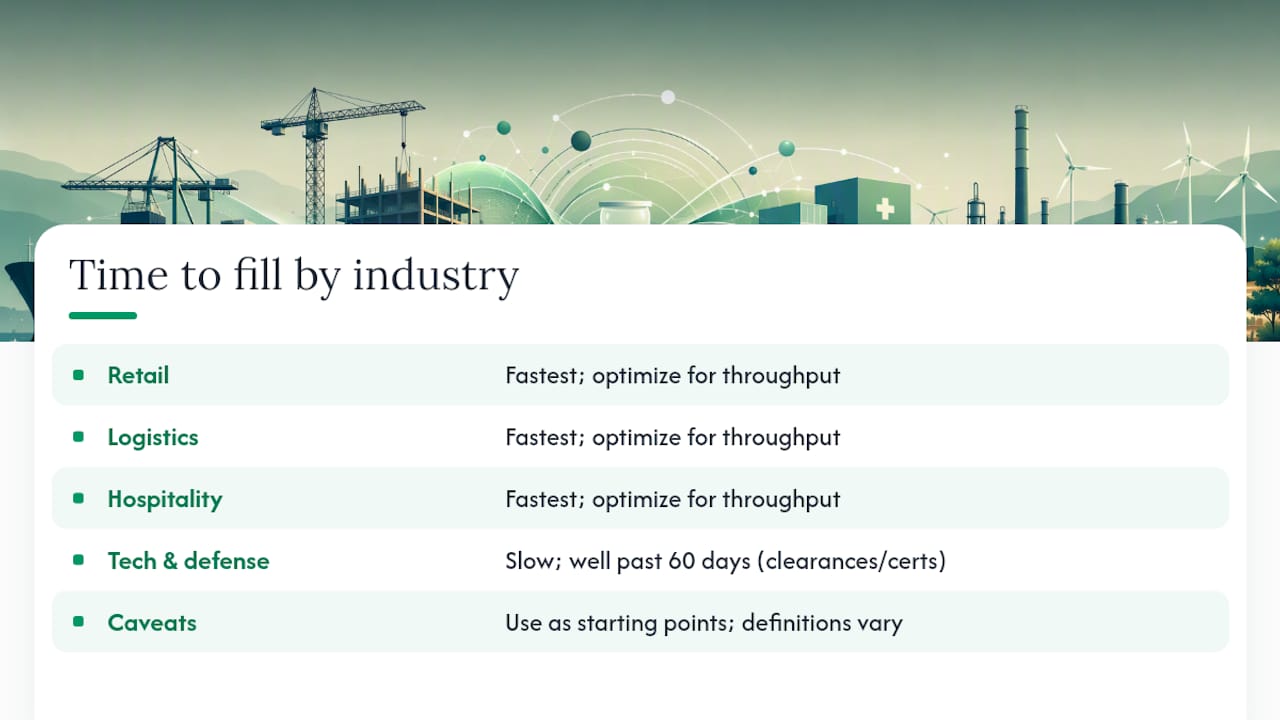
A few patterns are worth calling out beyond the table. Volume hiring in retail, logistics, and hospitality tends to move fastest because the role is well understood and the candidate pool is large; you are optimizing for throughput, not scarcity. Specialized technical and defense-adjacent roles sit at the other extreme, where security clearances, niche certifications, or a genuinely thin talent pool can push time to fill well past 60 days regardless of how efficient your interview process is.
Treat every figure in that table as a starting point, not gospel. Workable’s own guidance is blunt about this: differences in how organizations define start and end events mean two companies can report wildly different numbers for functionally identical hiring processes. Sample size and recency matter too. A benchmark pulled from data before 2020 will almost certainly understate how long hiring takes now, since labor-market shifts over the past several years have lengthened cycles for many mid-level and specialized roles.
What counts as a good time to fill for your organization
There is no universal “good” number; what counts as good depends on role complexity, hiring volume, and local labor market tightness.
A high-volume warehouse role filled in 20 days is unremarkable. A senior data scientist filled in 20 days, in most markets, would be a genuinely impressive outlier. The right benchmark for your organization is your own historical baseline, adjusted for the mix of roles you currently hire. Start by analyzing your recent quarters of time-to-fill data segmented by role family and seniority, not whatever a generic industry report claims. From there, set targets using a few practical rules of thumb:
- For high-volume, low-complexity roles, aim to beat your historical median by 10-15%. These roles have the most room for process improvement because the bottlenecks are usually administrative, not sourcing-related.
- For specialist and executive roles, set targets around consistency rather than speed. A predictable 60-day process that hiring managers can plan around beats an unpredictable one that occasionally lands at 35 days and other times drags past 100.
- For roles tied to a hard business deadline (a new store opening, a product launch), work backward from the required start date and add your baseline time to fill, plus a buffer for notice periods, to get the requisition-open date you actually need.
- Set an escalation threshold, not just a target. If a requisition passes 1.5x your baseline median with no offer extended, that is the trigger point for a structured check-in with the hiring manager, not a quiet extension of the deadline.
Market tightness will shift these numbers quarter to quarter, and it is worth checking pages like jobs in demand to get a sense of which skill categories are currently seeing longer searches due to scarcity.
Using the benchmark for workforce planning in 2025-26
Hiring timelines have generally lengthened since 2020, and teams still anchoring their planning to pre-pandemic benchmarks are quietly underestimating how long roles actually take to fill. That gap matters most when a benchmark feeds directly into a start date promise made to finance or a business unit head.
Organizations using AI-assisted sourcing and screening in their recruiting workflows can hire faster than those that do not, according to some benchmark data, based on sample data from the SmartRecruiters 2025-2026 benchmarking report. That gap is large enough to change how a hiring plan gets built, not just how a recruiter’s week goes.
The practical planning move is straightforward: take your current benchmark for a role type, work backward from the date the business actually needs someone in seat, and set your requisition-open date accordingly. If your mid-level professional roles average 38 days from requisition to acceptance, and the new hire needs a typical four-week notice period on top of that, a hiring manager who wants someone in seat by June 1 needs their requisition approved and open by roughly the second week of March, not the week before the deadline.
This is also where time to fill needs a partner metric, not a solo act, when you are talking to finance or a hiring manager. Quoting time to fill alone invites the question “why does it take so long,” when the more useful conversation pairs it with quality-of-hire and offer-acceptance-rate data. Enterprise risk planning resources increasingly treat hiring speed as a multi-year strategic factor rather than a purely tactical HR metric, and framing conversations with leadership that way tends to land better than presenting time to fill as an isolated KPI.
How to reduce time to fill without sacrificing quality
Reducing time to fill works best as a ranked list of interventions, tackled roughly in order of impact versus effort. Chasing every lever at once usually produces less improvement than fixing the two or three biggest bottlenecks first.
- Fix the intake and approval workflow first. Delays between a hiring manager deciding they need someone and the requisition actually opening are often the single largest hidden chunk of time to fill, and they are entirely within HR’s control to fix.
- Build role templates and pre-approved job descriptions. Standard templates for recurring roles cut the drafting and legal-review cycle from days to hours.
- Maintain warm pipelines for recurring role types. Recruiter-managed pipelining, keeping in touch with strong candidates from past searches, means a new requisition can start with names already in play instead of a cold search.
- Automate scheduling with two-way calendar integrations. Interview scheduling friction is a notorious silent killer of momentum; automated scheduling tools cut days off the process by removing the back-and-forth email chain.
- Use ATS automation for screening and rediscovery. Candidate rediscovery tools that resurface qualified applicants from old searches reduce the need to source from scratch every time.
- Compress the interview panel, not the interview count. Running four interviews across three weeks instead of four interviews across one week is a scheduling problem, not a rigor problem.
- Speed up the offer approval chain. A verbal offer that sits for five business days awaiting compensation sign-off routinely costs organizations strong candidates to faster-moving competitors.
- Align onboarding logistics before the offer goes out, not after acceptance, so equipment, access, and start-date logistics do not create a second bottleneck after the “fill” is technically complete.
Selective use of AI in sourcing and initial screening shows a measurable effect here too. Organizations using it in the SmartRecruiters benchmark sample hire roughly a quarter faster than those relying on manual sourcing alone, largely by cutting the time spent identifying and pre-qualifying candidates before a recruiter ever gets involved.
Pro Tip: Separate the “role approved to hire” decision from the “job posting goes live” decision in your tracking. Many teams lose two to three weeks between the two without realizing it, because nobody owns the handoff between finance sign-off and the recruiter actually posting the req.

Pro Tip: Offering a flexible start date window, instead of insisting on an immediate start, measurably widens your candidate pool for roles where notice periods are the real bottleneck, not sourcing.
Building your own defensible time-to-fill benchmark
External benchmarks tell you where the industry sits. They cannot tell you where your organization sits, and that gap is where most benchmarking efforts quietly fail. Building an internal benchmark worth trusting takes a bit of governance discipline upfront.
Start by writing down, in one page, exactly what counts as your start event (requisition approval, not posting date, is the more defensible standard) and your end event (offer acceptance, per SHRM’s recommended methodology). Decide calendar days versus business days once and never revisit it mid-year. Document your pause rules for frozen searches and your treatment of reopened requisitions, then store that policy somewhere every recruiter on the team can find it.
For cadence, a quarterly report works well for most mid-sized teams: too frequent and small cohorts produce noisy, unreliable averages; too infrequent and problems compound before anyone notices. Each report should publish the average, the median, the cohort size, and, where possible, the time spent in each major stage, sourcing, screening, interviewing, offer, so a slowdown in offer approval does not get buried inside an aggregate number.
Segment everything by role family, seniority, and location before you draw conclusions. A single blended “company average” hides more than it reveals, since a spike in executive searches can drag the whole number up even if your volume hiring is running faster than ever. Use your internal baseline as the primary target and external benchmarks like the ones in this guide as a sanity check, not the other way around.
What experienced recruiters get wrong about speed
The obsession with shaving days off time to fill sometimes does more harm than good, and it is worth saying plainly: a faster fill is not automatically a better one.
The clearest evidence for this comes from pairing metrics rather than chasing one in isolation. A team that cuts time to fill by rushing candidates through fewer interview rounds will often see the savings evaporate within a year, in the form of higher early attrition or a hire who was never properly assessed against the role. Speed without a quality check attached is just deferred cost.
What actually works is treating time to fill as one input into a decision, not the decision itself. Pair it with offer-acceptance rate and, where you can measure it, one-year retention by requisition cohort. If a role type consistently fills fast but churns fast too, the “efficient” number was never efficient at all. Conversely, some roles genuinely deserve a longer search, and the fix is setting expectations with the hiring manager upfront rather than quietly pressuring the recruiter to cut corners on evaluation.
Teams hiring at volume for entry-level or shift-based roles, the kind of listings you will find on pages built for weekend or part-time work, tend to get this balance right almost by necessity, because the process has to move fast and stay simple. The lesson generalizes: the fastest hiring processes usually work because they removed friction, not because they removed judgment.
Key takeaways for your next hiring-ops meeting
Time to fill works as a planning tool only when it is measured consistently and paired with a quality metric, not treated as a speed target on its own.
| Point | Details |
|---|---|
| Lock your measurement rules | Define start event, end event, and calendar-day counting in writing before comparing cohorts. |
| Report median alongside average | One slow executive search can skew an average by weeks; median shows the typical experience. |
| Benchmark against your own baseline | Use four to six quarters of your own data as the primary target, not a generic industry figure. |
| Fix approvals before sourcing | Requisition and offer approval delays are usually the largest recoverable chunk of total time. |
| Pair speed with retention data | A faster fill that raises early attrition was never actually faster in any meaningful sense. |
Sources
- SHRM recruiting benchmarking report (2025)
- What’s the difference between ‘time to fill’ and ‘time to hire’? | HR Dive
- Recruiting Benchmarks 2025-2026 Report FINAL
- What is Time to Fill? - Recruiterflow Glossary
- What’s a good benchmark for time to fill? | Workable resources
Always check the sample size and the data period behind any published figure before you hold your own team to it. A benchmark built on a few thousand records from a specific industry mix will not necessarily match your hiring reality, and if you are recruiting for high-volume roles like the ones listed on Findjobsza’s admin jobs page, your realistic target should reflect that volume, not a blended average pulled from executive searches.
FAQ
What is the formula for time to fill?
Time to fill equals the offer acceptance date minus the requisition open date, measured in calendar days. For a group of roles, calculate the average by summing individual values and dividing by the count, and the median by finding the midpoint value.
How do you calculate time to fill in recruitment?
Track the date each requisition opens and the date each candidate accepts an offer, then compute the difference in calendar days for every role in your cohort. Report both the average and the median, since a single slow hire can distort the average significantly.
What is a good time-to-hire metric?
There is no single universal figure; a good time to hire depends on role complexity and industry, though the global median sits around 38 days. The better practice is comparing against your own historical baseline rather than a generic external number.
What is the 30-60-90 rule in an interview?
The 30-60-90 rule typically refers to a new hire’s onboarding plan, outlining goals for their first 30, 60, and 90 days on the job, rather than a rule about the interview or hiring process itself. It is a separate concept from time to fill, though a slow-to-fill role can compress the runway available for that early ramp-up plan.
Why does time to fill differ from time to hire?
Time to fill measures how long a position stayed open, from requisition to acceptance, while time to hire measures how long a specific candidate’s journey took, from application to acceptance. A role can have a fast, well-run interview process and still show a long time to fill if the posting itself was delayed.
Recommended
Start with your city.
19 921 live jobs, filtered by city and suburb. No sign-up wall, no CV upload just to look.