Weekend Job Alerts in South Africa: How to Get Them
30 October 202614 min read

Contents15 sections
- 1TL;DR
- 2Table of Contents
- 3What weekend job alerts actually are
- 4What kinds of weekend work are advertised
- 5How to set up weekend job alerts that work
- 6Making alerts useful for entry-level and remote weekend roles
- 7What to check in a weekend job advert before you apply
- 8Spotting fake weekend job offers
- 9Pay and working-time rules for weekend jobs
- 10Perspective: why we built alerts without sign-ups
- 11Get new weekend listings every morning
- 12Tips for students, freelancers and first-time job seekers
- 13FAQ
- 14Sources
- 15Recommended
Weekend Job Alerts in South Africa: How to Get Them
The best way to get weekend job alerts in South Africa is to pick one or two sources that send new vacancies straight to you, narrow them to your town and the kind of shift you want, and check them in the morning, when most new adverts are fresh. You can do that with email alerts from large job boards, or with a daily WhatsApp message from a site like ours, which needs no CV upload and no sign-up. This guide covers how to set alerts up, what to put in them, what a real weekend advert looks like, and what the law says you should be paid.
TL;DR
- Set alerts by town or suburb and by role, not by the word “weekend” alone. Many weekend adverts say “part-time”, “shifts” or “relief” instead.
- Check alerts early in the day. Employers often shortlist the first applications they receive.
- Nobody may charge you a fee for finding you a job. A request for money is a warning sign.
- Sunday work has its own pay rules under the Basic Conditions of Employment Act: double pay if you do not normally work Sundays, one and a half times if you do.
- On FindJobsZA you can browse by city or job type without registering, and get new listings on WhatsApp every morning.
Table of Contents
- What weekend job alerts actually are
- What kinds of weekend work are advertised
- How to set up weekend job alerts that work
- Making alerts useful for entry-level and remote weekend roles
- What to check in a weekend job advert before you apply
- Spotting fake weekend job offers
- Pay and working-time rules for weekend jobs
- Perspective: why we built alerts without sign-ups
- Get new weekend listings every morning
- Tips for students, freelancers and first-time job seekers
- FAQ
- Sources
What weekend job alerts actually are
A job alert is an automatic message that tells you when a new vacancy matches a search you saved. For weekend work, that matters more than for most searches. Weekend vacancies are usually short-notice: a retailer needs extra cashiers before month-end, a warehouse needs loaders for a busy Saturday, an events company needs promoters by Friday. If you only look once a week, many of them are gone.
There are three common ways to receive alerts in South Africa:
| Type of alert | How it works | Good for | Watch out for |
|---|---|---|---|
| Email alerts from big job boards | You create an account, run a search, then save it as an alert | Office, graduate and professional roles | Inbox clutter, account sign-up, CV upload often expected |
| Social media job pages and groups | Posts appear in your feed or group | Quick, local casual work | Reposted old adverts, fake offers, no filtering |
| Daily WhatsApp alerts from a job site | A morning message with new listings | People who live on WhatsApp and want no sign-up | Check the listing details before you act |
No single option is perfect, so many people combine one email alert (for their profession) with one WhatsApp source (for quick local work).
What kinds of weekend work are advertised
Weekend work in South Africa clusters in a handful of areas. Roles you will see repeatedly include:
- Retail and sales: cashiers, sales assistants, merchandisers, stock counters. Malls and shops are busiest on Saturdays, so this is the largest group. Our retail jobs in Germiston and retail jobs in Alberton pages show what a busy East Rand retail market looks like.
- Customer service and call centres: part-time sales and support shifts, sometimes including weekends. Some call-centre roles run long shifts that cover Saturdays and Sundays.
- Events and promotions: event assistants and brand promoters, often paid per event.
- Delivery and driving: food and courier deliveries are advertised, and these typically expect you to have your own bike or car, a smartphone and availability on weekends.
- Logistics and warehousing: loaders, pickers, forklift operators and dispatch staff, especially around Johannesburg and Germiston. See logistics jobs in Johannesburg for an example of how large this category is.
- Tutoring and teaching support: weekend classes and extra lessons, which suit students and graduates. Browse teaching jobs in Pretoria or teaching jobs in Cape Town.
- Security and hospitality: security officers, servers, baristas and public area attendants.
The roles on offer differ a lot by place. A weekend search in Soweto, Tembisa or Edenvale tends to surface retail, sales and security work, while Cape Town leans towards retail, reception and café roles. Your alert should reflect the town you can actually reach on a Saturday morning, because public transport on weekends is thinner and shifts often start early.
How to set up weekend job alerts that work
Step 1: Choose your location first
Travel is the biggest weekend problem. Pick the suburb or town where you can be on time, plus one neighbouring area at most. A wide alert (“Gauteng”) fills your phone with jobs you will never take.
Step 2: Use several role words
Employers rarely write “weekend job” as the title. Create alerts, or browse categories, using the job itself: cashier, sales assistant, merchandiser, driver, packer, call centre agent, tutor. Then look for “weekends”, “Saturday”, “Sunday”, “shifts” or “part-time” in the description.
Step 3: Pick the right frequency
On most email-based job boards you can choose instant, daily or weekly notifications in your alert settings. For weekend work choose instant or daily. Weekly digests are too slow. Recruiters often look at the first batch of applications, so early notice gives you a real advantage.
Step 4: Decide where the alert lands
Email suits people who check it constantly. If you mostly use your phone for WhatsApp and have limited data, a WhatsApp message is easier to see and quicker to act on. That is the reason we built our daily WhatsApp alerts: new listings arrive each morning without you needing an account.
Step 5: Act on the same day
Set a routine. Read your alert with your morning coffee, shortlist two or three roles, and apply before lunch. A fast, clear application beats a perfect one that arrives three days late.
Making alerts useful for entry-level and remote weekend roles
Students and first-time job seekers often get poor alerts because they search too narrowly. A few adjustments help:
- Add “entry level”, “no experience” and “trainee” as separate searches. Many employers use different wording for the same thing.
- Search by category, not just title. Browsing a whole category such as sales, admin or customer service shows you adverts that a keyword search would miss.
- For remote work, search for terms such as “work from home”, “remote” and “virtual assistant”, and use the same alert routine. Remote weekend work is rarer and attracts more scams, so apply the checks below with extra care.
- Keep a ready message. Write a three-line introduction (who you are, your availability, your area) that you can paste into any application. Speed is the point.
- Prune weekly. Delete alerts that never produce a relevant job and tighten ones that produce too much.
If you are after office-based part-time work, the admin jobs listing is a good place to see how many vacancies are advertised across the country at any time.
What to check in a weekend job advert before you apply
A genuine weekend advert answers practical questions. Before you spend time on it, look for:
- A named employer. A company name, a physical location or a contactable representative. “Urgent hiring, no experience” with no company is a red flag.
- The exact days and hours. “Weekends” could mean Saturday only, both days, or rotating shifts. Check start times against your transport.
- Pay, or at least how pay is calculated. Hourly, daily, monthly or per event. If pay is not stated, ask before you commit.
- Duration. One-off event, seasonal peak, or ongoing weekend contract?
- Requirements. Own transport, a driver’s licence, a smartphone, a uniform, a bank account. Some requirements, such as a licence, are legitimate. Others, such as paying for your own training, are not.
- How to apply. A company email address or an official application page is normal. A personal email address or an instruction to pay something first is not.
- Consistency. The company name, contact details and role should match across the advert, the employer’s own website and its social pages.
Spotting fake weekend job offers
Weekend and “quick cash” adverts attract scammers because they are urgent and informal. The rules are simple.
Never pay to get a job. The Department of Employment and Labour has warned that no person may charge a work seeker a fee for employment services, and that a request for payment toward recruitment or related services is likely to be a scam. The same statement links the problem to South Africa’s high unemployment, which the department put at 31.9 percent, calling it fertile ground for people promising jobs for a fee.
Check the agency. Private employment agencies and temporary employment services must be registered with the Department of Employment and Labour under the Employment Services Act, and registration certificates have to be renewed every two years. If a recruiter is placing you at a company, ask for their registration details. The department says registration exists to protect vulnerable job seekers from fly-by-night operators.
Other warning signs, in plain terms:
- A “job” offered in a WhatsApp message from a number you do not know, with no company details.
- Requests for an “administration fee”, “uniform deposit”, “training fee” or “registration fee”.
- Pressure to reply within the hour.
- Requests for your ID number, bank PIN or one-time passwords before any interview. Share a copy of your ID only once you are sure the employer is real.
- Interviews held only by chat, with a job offer arriving within minutes.
If something feels wrong, stop replying, do not send money, and report it to the police or the Department of Employment and Labour.
Pay and working-time rules for weekend jobs
Weekend work is not a legal grey area. The Basic Conditions of Employment Act sets out the rules, and the key ones for weekend workers are these:
- Rest period: employers must give a weekly rest period of 36 consecutive hours, which must include Sunday unless you agree otherwise in writing.
- Sunday pay if you do not normally work Sundays: you must be paid double your normal wage for the time worked.
- Sunday pay if you ordinarily work Sundays: you must be paid one and a half times your wage, or receive equivalent paid time off if that is agreed.
- Public holidays carry their own premium rules.
A quick example. If your normal rate is R40 an hour and a shop asks you to cover a single Sunday when you usually work only weekdays, the Act’s double-pay rule means R80 an hour for that Sunday. If you are hired specifically to work Sundays regularly, the one-and-a-half rule applies, which on the same rate is R60 an hour. The figures are only an illustration of the multipliers, not a pay offer.
The Act has exclusions and thresholds, and sectoral wage determinations can add detail, so if an employer’s offer looks lower than what you expect, ask the Department of Employment and Labour or a labour centre near you before you sign.

Perspective: why we built alerts without sign-ups
We hear the same complaints from weekend job seekers. Job boards ask for a full CV and an account before you see anything useful. WhatsApp groups mix real vacancies with recycled posts and, worse, fake ones that ask for money. People end up scrolling for an hour and applying for nothing.
Our view is that a weekend job search should take five minutes. You should be able to open a page for your town, see what is open, and apply directly. You should not have to hand over personal details just to look. That is why FindJobsZA works without CV uploads or registration, and why we send new listings to WhatsApp each morning, the place most South Africans already check first.
We also believe alerts should be boring and reliable: the same time every day, local to you, and easy to ignore on days when nothing fits. Use them alongside the checks in this guide, and never pay anyone for a job, whoever sent the message.
— Nkosi
Get new weekend listings every morning
FindJobsZA lists vacancies across South Africa by city, province and job type, covering sales, retail, customer service, admin, logistics, driver, human resources and finance roles, including part-time, freelance and entry-level positions. You can browse without a CV and without creating an account, and you can receive new listings by WhatsApp each morning. Job seekers do not pay to browse or apply.
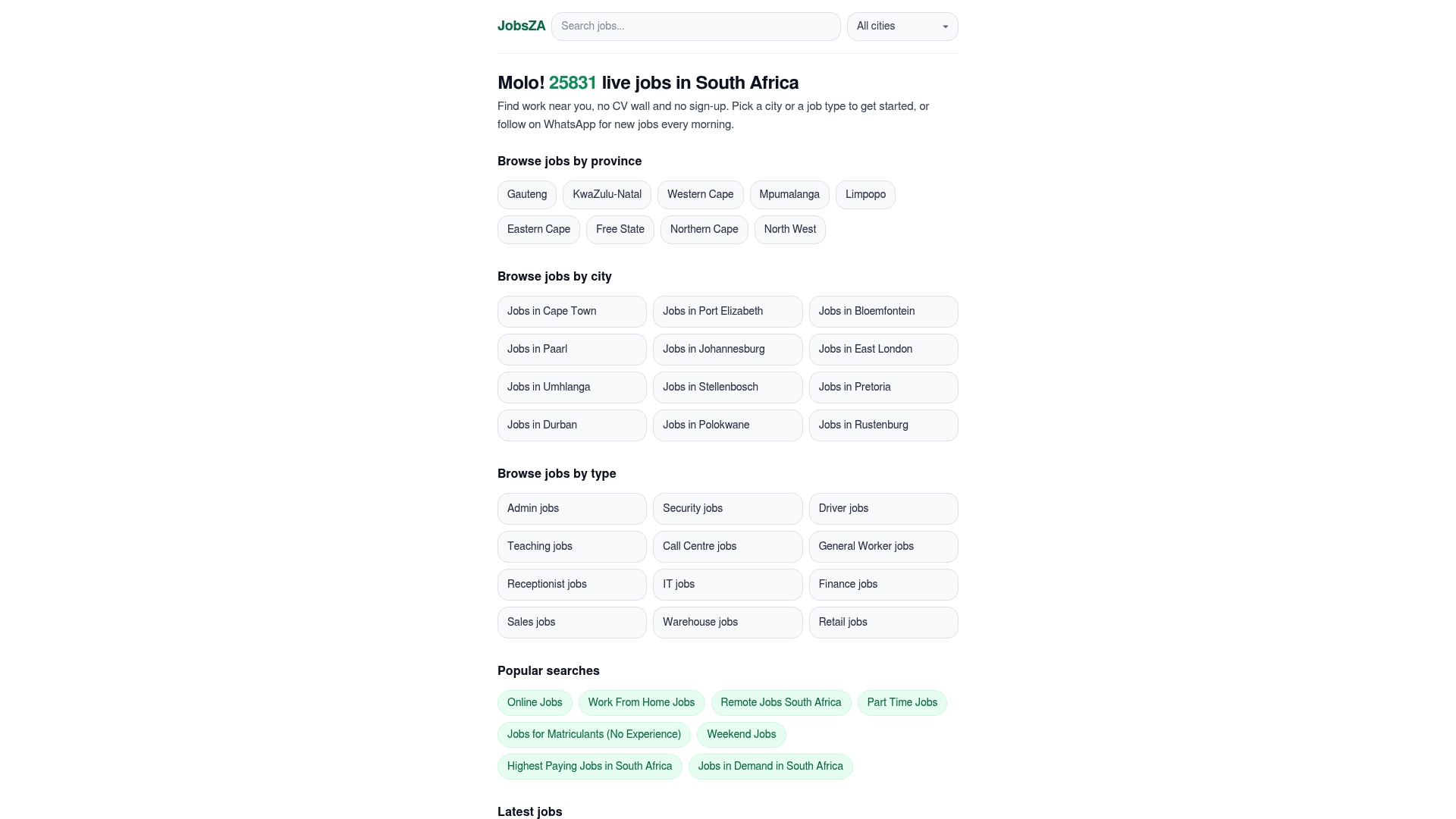
Start on the FindJobsZA homepage, or go straight to a category near you, such as sales jobs in Jeffreys Bay or logistics jobs in East London.
Tips for students, freelancers and first-time job seekers
Students: fit shifts around lectures and exams. Be honest about when you are free, because employers prefer a reliable Saturday worker to someone who cancels. Weekend tutoring, retail and events work are common starting points, and a good record at one can lead to a reference for the next.
Freelancers: treat every weekend gig as a small contract. Agree the rate, the hours and the payment date in writing, even if it is a WhatsApp message. Keep copies of what was agreed.
First-time job seekers: you do not need a long CV for casual work. A short summary of your availability, your area and one relevant strength (for example, “I have worked a till at a family shop”) is enough. Ask what the dress code is, how you get paid and who your supervisor is on the first day.
Everyone: keep a simple log of where you applied, the date and the contact person. Weekend job seekers often apply to ten places and forget which ones they heard from.

FAQ
How do I get weekend job alerts on WhatsApp?
Choose a job site that offers a WhatsApp service and follow its instructions to receive messages. FindJobsZA sends new listings every morning and does not ask you to upload a CV or register. Check each listing before you act on it.
Do I have to pay for a weekend job alert or a weekend job?
No. Job seekers should not pay to see vacancies, receive alerts or be hired. The Department of Employment and Labour says no one may charge a work seeker for employment services, so treat any request for money as a likely scam.
Is Sunday work paid more in South Africa?
In most cases, yes. Under the Basic Conditions of Employment Act, an employee who does not ordinarily work Sundays must be paid double for Sunday work. One who ordinarily works Sundays must be paid one and a half times, or receive equivalent paid time off by agreement.
What words should I put in a weekend job alert?
Use the role and your town rather than just “weekend”. Try cashier, sales assistant, merchandiser, driver, packer or tutor, then look for Saturday, Sunday or shift wording in the advert. Add “entry level” if you have no experience.
How quickly should I respond to a weekend job alert?
As soon as you can, ideally the same morning. Weekend vacancies are often filled quickly, and employers frequently start with the first applications they receive.
Sources
- Work seekers warned not to pay for employment, Department of Employment and Labour
- All recruitment agencies must be registered, Department of Employment and Labour
- Basic Conditions of Employment Act, Department of Employment and Labour
Recommended
Start with your city.
31 274 live jobs, filtered by city and suburb. No sign-up wall, no CV upload just to look.