Apply Without Registration: How to Find Jobs in South Africa
3 November 202614 min read

Contents16 sections
- 1TL;DR
- 2Table of Contents
- 3Why “no registration” matters when you are job hunting
- 4Which jobs you can apply for without registering
- 5Five ways to apply without creating an account
- 6Where registration cannot be avoided
- 7What employers may still ask for
- 8Applying without registration by type of job
- 9How to tell a real vacancy from a scam
- 10Perspective: why we built FindJobsZA without sign-ups
- 11Find vacancies you can act on today
- 12A simple routine to apply faster
- 13Common mistakes to avoid
- 14FAQ
- 15Sources
- 16Recommended
Apply Without Registration: How to Find Jobs in South Africa
You can apply for many jobs in South Africa without registering anywhere, but not all of them. Private employers, small businesses and retailers often accept an email, a WhatsApp message or a walk-in. Government portals usually do not: they ask you to create and verify an account first. The trick is knowing which type of vacancy you are looking at before you spend an hour filling in a profile.
This guide shows you how to find vacancies you can act on straight away, what employers still ask for, where registration cannot be avoided and how to keep yourself safe while you search.
TL;DR
- Private employers, shops and small firms often take applications by email, WhatsApp or in person, so no job-site account is needed.
- Government departments, municipalities and the Department of Employment and Labour’s ESSA service require you to register before you apply.
- A genuine employer never charges you to apply, be placed or be trained for a job.
- Browse local vacancies by city or job type on a site that needs no sign-up, and keep one ready-to-send CV on your phone.
- Verify every vacancy on the employer’s official website before you share your ID number or banking details.
Table of Contents
- Why “no registration” matters when you are job hunting
- Which jobs you can apply for without registering
- Five ways to apply without creating an account
- Where registration cannot be avoided
- What employers may still ask for
- Applying without registration by type of job
- How to tell a real vacancy from a scam
- Perspective: why we built FindJobsZA without sign-ups
- Find vacancies you can act on today
- A simple routine to apply faster
- Common mistakes to avoid
- FAQ
- Sources
Why “no registration” matters when you are job hunting
Most job seekers do not have unlimited time or data. Creating a profile, verifying an email address, uploading a CV and retyping your work history for each portal quickly adds up. If you are searching on a phone with limited data, that friction is a real barrier, and it often means you apply for fewer jobs than you could.
There is a second cost: every account is another place that holds your personal details. The more places that store your ID number, address and contact details, the more places that can leak or be copied by scammers. South Africa’s high unemployment makes this a live problem. The Department of Employment and Labour has said that the 31.9% unemployment rate at the time created fertile ground for scammers who promise jobs in return for a fee.
So the goal is not to avoid every form. It is to apply quickly where a quick route exists, and to register only where you have to.
Which jobs you can apply for without registering
The answer depends on who is hiring. Here is how the main groups usually work.
| Type of employer | Typical way to apply | Registration needed? |
|---|---|---|
| Retail stores and supermarkets | In-store drop-off, a store email address or the company careers page | Careers pages often ask for an account; in-store and email usually do not |
| Small and medium businesses | Email, WhatsApp message or phone call to the owner or manager | Rarely |
| Logistics, driving and warehousing firms | Email a CV, or apply through the advert’s contact details | Rarely |
| Freelance and gig work | Message the client directly with a short pitch | Rarely, although some platforms require a profile |
| Government departments and municipalities | Official online recruitment portal | Yes |
| Department of Employment and Labour ESSA service | Online work-seeker profile | Yes |
The pattern is simple. The smaller and more local the employer, the more likely you can reach a person directly. The larger and more formal the employer, the more likely there is an applicant tracking system with a login.
Five ways to apply without creating an account
1. Use a job site that lets you browse and apply directly
Some job sites do not make you sign up before you can see vacancies. You pick a city or a job type, read the advert and follow the employer’s instructions. On FindJobsZA that is the whole idea: no CV upload and no registration just to look. You can browse jobs by city, province or category, and the advert tells you how to reach the employer.
If you are not sure how to narrow your search by region, our short guide on searching jobs by province in three steps walks you through it.

2. Email your CV to the address in the advert
Many adverts end with an email address. A short message with your CV attached counts as a complete application for most small and mid-sized employers. Write the job title in the subject line so the right person sees it, and keep the body of the email to three or four lines: who you are, which job you want, and your availability.
3. Message the employer on WhatsApp
For local, part-time and entry-level work, a WhatsApp message to the number in the advert is often the fastest route. Send your name, the role you are applying for, one line about your experience and your CV as a PDF. Do this only when the number is in an advert you have checked, and never send ID copies or banking details in a first message.

4. Walk in with a printed CV
For shops, restaurants, warehouses and depots, going in person still works. Ask for the manager, hand over a clean copy of your CV and note the name of the person you spoke to. It costs a little transport money, but it also shows you are serious.
5. Approach employers who have not advertised
Not every vacancy is posted. Career writers in South Africa recommend that you research the company, find the person responsible for hiring or the HR manager, and contact them to ask about openings. Name the specific role you could fill and say why you suit the business. A short, specific email beats a generic one every time.
Where registration cannot be avoided
It is better to know in advance, so you do not waste time hunting for a “guest” option that does not exist.
- Western Cape Government: first-time applicants must create and verify an account, complete a profile, upload a CV and sign in before applying. Only online applications are accepted unless the advert gives a manual process.
- City of Tshwane: its career portal requires you to register first and then log in. An unregistered applicant cannot apply there.
- SARS: its external applicant manual requires account creation and sign-in. There is an “Apply Using LinkedIn” route, but it still uses your LinkedIn credentials, so it is not anonymous.
- ESSA (Department of Employment and Labour): work-seekers must register, receive credentials and complete the application online before searching and applying.
If you want government work, treat registration as a one-time investment. Once your profile is complete you can reuse it for later vacancies on the same portal. The Department of Employment and Labour says its ESSA job-matching service is free, as are employment counselling services such as CV writing and interview advice.
What employers may still ask for
Applying without registration does not mean applying without information. Expect to provide:
- a CV with your contact details, education and work history
- your matric or highest qualification, if the role needs it
- references, sometimes only later in the process
- a short covering message that names the job
You rarely need to send certified documents at the first step. In a recent Department of Employment and Labour internship advert, for example, only shortlisted candidates had to submit certified copies of qualifications on or before the interview. If an advert asks for certified copies, ID copies and bank statements with your first application, treat that as a warning sign and check the employer.
Applying without registration by type of job
Part-time and student work
Shops, restaurants and call centres hire often and quickly. Search your own suburb or nearest town so you can get to shifts cheaply, mention your available hours in the first line, and keep your CV to one page.
Entry-level and graduate roles
If you have no experience, lead with what you do have: your qualification, volunteer work, school responsibilities and any short courses. Admin, customer service and sales roles are common starting points, and many private employers accept an emailed CV for them. You can browse the current admin jobs in South Africa and filter by city to see what is close to you.
Driving, logistics and retail floor roles
These roles often hire in clusters around industrial areas and shopping centres. If you live near one, a local page helps: for example, see current openings for logistics jobs in Johannesburg or retail jobs in Germiston. Always have your licence, PrDP where required, and references ready when you apply.
Freelance and quick gigs
Pitch directly. Say what you can deliver, how long it will take and what you charge, and attach one or two examples of your work. Agree payment terms in writing before you start, and never pay a “registration fee” to get access to a client.
Remote work
Remote adverts attract the most fakes, because scammers know people are eager and cannot visit an office. Be slower and more careful with these: confirm the company exists, find the contact person on the company’s own website and avoid any job that asks you to buy equipment or pay for training first.
How to tell a real vacancy from a scam
Applying without registering means you are sharing your details by email or message, so a quick check matters more. Use this routine before you send anything sensitive.
- Find the employer’s official website yourself. Do not rely on the link in the message. Scammers have used websites that differ slightly from the official site of the Department of Public Works and Infrastructure, then asked for money and sensitive personal information.
- Confirm the vacancy there. The same department advises that you verify vacancies on its official website or at its offices and do not pay fees for advertised jobs.
- Search the company name with “scam” or “reviews”. A South African freelance-focused company suggests searching the name with those words, checking the official website and contact details independently, and cross-checking the vacancy on trusted job platforms.
- Refuse any payment request. The Employment Services Act 4 of 2014 says private employment agencies may not charge job seekers for employment services, including placement, training or employment counselling. Requests for money for background checks, training materials, registration or placement are recognised red flags.
- Hold back banking details. Do not share them until you have a formal offer.
- Distrust guarantees. The City of Cape Town has warned against messages, flyers or word of mouth that promise guaranteed employment or fixed monthly amounts, or tell people to report for work without a formal application. The City says it never charges a fee to apply.
If an advert fails any of these checks, drop it. There will be another one tomorrow.
Perspective: why we built FindJobsZA without sign-ups
We built FindJobsZA because we kept hearing the same thing from job seekers: “I spent the whole evening on forms and I still haven’t applied for anything.” Registration walls, repeated CV uploads and crowded group chats full of unverified posts turn a search into a chore.
Our view is simple. A job seeker should be able to open a page, choose a city or a job type and see real vacancies straight away. That is why you can browse FindJobsZA without uploading a CV or creating an account, and why we send new listings to WhatsApp every morning, so the work comes to you instead of you hunting for it.
We also think local matters. A cashier role two taxi rides away is worth more to you than a “perfect” role in another province. Listings organised by city, province and category let you see what is realistic for your budget and your day.
Speed and safety go together. When you apply directly to an employer and you are not handing your details to yet another database, there is one less place for them to end up. Pair that with the checks in this guide, and you can search quickly without taking silly risks.
Nkosi
Find vacancies you can act on today
If you want a place to start, FindJobsZA lists vacancies across sales, retail, customer service, admin, logistics, driving, human resources and finance. You do not pay to browse or apply, and you can get new jobs on WhatsApp each morning. Start on the FindJobsZA home page and pick your city or job type.
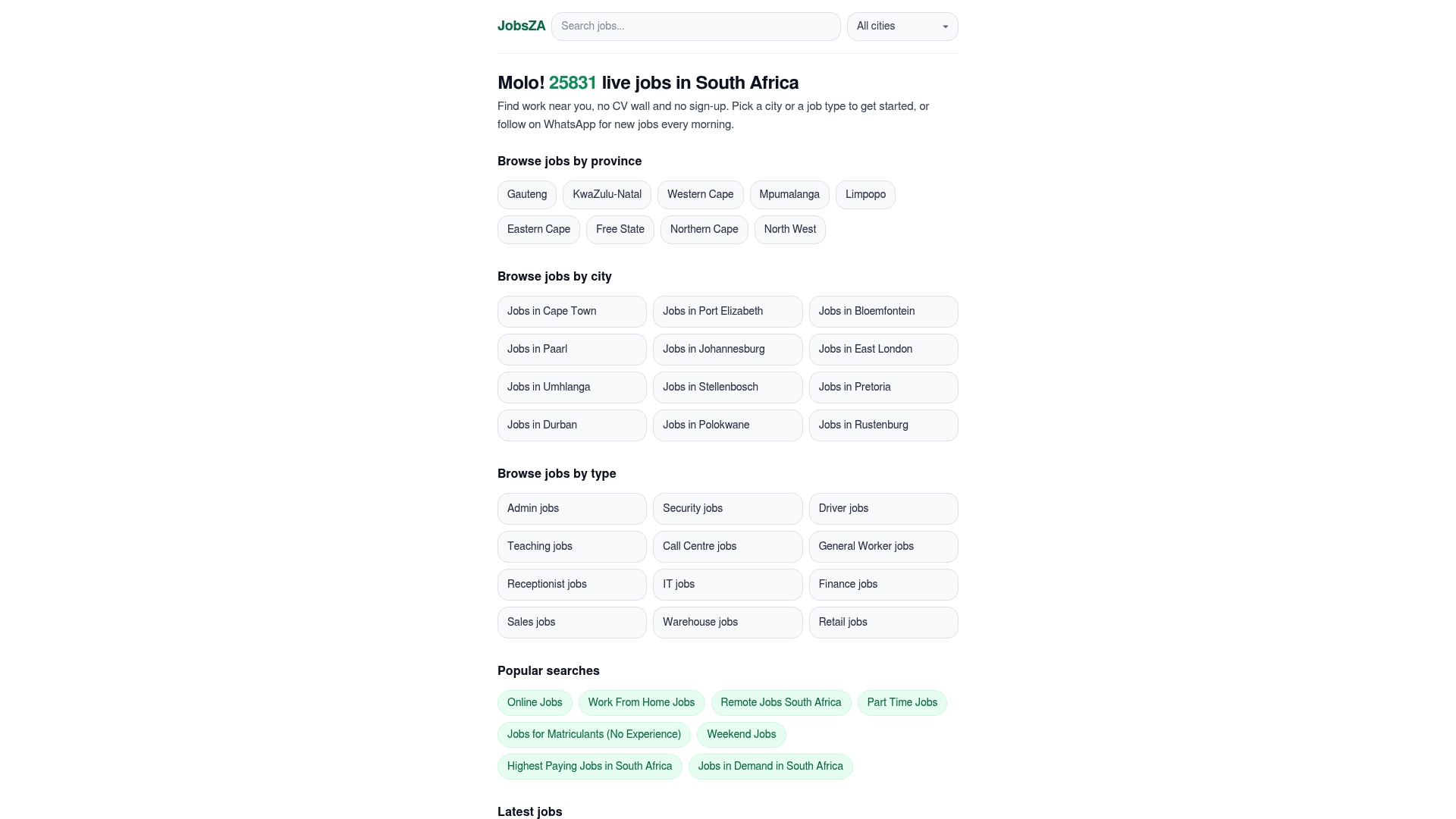
If you are already after a particular kind of work in a particular town, go straight to the local page, such as retail jobs in Newcastle or logistics jobs in George. Teachers can check teaching jobs in Cape Town or teaching jobs in Durban.
A simple routine to apply faster
A little preparation makes every application quicker, whether you register or not.
- Keep one master CV. Save it as a PDF on your phone and in your email drafts, with your name in the file name.
- Write a two-line message template. Leave a gap for the job title and employer name, and change those every time.
- Store your documents. Keep a clear scan of your ID, matric certificate and any other qualification so you can send them when an employer legitimately asks.
- Track what you send. A note on your phone with the date, employer, job and contact person is enough. It helps when someone calls back and you cannot remember which job it was.
- Follow up once. If you hear nothing after about a week, send a polite reminder. If there is still no reply, move on.
- Check daily. New vacancies fill fast, especially entry-level ones. A morning alert on WhatsApp means you see them while they are still open.
Common mistakes to avoid
- Sending the same CV to everything. Change the first few lines to match the job.
- Using an unprofessional email address or voicemail. Employers notice.
- Applying to jobs that need a registered account without finishing the profile. Half-complete profiles are often skipped.
- Paying for “guaranteed” placement. No legitimate employer or agency can sell you a guaranteed job, and charging you is not allowed for private employment agencies.
- Sharing sensitive documents too early. ID copies and bank details belong at offer stage, not in the first email.
FAQ
Can I apply for a job in South Africa without registering on a website?
Yes, for many private-sector jobs. Employers commonly accept an email, a WhatsApp message or an in-person CV drop-off. Government portals, municipalities and ESSA are different: they require you to register and sign in before you apply.
Do I need to upload a CV to browse vacancies?
Not on every site. On FindJobsZA you can browse by city, province or job type without uploading a CV or signing up. Once you choose to apply, the employer may ask for a CV, and the advert will tell you how to send it.
Is it safe to apply by WhatsApp or email?
It can be, if you check the employer first. Find the company’s official website yourself, confirm the vacancy there and share only your CV at first. Keep ID copies and banking details until you have a formal offer, and never pay anyone to be considered for a job.
Can I apply to government jobs without creating an account?
Usually not. The Western Cape Government, the City of Tshwane, SARS and ESSA all require registration or sign-in. Some adverts include a manual or offline route, so read the closing instructions on the advert carefully.
Sources
- Pave your own way: How to apply for an unadvertised job
- Finding a job: tips on how to find a good job (Department of Employment and Labour)
- Graduate Internship Programmes for the Financial Year 2025 to 2027
- How to apply online (Western Cape Government)
- Career Portal (City of Tshwane)
- How to apply for vacancies, external manual (SARS)
- Frequently Asked Questions (Department of Employment and Labour)
- Public Works and Infrastructure warns of a jobs scam
- City of Cape Town warns public against fake job advertisement
- How to Avoid Online Job Scams in South Africa (2026)
- Work seekers warned not to fall for jobs scam (SAnews)
Recommended
Start with your city.
25 658 live jobs, filtered by city and suburb. No sign-up wall, no CV upload just to look.