Jobs Without Experience in South Africa: Where to Start
9 November 202614 min read

Contents17 sections
- 1TL;DR
- 2Table of Contents
- 3What “no experience” really means to an employer
- 4Jobs you can get with no experience
- 5Learnerships: get paid while you learn
- 6What no-experience jobs pay
- 7What employers usually ask for
- 8Where the jobs are
- 9How to apply when your CV is empty
- 10Set up daily alerts so you apply early
- 11Spot a fake job before it costs you
- 12Our perspective
- 13Start your search today
- 14A simple one-week plan
- 15FAQ
- 16Sources
- 17Recommended
Jobs Without Experience in South Africa: Where to Start
You can get hired in South Africa without work experience. The roles that do this most often are retail, sales, customer service, admin support, logistics and driving. These employers hire for attitude, reliability and the ability to learn, and they train on the job. This guide shows which jobs to look at, what they pay, what employers ask for, how to apply with a thin CV and how to spot a fake advert before it costs you.
TL;DR
- Retail, sales, call-centre, data capturing, warehouse and delivery roles are the usual starting points when you have no experience.
- The national minimum wage is R30.23 per ordinary hour from 1 March 2026, so no legitimate employer should pay below that for ordinary work.
- Learnerships let you earn while you train, with allowances that depend on the qualification level.
- A one-page CV built from school, volunteering and community work is enough to apply.
- Never pay to get a job. Check any employer independently before you share your ID or banking details.
Table of Contents
- What “no experience” really means to an employer
- Jobs you can get with no experience
- Learnerships: get paid while you learn
- What no-experience jobs pay
- What employers usually ask for
- Where the jobs are
- How to apply when your CV is empty
- Set up daily alerts so you apply early
- Spot a fake job before it costs you
- Our perspective
- Start your search today
- A simple one-week plan
- FAQ
- Sources
What “no experience” really means to an employer
When an advert says “no experience needed”, the employer is telling you it will teach the tasks. It is not telling you it will accept anyone. They still look for the basics: you turn up on time, you can communicate clearly, you can follow instructions and you are honest with money and customers.
Most of these roles also expect a matric certificate, and many ask for a valid ID, a clean criminal record or a driver’s licence, depending on the work. That is why reading the requirements line is more useful than reading the job title.
You also have more experience than you think. Helping in a family shop, looking after siblings, doing church or youth group duties, school projects and community work are all things you can point to. We come back to this in the CV section.

Jobs you can get with no experience
The list below combines the roles most often described as open to beginners in South Africa. A South African guide to matric-level jobs lists cashier, sales assistant, shelf packer, call-centre agent, customer-service representative, data capturer, receptionist, warehouse picker, kitchen assistant, waiter, cleaner, delivery driver and security officer.
Retail and sales
Cashiers, shelf packers, shop assistants and sales consultants are the biggest entry point. Stores hire in volume, and shift work suits students and school leavers. Sales roles often include commission on top of a base, which can reward you for effort even without a track record. Browse sales jobs across South Africa to see what is currently listed, or narrow it down by city, such as sales jobs in Johannesburg or sales jobs in Sandton. In Gauteng’s capital, retail jobs in Pretoria are worth a look, and smaller towns have listings too, for example retail jobs in Louis Trichardt.

Customer service and call centres
Call-centre agents and customer-service representatives need clear speech, patience and basic computer skills. Companies run paid training before you take your first call. If you speak more than one South African language, say so on your CV, because many centres serve customers in several languages.
Admin, data capturing and reception
Data capturers, receptionists and filing clerks need accuracy and basic Word and Excel. If you did Computer Applications Technology or Information Technology at school, mention it. You can see what is open in admin jobs in South Africa.
Logistics, warehouse and driving
Warehouse pickers, packers, loaders and delivery drivers are in steady demand around the big distribution hubs. Many of these jobs value fitness, punctuality and a driver’s licence more than a work history. Look at logistics jobs in South Africa, or by area: Johannesburg, Sandton, East London and Brits.
Hospitality, cleaning and security
Waiters, kitchen assistants and cleaners get hired quickly, and tips can add to your income in restaurants. Security officers must be registered with PSIRA, the Private Security Industry Regulatory Authority, according to the matric-jobs guide above. Any employer asking you to start guarding without registration is not following the rules.
Part-time, casual and freelance work
Students and anyone who needs income fast can look at part-time shifts in retail and hospitality, short delivery contracts, merchandising, and freelance tasks such as data entry or social media help. These are often easier to start than permanent jobs, and they give you a first reference. Treat any gig that asks you to pay a registration fee with suspicion (see the scams section below).
Learnerships: get paid while you learn
A learnership combines a structured qualification with workplace training, and many are open to people with no work history. They suit matriculants who want a recognised certificate along with experience. You can look through learnerships in South Africa on our site.
Pay is regulated. The 2026 Government Gazette amendment lists minimum weekly learnership allowances that start at R455.00 at the lower credit bands and rise to R2,654.04 for NQF levels 5 to 8 with 481 to 600 credits. So the amount depends on the qualification, and you should read the allowance in the advert against that schedule.
What no-experience jobs pay
The floor is the national minimum wage. According to the 2026 Government Gazette, it is R30.23 per ordinary hour from 1 March 2026, and it covers farm and domestic workers too. Expanded public works programme workers receive R16.62 per hour under the same notice.
Above that floor, what you earn depends on:
- The sector. Call-centre and data-capturing jobs usually pay more than shelf packing or cleaning.
- Commission and bonuses. Sales jobs may have a lower base and a variable top-up.
- Hours and shifts. Night, Sunday and public holiday work can be paid differently, so read the contract.
- Location. Employers in the big metros often pay differently from small towns, and so does the cost of living.
- Whether it is a learnership. Allowances follow the schedule above rather than a normal salary.
Salary estimates from one South African blog put cashiers at roughly R4,000 to R6,000 a month and customer-service representatives at roughly R6,000 to R10,000, in its March 2026 salary table. Treat those as rough ranges. The pay in the actual advert is what counts.
A quick check: multiply R30.23 by the hours you will work in a month. If the monthly figure in an offer is clearly lower than that for the same hours, ask the employer to explain before you sign.
What employers usually ask for
Requirements vary, but most entry-level adverts ask for some mix of the following:
| Requirement | Where it matters most |
|---|---|
| Matric certificate (or a copy of your results) | Retail, call centres, admin, logistics |
| Valid South African ID | Almost every formal job |
| Driver’s licence | Delivery, driving, some sales roles |
| PSIRA registration | Security officer roles |
| Basic computer skills | Data capturing, reception, admin |
| Own transport or availability for shifts | Retail, warehouse, hospitality |
| Clear criminal record check | Cash handling, security, some warehouse work |
If you do not have matric, do not stop. Some cleaning, general worker, kitchen and warehouse roles ask for none, and a learnership or skills programme can help you move on later. Our page for matriculant jobs with no experience groups listings for school leavers in one place.
Where the jobs are
The volume of entry-level roles follows the economy. Gauteng, with Johannesburg, Sandton and Pretoria, has the largest number of retail, sales, admin and logistics listings. Cape Town and its surrounds hire heavily in retail, hospitality, call centres and tourism. Durban and the Eastern Cape ports, such as East London, have logistics and manufacturing work. Smaller towns have fewer vacancies, but retail and warehouse openings still come up, and there is often less competition for each one.
Three practical tips:
- Search by your own city first. A shorter commute matters when entry-level pay is modest.
- Widen to the nearest hub. If your town has few listings, check the closest large town, and ask about transport before you accept.
- Look at remote and flexible work separately. Remote jobs for beginners are mostly customer support, data entry and freelance tasks, and they attract more scams than local shop jobs. Apply the checks below.
How to apply when your CV is empty
A first CV can be short. A South African CV guide suggests a one-page CV for someone with no experience, and says to match your skills to the vacancy and list references only after you have their permission.
A simple order that works:
- Contact details. Name, cell number and a sensible email address.
- A two-line profile. For example: reliable matriculant who is good with people, available for shifts and keen to learn in retail.
- Education. Your matric subjects and any short courses.
- Experience that is not a job. Volunteering, school projects, community work, helping in a family business, church or youth activities, and informal jobs such as car washing or tutoring all count, as the same guide notes.
- Skills. Languages, basic computer skills, cash handling, teamwork.
- References. Two people who agreed to be called, such as a teacher or a community leader.
Write each point as something you did, not something you are. Strong verbs help: organised, served, counted, trained, led. If you want ideas, this list of action verbs for your CV gives you wording for it.
Then tailor it. If the advert says “customer-facing”, move your volunteering at the clinic or tuck shop to the top. Read the closing instructions carefully too: some employers want an email, some a form, and some only a walk-in with a printed copy.
Apply without the paperwork wall
Many job boards make you register, upload a CV and create a password before you can even see the contact details. If you are applying from a phone with limited data, that wastes time. Our guide to applying without registration explains how to find and apply for jobs without signing up. If you are a graduate rather than a school leaver, our overview of entry-level job sites for graduates compares the kinds of sites available.
Set up daily alerts so you apply early
Entry-level vacancies close fast because they attract many applicants. Applying on the first morning gives you a real advantage. A daily alert saves you from searching every day, and our guide on setting up entry-level job alerts walks through a daily setup for South Africa.
Spot a fake job before it costs you
Because “no experience” adverts attract many hopeful applicants, scammers use them. A South African media report on online job scams advises job seekers to check a company’s official presence rather than rely on the advert alone or on unsolicited contact.
A South African guide to spotting fake job posts recommends these checks:
- Look the company up on CIPC, the Companies and Intellectual Property Commission, to see whether it is registered.
- Go to the company’s own website and check its careers page for the same vacancy.
- Phone using contact details you found yourself, not the ones in the message.
- Be wary of upfront fees, unsolicited approaches and requests for personal information very early on.
Add two rules of your own. First, a real employer does not charge for an interview, a uniform, a “training kit” or a placement. Second, do not send your ID copy, bank details or a photo of your card until you have a confirmed offer from a company you verified. Social media hiring needs extra care, and our article on what is real and what is a scam on Facebook hiring shows the common patterns.
Our perspective
Most people who write to us about their first job say the same thing: they are tired. Tired of creating accounts, uploading the same CV again and again, and scrolling through WhatsApp groups where half the posts are old or suspicious.
That is why we built FindJobsZA the way we did. You browse by city, province or job type. You do not need to upload a CV or register to look. New listings can reach you on WhatsApp every morning, so you see them while they are still open.
Our view is simple: when you have no experience, speed and clarity are your best tools. Employers hiring for entry-level roles want to fill the post quickly, and the first people to apply are often the first people to be called. A search that removes barriers gives you more tries in the same week.
We also think a clean, local list is safer than a forwarded message. Browsing a board built for South Africa, by place and category, helps you stay away from the noise. You still need to verify every employer, and we encourage you to use the checks above.
Nkosi
Start your search today
If you are ready to look, FindJobsZA lists sales, retail, customer service, admin, logistics, driver, human resources and finance jobs across South Africa. You can browse by city or job type, with no CV upload and no sign-up needed to see the vacancies, and you can get daily job alerts on WhatsApp.
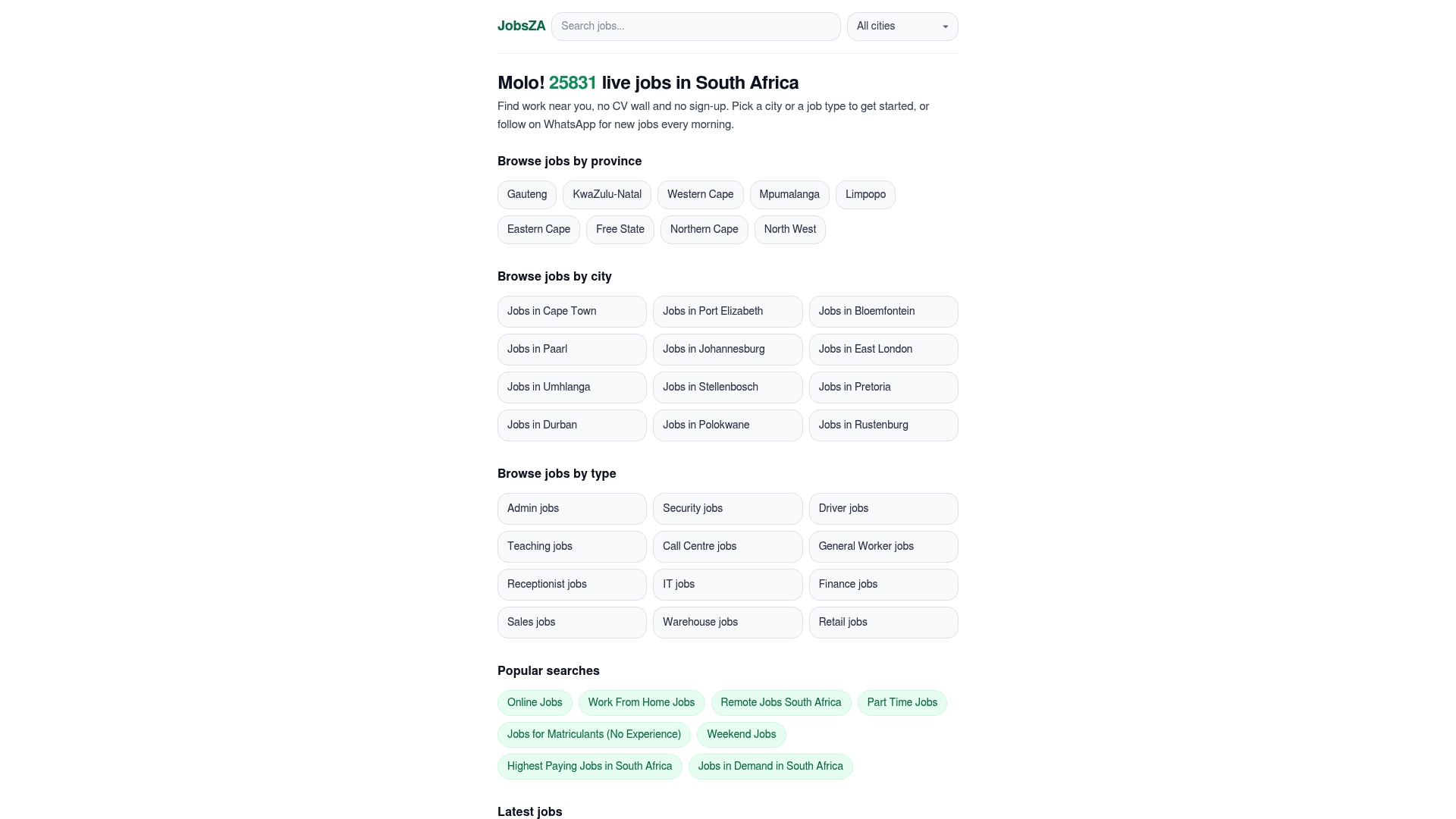
Go to FindJobsZA and pick your city, or go straight to retail and sales listings if you want a customer-facing start. Graduates may also like our guide to graduate recruitment in South Africa.
A simple one-week plan
If you want a routine rather than a long list, try this:
- Day 1: Write your one-page CV and ask two people if you can list them as references.
- Day 2: Choose two job types you could do well and one nearby city or town. Set up your daily alert.
- Day 3: Apply to five vacancies that match your skills, changing your profile line each time.
- Day 4: Verify each employer: CIPC, official website, independent phone number.
- Day 5: Prepare for interviews: how you will travel, what you will wear, and three examples from school or community life.
- Weekend: Check learnership listings and walk in at shops near you if they take walk-in CVs.
Keep a small list of where you applied and on what date. Following up politely after a few days is normal, and it shows interest.
FAQ
Can I get a job in South Africa with no experience and no matric?
Yes, some roles such as cleaning, general work, kitchen assistance and warehouse packing may not ask for matric, although many employers prefer it. Read the requirements line in each advert. A learnership or short skills course can open more doors later.
How much will I earn in my first job?
For ordinary work, the national minimum wage is R30.23 per hour from 1 March 2026, according to the Government Gazette. Many jobs pay more, depending on the sector, commission and shifts. Learnerships follow a separate allowance schedule.
Do I have to pay to get a job?
No. Be wary of any employer or agent who asks for money for an interview, training kit or placement. Check the company on CIPC and contact it through details you found yourself.
What should I put on my CV if I have never worked?
List your matric subjects, skills, languages and any volunteering, school projects, community work or help in a family business. Keep it to one page and list references only with their permission.
Sources
- Jobs You Can Get With Only Matric in South Africa
- National Minimum Wage Act amendment, Government Gazette 2026
- How to Write a CV in South Africa
- How to Spot a Fake Job Post in South Africa
- How to avoid online job scams when looking for work
- CV action verbs
Recommended
Start with your city.
25 658 live jobs, filtered by city and suburb. No sign-up wall, no CV upload just to look.