Full-Time vs Part-Time Work in South Africa: What Differs
7 November 202611 min read

Contents12 sections
Full-Time vs Part-Time Work in South Africa: What Differs
The core difference is hours. A part-time employee works fewer hours than a comparable full-time employee and is paid by the time worked. South African law does not fix a universal number of weekly hours for either. What it does fix is a ceiling on ordinary hours, a minimum hourly wage and a rule that part-timers cannot be treated worse just because they work fewer hours. Below we cover hours, pay, leave and freelance status, and then how to choose.
TL;DR
- Full-time is set by the employer’s custom and practice, not by one legal number. Ordinary hours are capped at 45 a week.
- Part-time means fewer hours than a comparable full-timer. Covered part-timers must generally be treated no less favourably, with hours taken into account.
- The national minimum wage is R30.23 an hour from 1 March 2026 and applies to full-time, part-time and casual workers alike.
- Freelancers are not employees: no paid leave, sick pay or UIF, and you handle your own tax.
- Pick by your life stage and cash needs, then browse jobs by type on FindJobsZA without uploading a CV.
Table of Contents
- What part-time and full-time mean in South Africa
- Hours: what the law allows
- Pay, leave and benefits compared
- Where freelance fits in
- What the numbers say about South Africa
- Which one should you choose?
- Find full-time and part-time jobs near you
- FAQ
- Sources
What part-time and full-time mean in South Africa
Most people assume there is a magic number, such as 40 hours. There isn’t. South African law has no single statutory definition of a full-time schedule. Full-time status is determined by employer custom and practice, which is why one retailer’s full-timer works 45 hours and another’s works 40.
Part-time is defined by comparison. Section 198C of the Labour Relations Act describes a part-time employee as someone paid wholly or partly by actual time worked who works fewer hours than a comparable full-time employee. The law does not set a universal weekly-hours threshold for part-time work either.
In practice, then:
- Full-time: the standard working week at that employer, often five days, usually up to the 45-hour ordinary-hours ceiling.
- Part-time: a regular but shorter pattern, such as three days a week or afternoon shifts.
- Casual or ad hoc: work offered shift by shift with no guaranteed pattern. Check your contract to see which one you are being offered.
The label on the contract matters less than the arrangement: hours, pay basis and who controls your time.
Hours: what the law allows
The Department of Employment and Labour’s summary of the Basic Conditions of Employment Act (BCEA) says ordinary hours may not exceed 45 per week. That works out to 9 hours a day on a week of five days or fewer, or 8 hours a day if you work more than five days.
Overtime has its own rules. It requires agreement, is generally capped at 10 hours a week, and must be paid at 1.5 times your normal wage or swapped for agreed paid time off, according to the same departmental summary. The summary also describes a 60-minute meal interval after five hours, a daily rest of 12 consecutive hours and a weekly rest of 36 consecutive hours, subject to the Act’s agreements and exceptions.
These limits apply to full-timers and part-timers who are covered by the Act. If you want to see how ordinary-hour limits play out in a household job, this guide to au pair working hours in South Africa walks through a real example.
A useful rule of thumb when reading a job advert: if a “part-time” role asks for 12pm to 8pm, Monday to Saturday, it is close to a full-time load, and you should expect to be treated and paid accordingly. Ask for the weekly hours in writing before you accept.

Pay, leave and benefits compared
Hourly pay and the minimum wage
Full-timers are not paid a higher hourly rate by law. Part-timers earn less in total because they work fewer hours. The floor is the same for everyone: from 1 March 2026 the national minimum wage is R30.23 per ordinary hour, covering all workers including farm and domestic workers. The same flyer illustrates weekly pay of R1,209.20 for 40 hours and R1,360.35 for 45 hours.
For monthly figures, one payroll guide calculates that a 45-hour week gives a monthly minimum of R5,894.85, while a 20-hour part-time week gives R2,619.93. Check the Department’s page for the current rate, since the wage is reviewed regularly.
Equal treatment for part-timers
This is the protection many part-timers don’t know about. Covered part-time employees must generally be treated no less favourably overall than comparable full-timers doing the same or similar work, taking hours into account, unless there is a justifiable reason. They must also get the same access to training, skills development and chances to apply for vacancies. That last point matters if you want to move from part-time to full-time inside the same company.
There are exclusions. The CCMA says this protection is generally excluded for employees above the BCEA earnings threshold, qualifying small employers, people ordinarily working fewer than 24 hours a month, and the first three months of continuous employment.
Leave, UIF and notice
Leave follows the days you work. One employment-law guide says annual leave is at least 21 consecutive days on full remuneration per 12-month cycle, or one day for every 17 days worked by agreement. The same guide says sick leave is based on the days you normally work in six weeks over a 36-month cycle, and family-responsibility leave is three paid days per cycle for employees with more than four months’ service who work at least four days a week.
That four-day condition is the one that catches part-timers out. If you work three days a week, you may not qualify for family-responsibility leave.
UIF is generally 1% from the employee and 1% from the employer, each capped at R177.12 a month, so it is a percentage of pay and applies to both full-time and part-time work.
| Full-time | Part-time | Freelance | |
|---|---|---|---|
| Hours | Employer’s standard week, ordinary hours capped at 45 | Fewer than a comparable full-timer | You set them with the client |
| Minimum wage | R30.23 an hour | R30.23 an hour | Not applicable to genuine contractors |
| Paid leave | Yes, under the BCEA | Yes, scaled to days worked | No |
| UIF | Yes | Yes | No, ordinarily |
| Tax | PAYE withheld | PAYE withheld | You manage provisional tax |
Where freelance fits in
Freelance work is a different category, not a third kind of employment. A genuine independent contractor is a service provider who invoices for time or deliverables, and labour legislation generally does not apply, so there is ordinarily no paid leave, sick pay, UIF or minimum-wage protection. The same article stresses that the actual working relationship, not the contract label, determines your status.
How that is judged: classification depends on the common-law dominant-impression test, with statutory presumptions in LRA section 200A and BCEA section 83A. A genuine contractor carries their own SARS obligations, including provisional tax and, above the applicable turnover threshold, VAT registration.
Money-wise, employees normally get PAYE and a predictable salary, while freelancers face volatile project or hourly income. When you compare a freelance rate with a salary, subtract unpaid leave, tax admin, insurance, retirement saving, equipment and the gaps between clients. A high hourly rate can still come out below a decent salary once those are counted.
Freelancing suits people with a marketable skill and some savings. Common freelance fields in South Africa include development, design, writing, finance and marketing, according to the same comparison.

What the numbers say about South Africa
Full-time work is still the dominant form of formal employment. Stats SA reports that full-time employment stood at 9,434,000 in December 2025, against 1,117,000 part-time. Over the year, part-time employment fell by 33,000 (2.9%) and full-time by 69,000 (0.7%) in that survey.
The wider labour force survey found 17.1 million people employed, 12.3 million of them in the formal sector, 3.7 million in the informal sector and 1.1 million in the household sector. Part-time vacancies are the smaller pool, so it pays to search by type and location rather than waiting for them to find you.
Which one should you choose?
There is no universally better option. Choose by what you need in the next one to three years.
Students
Part-time fits around lectures, and retail, admin and customer service roles often offer shift patterns. Ask for your weekly hours and days in writing, and check that exam periods are accommodated. Remember the first three months fall outside the part-time equal-treatment protection.
Recent graduates
Full-time entry-level work usually gives you leave, UIF, training access and a clearer path to promotion. If you cannot land one yet, a part-time role in your field keeps your CV moving, and covered part-timers have the same chance to apply for internal vacancies as full-timers.
Parents, carers and people with a second income
Part-time gives you control of your week. Do the arithmetic first: a 20-hour week at the minimum wage is a very different monthly income from a 45-hour one, as the figures above show.
Remote and flexible seekers
Beginner remote roles include customer support, call-centre work, virtual assistance, tutoring, freelance writing and social-media assistance. Even so, applicants still need a working device, internet access, communication ability and proof of skill.
A quick checklist before you accept
- How many hours a week, and on which days?
- Is the pay hourly or monthly, and is it at or above R30.23 an hour?
- Will UIF be deducted and leave accrue?
- Are you an employee or a contractor in practice?
- Can the role grow into more hours?
Our view
We built FindJobsZA because most job seekers we hear about are not choosing between full-time and part-time in the abstract. They are choosing between whatever is open near them this week. A search that asks for a CV upload and an account before you can even see the hours is a poor start.
So we let you browse by city, province or job type, in categories such as sales, retail, customer service, admin, logistics, driver, human resources and finance, with no registration. Then you decide whether the hours suit you. New listings also arrive by WhatsApp every morning, so you see fresh openings early, whether you want a Saturday shift or a permanent post.
Our advice: write down the hours you can really give, filter by your town, and compare what you find against the checklist above.
Nkosi
Find full-time and part-time jobs near you
FindJobsZA lists jobs across South Africa that you can browse by city, province or type, including full-time, part-time, freelance and entry-level roles. There is no CV upload and no sign-up, and you do not pay to browse or apply.
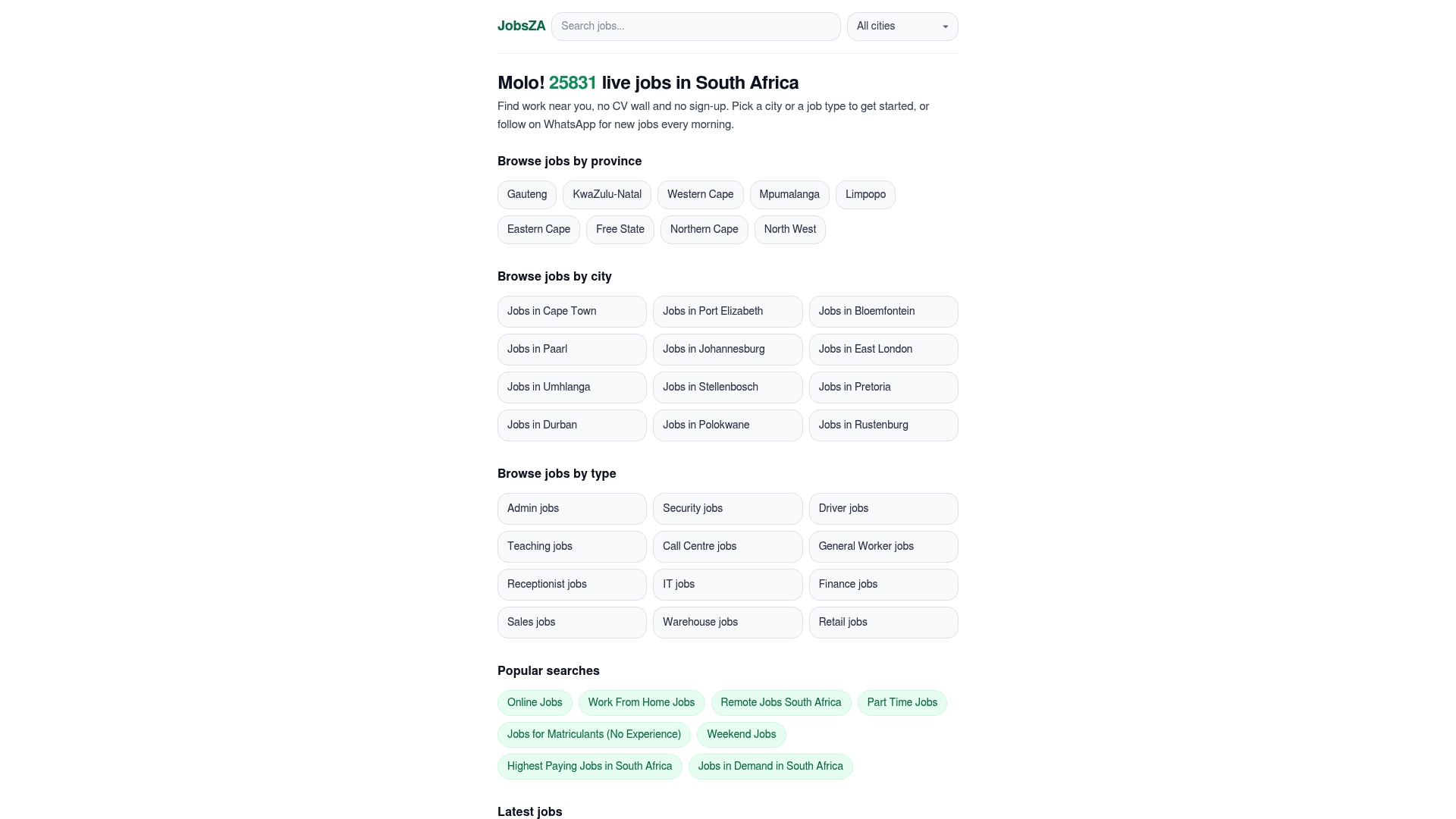
Start with the category that matches your skills, such as sales, retail, customer service, admin, logistics, driver, human resources or finance, on the FindJobsZA home page, and turn on the daily WhatsApp alerts so new listings reach you each morning.
FAQ
Do full-time employees get paid more than part-time employees?
Not per hour, by law. The national minimum wage of R30.23 an hour applies to both, so full-timers earn more in total because they work more hours. Covered part-timers should also not be treated less favourably overall, taking their hours into account.
How many hours is full-time in South Africa?
There is no single legal number. Full-time is set by the employer’s practice, while the BCEA caps ordinary hours at 45 a week. Many employers use a five-day week, so check your contract.
Is freelance better than full-time?
It depends on what you need. Freelancing gives you control over clients and hours, but ordinarily no paid leave, sick pay or UIF, and you handle provisional tax. Full-time employment gives you those protections and a predictable salary.
Can a part-time job become full-time?
Yes. Covered part-time employees have the same access as full-timers to opportunities to apply for vacancies, and to training and skills development. Ask your manager which roles are opening and what skills they want.
Sources
- Global Employment Compass South Africa
- Section 198A-D of the LRA information sheet (CCMA)
- Different forms of s198 contracts information sheet
- Part-time and casual work in SA: 24-hour rule and s 198C
- BCEA summary, Department of Employment and Labour
- National Minimum Wage flyer 2026
- Minimum Wage South Africa 2026
- Different Types of Employment Contracts in South Africa
- Permanent, fixed-term or freelance? (The Post)
- Understanding Independent Contractor Rights in South Africa
- Freelancing vs Employment in South Africa
- Remote jobs in South Africa that need zero experience
- Quarterly Employment Statistics Q4 2025, Stats SA
- Quarterly Labour Force Survey Q4 2025, Stats SA
Start with your city.
25 658 live jobs, filtered by city and suburb. No sign-up wall, no CV upload just to look.