Welding Jobs in South Africa: Roles, Pay and How to Apply
10 November 20269 min read

Contents13 sections
- 1TL;DR
- 2Table of Contents
- 3What welding jobs are available in South Africa
- 4Which industries and cities hire welders
- 5Qualifications, trade tests and skills
- 6What welders earn
- 7Electrician and plumber vacancies
- 8How to check a trade vacancy and apply
- 9Our perspective
- 10Start your search
- 11FAQ
- 12Sources
- 13Recommended
Welding Jobs in South Africa: Roles, Pay and How to Apply
Welding jobs in South Africa range from assistant and production MIG roles to coded pipe work and boilermaker posts. They are advertised in Johannesburg, Cape Town, Pretoria, Durban and the industrial towns around them. You can browse current welder jobs in South Africa on our site without uploading a CV or signing up. The rest of this guide explains what each role asks for, what pay looks like, and how to check and apply for a trade vacancy. It also covers electrician and plumber vacancies, because many trade seekers look at all three.
TL;DR
- Entry-level welder, assistant and production MIG roles are the easiest way in. Coded, pipe, TIG and artisan roles ask for more proof of skill.
- The formal route is the Occupational Certificate: Welder, which asks for Grade 9 with Mathematics and Science. The national artisan certificate comes after an external trade test.
- One illustrative pay dataset puts average welder base pay at about R12,184 a month, with a wide spread by role and experience.
- Browse by city or job type, read the requirements line by line, and never pay a fee to apply for a job.
- Electrician and plumber adverts work the same way: match the certificate and experience in the advert to what you hold.
Table of Contents
- What welding jobs are available in South Africa
- Which industries and cities hire welders
- Qualifications, trade tests and skills
- What welders earn
- Electrician and plumber vacancies
- How to check a trade vacancy and apply
- Our perspective
- Start your search
- FAQ
- Sources
What welding jobs are available in South Africa
Welding is not one job. Adverts use different titles for very different levels of responsibility. A guide to welding careers in South Africa lists these common paths:
- Entry-level or assistant welder: preparation, grinding, cutting, basic fabrication, machine set-up and supervised welding.
- Production MIG welder: repeat work in a factory or fabrication shop.
- Structural welder: steel for buildings, plant and infrastructure.
- Maintenance welder: repairs on site, often in a plant or mine.
- TIG welder: precision work, stainless steel and aluminium.
- Pipe and coded welder: the most specialised group, where you must prove your skill against a procedure.
- Artisan and boilermaker with welding skills: trade-certified roles, often with supervision duties.
When you search, try several titles. The same work may appear as welder, fabricator, boilermaker or artisan. Listings also use phrases like “semi-skilled welder” for roles between assistant and fully qualified.
Which industries and cities hire welders
Welding work is advertised in manufacturing, fabrication, maintenance, construction, engineering, food processing, mining-related operations, transport, marine, ports, energy and infrastructure projects, according to a 2026 industry outlook.
That spread explains the map of vacancies. Browse by city and you will find that most work clusters around industrial areas:
| Area | Where to look |
|---|---|
| Gauteng, Johannesburg | Welder jobs in Johannesburg, plus Germiston and Alberton on the East Rand |
| Gauteng, Tshwane | Welder jobs in Pretoria and Centurion, and Midrand in between |
| Western Cape | Welder jobs in Cape Town and Stellenbosch |
| KwaZulu-Natal | Welder jobs in Durban, with port and marine work nearby |
If you live near a smaller industrial town, start with the nearest big city page, then widen your search by province. Many employers will consider you if you can get to site, so check transport and shift times in the advert.
Qualifications, trade tests and skills
The formal qualification
The Occupational Certificate: Welder is a QCTO qualification of 372 credits. It prepares learners to join metal products using electric arc and gas welding processes, following Welding Procedure Specifications. Entry requires NQF Level 1 (Grade 9) with Mathematics and Science. Training providers and colleges offer it, so ask them about intake and fees directly.

The trade test and the Red Seal
The Red Seal is the national artisan trade certificate. It is issued by the Quality Council for Trades and Occupations (QCTO) after you pass an external trade test moderated by the National Artisan Moderation Body. It is valid nationwide and replaced the older Section 13 and 28 certificates, according to AITF. Adverts that say “red seal” or “qualified artisan” expect this certificate, so do not apply for those posts without it unless the advert allows experience instead.
Processes employers name
Adverts usually name the process. A welding careers guide describes the usual fit:
- MIG/GMAW: fabrication and production.
- TIG/GTAW: precision, stainless steel and aluminium.
- SMAW (stick): structural and maintenance work.
- FCAW: structural and production applications.
- Pipe or coded welding: more specialised.
Foundations that help at entry level are workshop safety, measuring, joint preparation, and SMAW or MIG basics. If you want to practise MIG and MAG technique before you apply, a hands-on MIG/MAG welding course shows the kind of process training employers look for.
What welders earn

Pay depends on the process, the certificate, the site and your experience. One illustrative September 2026 dataset reported an average welder base pay of R12,184 a month from 63 salaries, with illustrative low and high figures of R5,980 and R24,825. Treat these as estimates, not a wage guarantee.
What that spread tells you:
- Assistant and semi-skilled posts sit toward the bottom of the range.
- Certified artisans and coded welders can reach the upper part.
- Adverts often show a range or a rate per hour. If there is no figure, ask at the interview stage what the basic pay, overtime and benefits are.
Also check the arrangement: permanent, fixed-term, contract or part-time. Welding posts are advertised in all of these forms.
Electrician and plumber vacancies
Many people searching for welding work also look for electrician jobs, electrical jobs and plumbing work. These trades are advertised in much the same way, and the method for reading an advert is the same.
- Electrician vacancies: adverts list the type of work (installation, maintenance, industrial or domestic) and the certificate and experience wanted. Match the wording, because “electrician” and “electrical technician” are not always the same level.
- Plumber vacancies: adverts tend to list the kind of site (residential, commercial or maintenance), whether you need a driver’s licence and your own tools, and the certificate expected.
- Both trades: employers commonly ask for a trade certificate plus proven experience. If you are still training, look for assistant, apprentice or learner posts. Plumbing and electrical roles often overlap with maintenance teams that also hire welders, so browse across trades on the same site.
For the exact qualification and registration an employer needs, read the advert and, if it is unclear, ask the employer or the relevant trade body before you apply.
How to check a trade vacancy and apply
- Read the requirements twice. Note the process, the certificate, years of experience and any licence or medical.
- Check the location and hours. Shift work and site distance matter more for trades than for office jobs.
- Look for the employer. A real advert names a company or a recognisable agency and gives a way to apply.
- Never pay to apply. Be wary of any post asking for fees for a “placement”, uniform or training before you are hired.
- Keep your proof ready. Have your ID, certificates, trade test results and a short list of past employers on your phone, so you can respond the same morning.
- Apply early. Fresh listings attract many applicants, so a quick response helps.
On our site you can open the vacancy and apply directly, with no registration step in between.
Our perspective
Trade seekers rarely sit at a desk. You check your phone on a break, on a taxi, or before a shift. Most job boards ask you to build a profile and upload a CV before you see a thing, and that is the wrong way round for a welder, an electrician or a plumber.
We built FindJobsZA for South Africa so you can browse by city, province or job type, open the listing and apply directly, with no CV upload and no sign-up. We also send new listings to WhatsApp every morning, so the freshest welding vacancy reaches you before the day starts.
Our aim is to remove the friction and the search fatigue that come with scrolling endless groups and aggregator pages, and to give you a cleaner, more local way to look for work.
Nkosi
Start your search
We list vacancies across sales, retail, customer service, admin, logistics, driver, human resources and finance, alongside the trade roles above. If you are open to work near welding sites, logistics and driver posts are worth a look too. Browse everything from the FindJobsZA home page, then narrow by city or job type, and switch on the morning WhatsApp alerts.
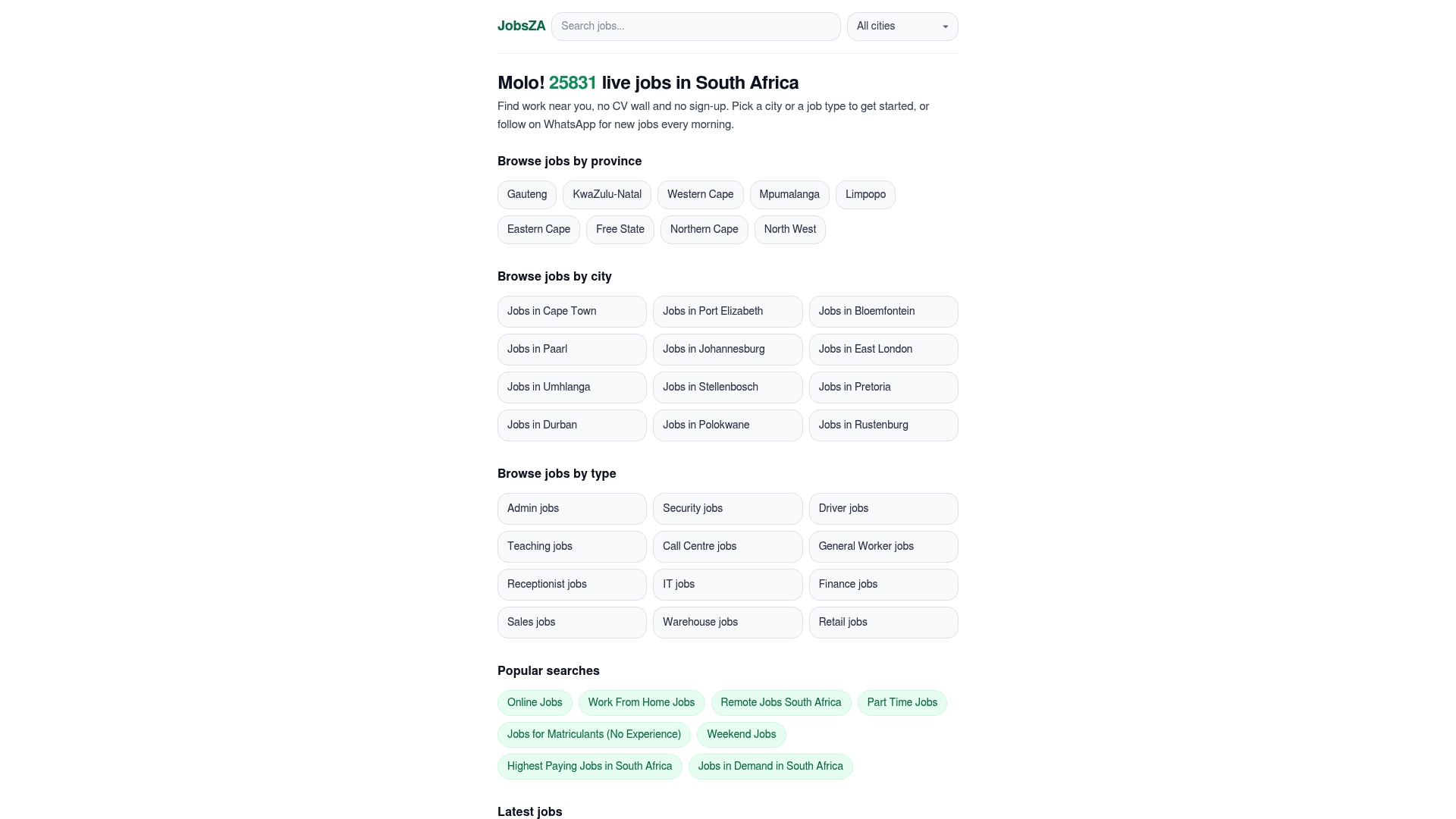
If you want welding first, go straight to welder jobs in South Africa and filter by your city.
FAQ
Do I need a qualification to get a welding job in South Africa?
Not for every role. Assistant and entry-level posts often involve preparation, grinding and supervised welding. For higher roles employers ask for a certificate, and artisan posts expect a trade test pass. The formal Occupational Certificate: Welder asks for Grade 9 with Mathematics and Science.
How much does a welder earn per month?
It varies widely. One illustrative dataset shows an average base pay of R12,184 a month, with figures from R5,980 to R24,825. Process, certificate and experience move you along that range.
Where can I find welder vacancies near me?
Browse by city on our site: Johannesburg, Cape Town, Pretoria, Durban, Germiston, Centurion and more. Switch on WhatsApp alerts and new listings reach you each morning.
Can I apply without a CV?
On FindJobsZA you can open a listing and apply directly without uploading a CV or registering. Some employers may still ask for documents later, so keep your certificates ready.
Sources
- Welding Jobs South Africa | Careers, Salaries & Skills
- Welding jobs South Africa 2026 industry outlook
- Occupational Certificate: Welder, Central Johannesburg College
- Welder Trade Test, AITF
Recommended
Start with your city.
25 658 live jobs, filtered by city and suburb. No sign-up wall, no CV upload just to look.