How to beat ATS and get your CV seen in South Africa
6 August 202614 min read

Contents15 sections
- 1Table of Contents
- 2What does an Applicant Tracking System actually do?
- 3How ATS parsing and filtering actually work
- 4Resume formatting dos and don’ts
- 5How to extract and include the right keywords
- 6File types, filenames, and submission checks
- 7Cover letter and LinkedIn tweaks that help
- 8How to test your resume before you apply
- 9South Africa-specific notes every applicant should know
- 10Key takeaways
- 11The ATS is not the enemy — your formatting is
- 12Skip the ATS queue on some roles with Findjobsza
- 13Useful sources and further reading
- 14FAQ
- 15Recommended
How to beat ATS and get your CV seen in South Africa
Make your CV a single-column, plain-font document with keywords pulled directly from the job description, then save it as a text-based PDF or DOCX. That one change is what separates applications that reach a human reviewer from those that vanish into a database.
Three things you can do right now, in under 10 minutes:
- Paste the job description into a blank document and highlight every skill, tool, or qualification phrase that appears more than once.
- Drop those exact phrases into your CV’s skills section and weave them naturally into your experience bullets.
- Export as a text-based PDF (or .docx), open it, and confirm you can highlight and copy the text. If you cannot, the file is image-based and most parsers will fail to read it.
This is not about tricking software. It is about making your CV readable to a parser and compelling to the person who opens it next.
Table of Contents
- What does an Applicant Tracking System actually do?
- How ATS parsing and filtering actually work
- Resume formatting dos and don’ts
- How to extract and include the right keywords
- File types, filenames, and submission checks
- Cover letter and LinkedIn tweaks that help
- How to test your resume before you apply
- South Africa-specific notes every applicant should know
- Key takeaways
- The ATS is not the enemy — your formatting is
- Skip the ATS queue on some roles with Findjobsza
- Useful sources and further reading
- FAQ
What does an Applicant Tracking System actually do?
An Applicant Tracking System (ATS) is three things in one: a text parser, a searchable database, and a workflow tool that routes candidates through a hiring pipeline. Most job seekers picture it as a robot that rejects CVs automatically. The reality is closer to a CRM for recruiters — it organizes applications so a human can shortlist faster.
Here is what happens to your file the moment you hit submit:
- Parsing: The ATS extracts raw text from your document and attempts to map it to structured fields: name, contact details, job titles, dates, skills, qualifications.
- Indexing: Extracted data is stored in a searchable database. Recruiters then search by keyword, qualification, or experience level to pull a shortlist.
- Ranking and routing: Some systems score your application against the job description and flag it as a match or a miss before a recruiter ever opens it.
Industry reporting confirms that most applications are screened by ATS before reaching a human reviewer. The implication is straightforward: a CV that breaks parsing never gets read, regardless of how strong your experience is.
How ATS parsing and filtering actually work
Understanding the parser pipeline tells you exactly where to focus your edits.
- Ingest: The ATS receives your file and attempts to extract text. A text-based PDF or .docx passes cleanly. An image-based PDF or scanned document produces nothing usable.
- Parse: The system reads the extracted text and tries to identify sections. It looks for recognizable headings like “Work experience” and “Education.” A heading like “Where I’ve been” or “My story” often gets ignored entirely.
- Extract fields: The parser maps content to structured fields: employer name, job title, start/end dates, skills, qualifications. Two-column layouts frequently scramble this step because the parser reads left-to-right across both columns, merging unrelated text.
- Match: The system compares extracted skills and titles against the job description. Exact-phrase matches score higher than synonyms in most systems.
- Score: A relevance score is calculated. High scores surface in recruiter searches; low scores sink to the bottom of the pile.
- Route: The application is flagged as active, pending, or rejected, and the recruiter receives a shortlist.
Common parsing traps include two-column layouts, decorative templates, images embedded in the document, contact details placed in headers or footers, and tables used for core content. Each one can cause the parser to skip, scramble, or discard your information.
Pro Tip: Open your exported PDF, press Ctrl+A to select all, then paste into Notepad. If the text appears in a logical order with no garbled characters, your file will parse cleanly. If it looks like a jumbled mess, rebuild the layout.

Resume formatting dos and don’ts
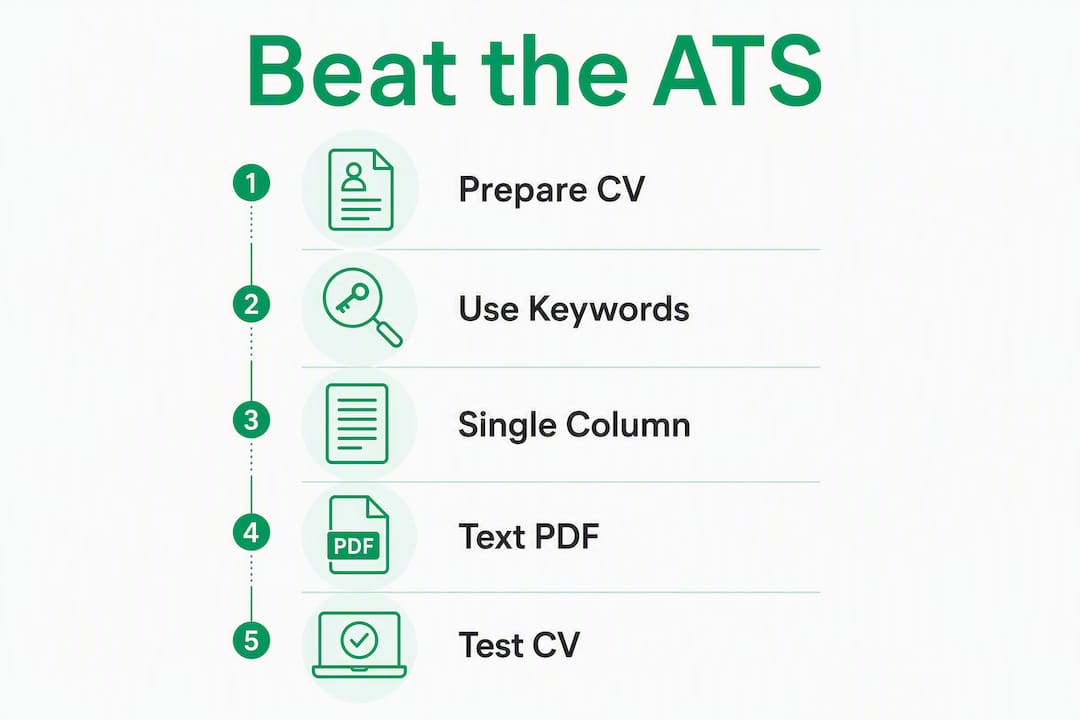
The formatting choices that help a parser also tend to help a recruiter scan quickly. They are not in conflict.
Do:
- Use a single-column layout throughout.
- Stick to standard section headings: “Professional summary,” “Work experience,” “Education,” “Skills,” “Certifications.”
- Choose system fonts: Arial, Calibri, or Times New Roman at 11–12pt for body text and 14–16pt for your name.
- Place contact details (phone, email, LinkedIn URL, city) in the main body of the document, not in a header or footer.
- Use consistent date formatting throughout (e.g., “Jan 2022 – Mar 2024”).
Don’t:
- Use two-column or multi-column templates, even if they look polished.
- Add icons, profile photos, or decorative graphics.
- Put your contact details in the document’s header or footer field — most parsers skip those zones entirely.
- Use decorative or script fonts.
- Build your skills section or experience layout inside a table.
Before/after example:
Before (parser-hostile): “Spearheaded cross-functional synergies to drive holistic outcomes across the business ecosystem.”
After (parser-friendly): “Led a five-person team to reduce monthly reporting time by 30% by introducing automated dashboards in Power BI.”
The second version contains a job title, a measurable result, and a named tool. All three are things a parser can extract and a recruiter can verify.
Pro Tip: Local SA career guides recommend keeping your CV to 1–2 pages in reverse-chronological order. Longer documents do not improve your ATS score and often reduce recruiter engagement.
How to extract and include the right keywords
Keyword matching is the core mechanic of ATS filtering. The goal is to mirror the job description’s exact language, not to guess what the system might accept.
- Copy the full job description into a blank document or a free word-frequency tool like WordCounter.
- Identify repeated phrases. Skills, tools, qualifications, and job titles that appear two or more times are the terms the recruiter (and the ATS) cares most about.
- Build a “Core skills” section near the top of your CV and list those exact phrases. If the JD says “project management” and “Agile methodology,” use those exact strings, not “managing projects” or “agile working.”
- Weave keywords into experience bullets. A skills list alone is weak. Embedding the same terms in context (“Managed a R2.5 million project using Agile methodology”) gives the parser two matches and gives the recruiter evidence.
- Include both the acronym and the full term where relevant. Write “Search Engine Optimization (SEO)” the first time, then “SEO” thereafter. Literal-match parsers can miss one form or the other.
For a CV in the 400–600 word range, aim for 2–3 mentions of your primary skills across the document. One in the skills section, one or two in experience bullets. More than that and the language starts to feel forced, which costs you when a human reads it.
Pro Tip: If the job description uses “financial reporting” and your CV says “financial analysis,” you may be a strong candidate who scores poorly. Copy the exact phrase, then add your own context around it.

File types, filenames, and submission checks
| File type | ATS readability | Common failure mode |
|---|---|---|
| Text-based PDF | High | None, if layout is single-column |
| .docx (Word) | High | Tracked changes or embedded objects can confuse parsers |
| Image-based PDF | Very low | Parser extracts no text; application appears blank |
| Scanned document | Very low | Treated as an image; no data extracted |
| .pages or .odt | Low | Many ATS platforms do not support these formats |
Beyond the file type, the filename matters more than most applicants realize. Some ATS workflows use filenames in folder organization or candidate records. A file named “CV_final_v3.pdf” tells a recruiter nothing. “Thabo-Mokoena-CV-Marketing-Manager.pdf” is clear, professional, and searchable.
Quick checks before you submit:
- Open the PDF and try to highlight text. If you cannot select it, the file is image-based.
- Paste the full CV text into Notepad and read it top to bottom. The order should make sense.
- Confirm your phone number and email appear in the main body, not only in the document header.
Cover letter and LinkedIn tweaks that help
Your LinkedIn profile and cover letter are often scanned alongside your CV, either by the ATS itself or by the recruiter immediately after.
- LinkedIn headline: Mirror the job title you are applying for, not a creative label. “Digital Marketing Specialist | SEO | Google Analytics” parses better than “Passionate storyteller helping brands grow.”
- Skills section: Add the exact skills from the job description to your LinkedIn skills list. Recruiters search LinkedIn the same way they search an ATS database.
- Cover letter: Use the job title and one or two exact phrases from the JD in your opening paragraph. Keep it evidence-led: one specific achievement that proves you can do the role. A cover letter stuffed with keywords reads as hollow to any human reviewer.
- Certifications: List them with the issuing body and date (e.g., “Google Analytics Certification, Google, 2024”). For South African qualifications, add the NQF level after the qualification name where relevant (e.g., “National Diploma in Human Resource Management, NQF Level 6”).
- Portfolio links: Place these in the main body of your LinkedIn profile, not only in the “Featured” section, which some ATS integrations do not read.
Measurable results matter to both ATS scoring and human reviewers. A bullet that says “Increased sales by 22% in Q3 2024” carries more weight than “Responsible for sales growth.”
How to test your resume before you apply
Run this sequence before submitting any application. It takes about 15 minutes.
- Text-extraction test: Copy all text from your CV and paste into Notepad. Check that sections appear in logical order and no text is missing or scrambled.
- Header/footer check: Scroll to the top and bottom of your document. If your name or contact details live only in the header or footer field, move them into the main body.
- ATS checker: Upload your CV to a free tool like Jobscan or Resume Worded (both offer free tiers). These tools compare your CV against a job description and flag missing keywords and formatting issues.
- Recruiter-read test: Ask a friend to look at your CV for six seconds, then tell you what role you are applying for and your strongest qualification. If they cannot answer both, your headline and summary need work.
A few things to avoid completely:
- Hidden white text stuffed with keywords. ATS platforms have spam heuristics that flag this, and any human reviewer who spots it will reject the application immediately.
- Keyword lists copied verbatim from the job description with no context.
- Submitting a .pages or .odt file unless the job posting explicitly requests it.
Career platforms warn that deceptive optimization tricks can trigger spam filters and eliminate an otherwise strong application.
South Africa-specific notes every applicant should know
A few local details that generic ATS guides miss entirely.
NQF levels: South African qualifications carry a National Qualifications Framework (NQF) level assigned by SAQA. When listing your qualifications, add the NQF level in brackets: “Bachelor of Commerce in Accounting (NQF Level 7), University of Pretoria, 2021.” This helps both the parser and the recruiter confirm your qualification level without ambiguity.
BEE and employment equity: Many South African employers are required to report on employment equity. Some application forms ask for demographic information separately. Your CV itself does not need to include this, but your qualifications and measurable results should be specific and verifiable, since local recruiters often cross-reference these against SAQA records.
Do not include your ID number. South African employers do not need your ID number at the CV stage, and including it creates an unnecessary privacy risk. Your name, phone number, email address, city, and LinkedIn URL are sufficient contact details.
Contact details placement: As noted above, place all contact information in the main body of your CV. Many South African ATS platforms used by larger employers, including those running SAP SuccessFactors or Oracle Taleo, skip header and footer zones during parsing.
Key takeaways
A single-column, keyword-tailored CV saved as a text-based PDF is the most reliable way to pass ATS filters and reach a human reviewer in South Africa.
| Point | Details |
|---|---|
| Single-column layout | Avoid two-column templates; they scramble parser output and cause fields to be missed. |
| Standard headings | Use “Work experience,” “Education,” and “Skills” so the ATS maps your content correctly. |
| Exact JD keywords | Mirror the job description’s exact phrases, including both acronyms and full terms. |
| Text-based PDF or DOCX | Test by highlighting text in the exported file; if you cannot select it, rebuild the document. |
| No ID number on your CV | Omit your South African ID number to protect your privacy at the application stage. |
| Findjobsza for direct browsing | Browse jobs in demand on Findjobsza to find roles with simplified application flows and no CV upload required. |
The ATS is not the enemy — your formatting is
Most job seekers treat ATS optimization as a game of stuffing the right words into a document. That framing leads to CVs that score well on a keyword checker and read terribly to the recruiter who opens them next.
The better frame: an ATS is a piece of readable technology with predictable behavior. It fails on columns, images, and creative headings. It succeeds on clean text, standard structure, and exact-phrase matches. Fix those three things and the system works with you, not against you.
What actually separates strong applications from weak ones is not keyword density. It is the combination of a parseable structure and quantified, specific achievement bullets that give a recruiter a reason to call. A CV that says “Managed a team” and a CV that says “Managed a team of eight and reduced staff turnover by 18% over 12 months” may score identically on a keyword check. Only one of them gets the interview.
Test your CV before every application. Paste it into Notepad. Run it through a free checker. Ask someone to scan it for six seconds. These are five-minute habits that compound quickly across a job search.
Skip the ATS queue on some roles with Findjobsza
Not every vacancy in South Africa runs through a multi-stage ATS pipeline. Smaller employers, direct-hire roles, and high-volume sectors often use simpler application flows where your CV goes straight to a hiring manager.
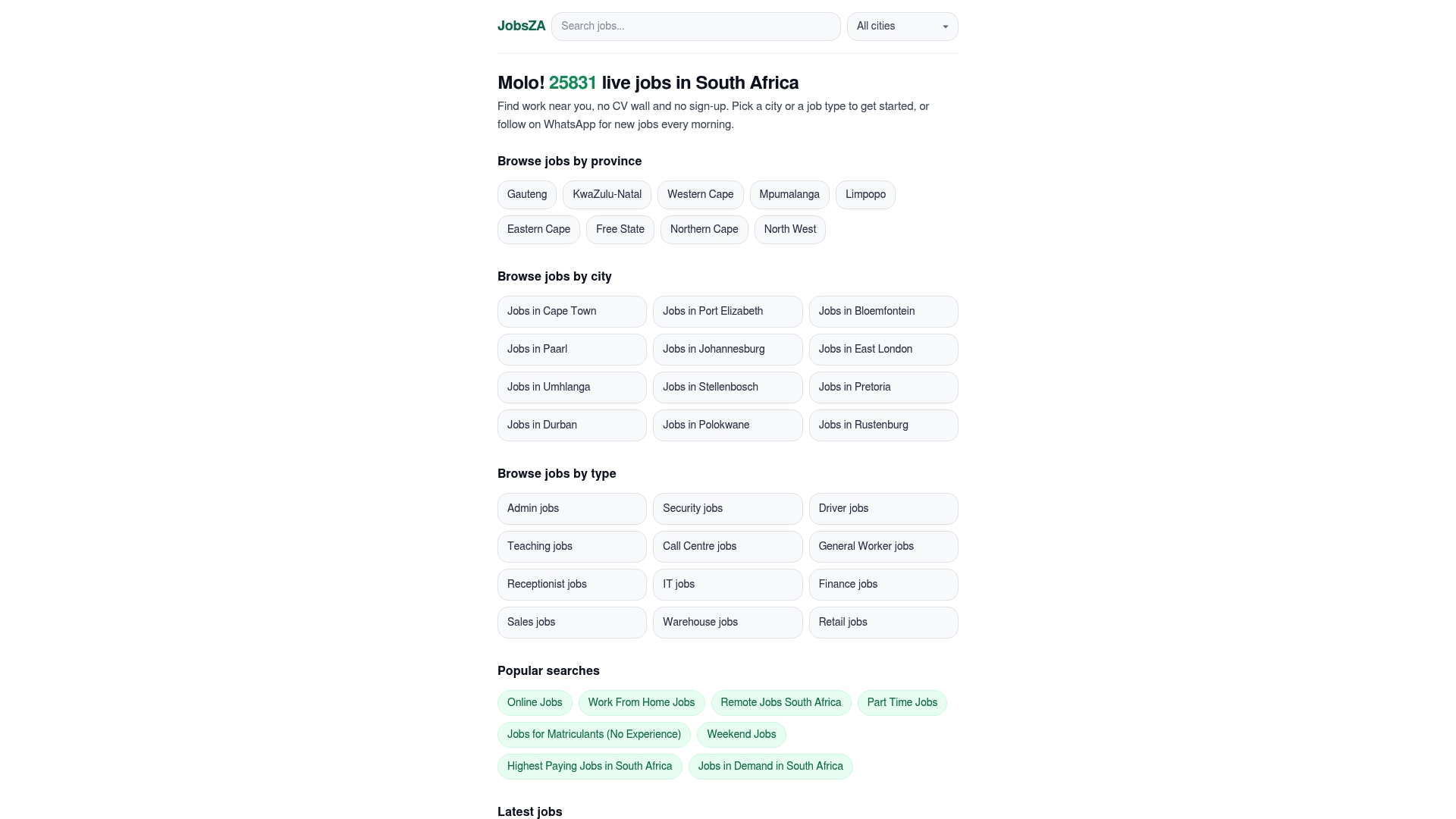
Findjobsza lists thousands of South African vacancies across sectors like sales, admin, IT, and jobs in demand with no CV upload or registration required. You browse by city or job type, apply directly, and receive new listings every morning via WhatsApp. For job seekers who want to keep applying while they refine their ATS-optimized CV, it is a practical parallel track. Browse current vacancies at findjobsza.co.za and sign up for the daily WhatsApp alert to get new listings before most applicants see them.
Useful sources and further reading
- Virginia Tech Career and Professional Development — What Is an Applicant Tracking System? — Plain-language explanation of ATS as a CRM and recruiter workflow tool.
- Coursera — Navigating the Applicant Tracking System — Course-backed guidance on keyword strategy and the risks of over-optimization.
FAQ
How do I beat ATS on my CV?
Use a single-column layout, standard section headings, and exact keywords from the job description. Save as a text-based PDF or .docx, then run a plain-text paste test to confirm the file parses correctly.
Is a 70% ATS match score good enough to apply?
A reasonable threshold score varies by platform and role. Aim to close obvious keyword gaps before submitting, particularly for roles where the JD lists specific tools or qualifications by name.
Do South African employers use ATS?
Larger South African employers and recruitment agencies commonly use ATS platforms such as SAP SuccessFactors and Oracle Taleo. Smaller businesses and direct-hire roles often do not, which is why browsing platforms like Findjobsza can surface roles with simpler application flows.
Should I include my South African ID number on my CV?
No. South African employers do not require your ID number at the CV stage, and including it creates an unnecessary privacy risk. Your name, phone number, email, and city are sufficient.
What file format should I use for an ATS resume?
A text-based PDF or .docx file gives the best results across most ATS platforms. Avoid image-based PDFs, scanned documents, and .pages files, which most systems cannot parse.
Recommended
Start with your city.
21 935 live jobs, filtered by city and suburb. No sign-up wall, no CV upload just to look.