Best remote job sites for South Africans: 2026 picks
1 August 202618 min read

Contents12 sections
- 1Table of Contents
- 2How do the best remote job sites compare for South Africans?
- 3What each remote job site does and how to use it effectively
- 4How do you choose the right remote job site for your search?
- 5A South Africa–first strategy: combine local boards with international sites
- 6Why Findjobsza is the right starting point for South African remote jobseekers
- 7Key takeaways
- 8What actually works for South African remote jobseekers
- 9Daily remote listings for South Africans, no CV needed
- 10Useful sources and further reading
- 11FAQ
- 12Recommended
Best remote job sites for South Africans: 2026 picks
For South African jobseekers, Findjobsza is the strongest local-first pick for daily remote listings with no CV upload or signup required. Pair it with a small set of global boards and you cover both the local market and international employers who are actively hiring South Africans right now.
Quick shortlist:
- Findjobsza — daily WhatsApp alerts, no-signup browsing, strong local category filters; start here every morning
- LinkedIn — best for full-time professional roles and networking-based hiring; use the “Remote” filter
- Indeed — high-volume aggregator; good for entry-level and broad industry searches
- Upwork — go-to freelance marketplace for contract and project-based remote work
- FlexJobs — paid membership board with vetted listings; worth it if scam fatigue is real
- We Work Remotely — large “anywhere” community; strong for developers, designers, and product roles
On fees: Most top remote job boards are free for jobseekers. FlexJobs charges a membership fee (jobseeker-facing) in exchange for curated, vetted listings with fewer scams. Upwork takes a service fee from freelancer earnings on completed contracts. Every other site on this list is free to browse and apply.
Table of Contents
- How do the best remote job sites compare for South Africans?
- What each remote job site does and how to use it effectively
- How do you choose the right remote job site for your search?
- A South Africa–first strategy: combine local boards with international sites
- Why Findjobsza is the right starting point for South African remote jobseekers
- Key takeaways
- What actually works for South African remote jobseekers
- Daily remote listings for South Africans, no CV needed
- Useful sources and further reading
- FAQ
How do the best remote job sites compare for South Africans?
| Platform | Best for | Pricing (jobseeker) | Job types | Geographic coverage | Application method | Alerts & mobile | Vetting/trust |
|---|---|---|---|---|---|---|---|
| Findjobsza | Local daily remote listings, SA jobseekers | Free | Full-time, part-time, freelance, entry-level | South Africa–focused | Direct apply, no CV/signup | Daily WhatsApp alerts | Local listings, no-scam focus |
| Professional full-time remote roles | Free (Premium paid) | Full-time, contract | Global | Profile apply | Strong app + alerts | High employer verification | |
| Indeed | Broad searches, entry-level | Free | All types | Global | Direct apply | Email alerts, mobile app | Moderate (aggregated) |
| Upwork | Freelance/contract gigs | Free to join; % fee on earnings | Freelance, contract | Global | Marketplace bidding | App + notifications | Escrow, reviews, ID verify |
| FlexJobs | Vetted, scam-free listings | Paid membership | Full-time, part-time, freelance | Global (SA accessible) | Direct apply | Email alerts | Manually vetted |
| Remote.co | Full-time remote roles, company research | Free | Full-time, contract | Global | Direct apply | Email alerts | Curated |
| Remote OK | Tech/startup roles, fast scanning | Free | Full-time, contract | Global | Direct apply | Email/RSS alerts | Moderate |
| We Work Remotely | Developers, designers, “anywhere” roles | Free | Full-time, contract | Global | Direct apply | Email alerts | Curated |
| Wellfound (AngelList) | Startup roles, early-stage companies | Free | Full-time, contract | Global | Direct + profile | App + alerts | Startup-verified |
| PNet | SA market research, sector-specific roles | Free | Full-time, contract | South Africa–focused | Direct apply | Email alerts | Local, established |
| JobMail | Entry-level, part-time SA roles | Free | All types | South Africa–focused | Direct apply | Email alerts | Local aggregator |
| JustRemote | Timezone/contract-type filtering | Free | Full-time, part-time, freelance | Global | Direct apply | Email alerts | Curated |
| Arc | Remote software/engineering roles | Free | Full-time, contract | Global | Marketplace/profile | Alerts | Developer-vetted |
| Contra | Creatives, consultants, contractors | Free (no commission) | Freelance, contract | Global | Direct client contact | Notifications | Profile-based |
| Remotive | Customer success, writing, admin | Free | Full-time, contract | Global | Direct apply | Newsletter | Curated |
| NoDesk | Remote-culture resources + listings | Free | Full-time, contract | Global | Direct apply | — | Curated |
| The Mom Project | Parents/caregivers, flexible roles | Free | Part-time, flexible, full-time | Global (US-heavy) | Profile apply | Alerts | Employer-committed |
| Truly Remote | General remote, wide industry spread | Free | All types | Global | Direct apply | — | Moderate |

Fee caveats: FlexJobs is the only platform here that charges jobseekers directly. Upwork’s fee applies only when you earn on a contract. All other platforms are free to use. Findjobsza has no jobseeker fees, no CV upload requirement, and no mandatory account creation.
How we chose these sites: Each platform was assessed on listing freshness, volume of remote roles accessible to South African applicants, ease of use without a paid account, and evidence of trust signals (employer verification, escrow, or manual curation). Local boards were included when they carry a meaningful volume of remote-tagged roles. Platforms with no South Africa accessibility or a history of low-quality listings were excluded.
What each remote job site does and how to use it effectively
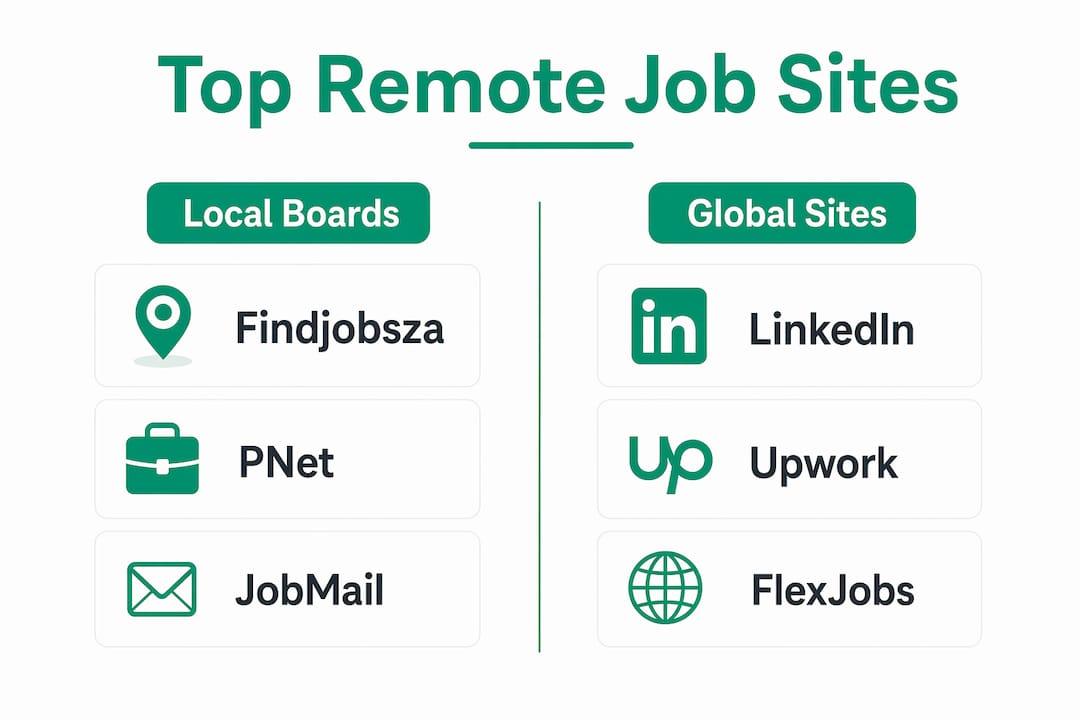
Findjobsza is built specifically for the South African market. Browse remote jobs in South Africa by city, province, or category without creating an account or uploading a CV. The daily WhatsApp alert is the standout feature: new listings land in your phone every morning before you’ve opened a laptop. Filter by “remote,” “online,” or “work from home” to narrow results fast.
LinkedIn rewards a complete profile more than almost any other platform. Recruiters search LinkedIn daily; a profile with a clear headline (“Remote Finance Analyst | South Africa”) and a skills section that includes Slack, Zoom, and Microsoft Teams will surface in more searches. Use the Jobs tab, filter by “Remote,” and set a daily alert for your top two or three role titles.
Indeed aggregates listings from thousands of employer sites, which means volume but also noise. Search “remote” plus a specific job title rather than browsing broadly. Set an email alert and check it daily; listings on Indeed can fill within 48 hours of posting.
Upwork works differently from a traditional job board. You build a profile, set an hourly or project rate, and submit proposals to clients. The escrow system protects payment on fixed-price contracts. South African freelancers on Upwork typically compete globally, so a strong portfolio and early reviews matter more than location.
FlexJobs charges a membership fee, but every listing is manually reviewed before it goes live. If you’ve wasted hours on scam listings elsewhere, the paid filter is worth considering. The site covers remote, hybrid, and flexible roles across dozens of categories.
Remote.co is more than a job board. It publishes company profiles and remote-work guides alongside listings, which makes it useful for researching whether a company genuinely supports remote culture before you apply.
Remote OK updates fast and lets you filter by timezone, which matters when you’re in SAST (UTC+2) and a role requires overlap with a US or European team. Tech and startup roles dominate, but marketing and customer success listings appear regularly.
We Work Remotely is one of the oldest and largest dedicated remote communities. Listings skew toward developers, designers, and product managers, and many are explicitly open to global applicants. Global boards like We Work Remotely regularly post “anywhere” roles that accept South African applicants.
Wellfound (AngelList) lets you apply directly to startup founders and hiring managers, often skipping the recruiter layer entirely. Useful if you want equity, a startup culture, or early-stage company exposure.
PNet is South Africa’s established local job portal. Its July 2026 Job Market Trends Report is the most cited source on remote-work growth in the country. Use PNet both for actual listings and to track which sectors are expanding remote roles.
JobMail is a local aggregator with broad category coverage. It suits entry-level and part-time seekers who want South African listings without navigating international platforms.
JustRemote filters by role type, timezone, and contract length, which makes it efficient when you have specific requirements. Useful as a secondary board rather than a primary daily source.
Arc focuses on software developers and engineers. The platform vets candidates before surfacing them to employers, which means the application process is more involved but the quality of matches is higher.
Contra is commission-free for contractors, which is a genuine differentiator. Creatives, writers, designers, and consultants build a public profile and contract directly with clients. No platform fee on earnings.
Remotive sends a curated newsletter of remote roles in customer success, writing, and admin. Subscribe to the newsletter and you get a weekly digest without having to check the site manually.
NoDesk combines a job board with remote-work resources and company profiles. Useful for researching remote-friendly employers rather than just scanning listings.
The Mom Project focuses on parents and caregivers seeking flexible remote work. The platform is US-heavy, but some roles are open to international applicants.
Truly Remote covers a wide range of industries with a simple filter set. Good as a supplementary board when you want variety without complexity.
Pro Tip: When a listing appears on three or more boards simultaneously with identical wording, it is almost certainly a repost or aggregated scrape. Go directly to the employer’s careers page to confirm the role is live before spending time on a proposal or cover letter.
How do you choose the right remote job site for your search?
Start with two or three complementary platforms: one local (Findjobsza or PNet), one high-volume global board (LinkedIn or Indeed), and one niche or marketplace site that matches your field (Upwork for freelancers, Arc for developers, Contra for creatives). More than three active boards usually creates noise rather than coverage.
Five questions to ask before committing to a board:
- How fresh are the listings? Check the posting date on five random listings. If most are older than two weeks, the board has a freshness problem.
- What is the application method? Direct-apply boards (Indeed, Remote OK) are faster; marketplace platforms (Upwork, Contra) require a profile investment upfront.
- Is there a jobseeker-facing fee? Free is the norm. A membership fee is only worth paying when the board offers genuine vetting (FlexJobs is the clearest example).
- Does the platform have escrow or payment protection? For freelance work, this is non-negotiable. Upwork’s escrow and Contra’s direct contracting both protect earnings.
- Are South African applicants explicitly welcome? Look for “worldwide,” “anywhere,” or “EMEA” in the location field. A role restricted to US residents or requiring a US work permit is not worth applying for.
Red flags to walk away from:
- Job descriptions with no company name, no contact details, and a generic Gmail address
- Any listing that asks you to pay a fee to access the “full job details” or to “secure your spot”
- Roles promising unusually high pay for vague tasks (“data entry, $5,000/week”)
- Listings with no application deadline and no posting date
Quick verification: search the company name on LinkedIn, check that their domain matches the email in the listing, and confirm the role appears on their own careers page.
A South Africa–first strategy: combine local boards with international sites
The most effective approach for South African remote jobseekers is a hybrid local-plus-international routine. Local boards give you immediate, relevant listings with less competition; international boards open up higher pay and a wider range of roles.
Remote work in South Africa is growing fast. According to PNet’s July 2026 Job Market Trends Report, remote employment opportunities were 28% higher in the first half of 2026 than in the same period of 2025, and 41% higher than two years earlier. That growth is no longer confined to IT. Finance remote roles increased dramatically over two years; marketing and design roles doubled since 2024. Bookkeeping, admin, customer support, and sales are all expanding alongside tech.
“UK companies are increasingly hiring South Africans to work from home, and they’re paying them well. The demand has shifted from IT-only to roles in finance, sales and marketing. South African workers offer a strong timezone overlap with Europe and excellent communication skills.” — Sasha Knott, CEO of Job Crystal, EWN, July 2026
Career expert Douw Steyn makes the same point from the jobseeker side: use a local, high-refresh board for daily opportunities and layer in international boards for higher-pay roles and broader choice.
Daily routine that works:
- Check Findjobsza WhatsApp alerts each morning and shortlist two or three relevant roles
- Run a saved LinkedIn search for your top role title with the “Remote” filter
- Apply to roughly five targeted roles each day and log every application in a spreadsheet (role, company, date, status)
- Expect the first offer to come after many applications; consistency matters more than volume; consistency matters more than volume
On timezone and pay: SAST (UTC+2) overlaps well with UK and European business hours, which is exactly why British employers are actively recruiting South Africans. When negotiating pay with an international employer, research the role’s market rate in the employer’s country and anchor your ask there rather than to local South African benchmarks.
Industries to prioritise: Finance, marketing, admin, and IT are the four sectors with the strongest remote-role growth in South Africa right now. If your background is in any of these, you have more options than the job boards alone suggest.
Why Findjobsza is the right starting point for South African remote jobseekers
Findjobsza is the recommended local-first destination for daily, no-signup remote listings and WhatsApp alerts in South Africa. No other platform on this list combines local listing depth with that level of friction removal for South African jobseekers.
What makes it different in practice:
- Go to findjobsza.co.za/remote-jobs-south-africa and browse immediately, no account needed.
- Filter by city or province to see roles relevant to your location or timezone.
- Select a category (remote, online, part-time) to narrow the feed.
- Click “Apply” on any listing for a direct application path, no CV upload required.
- Sign up for the daily WhatsApp alert to receive new listings every morning before competitors see them.
Findjobsza is free for jobseekers. The platform’s revenue comes from employers who pay to post listings, which means there is no paywall between you and the jobs. The online jobs category covers virtual, work-from-home, and remote-tagged roles across all major sectors.
Pro Tip: Set your Findjobsza WhatsApp alert and your LinkedIn job alert for the same role title on the same day. You’ll cover the local market and the international market in under five minutes each morning, leaving the rest of your time for applications.
Key takeaways
The single most effective strategy for South African remote jobseekers is to combine Findjobsza for daily local listings with one or two global boards, apply to roughly five targeted roles each day, and track every application in a spreadsheet.
| Point | Details |
|---|---|
| Start local, go global | Use Findjobsza for daily SA listings, then add LinkedIn or Indeed for international roles. |
| Remote work is growing fast | PNet data shows SA remote opportunities were 28% higher in H1 2026 than a year earlier. |
| Most boards are free | Only FlexJobs charges jobseekers; Upwork takes a cut of freelance earnings only. |
| Apply consistently | Most jobseekers who apply consistently need between 50 and 100 targeted applications before receiving their first remote offer; track every one in a spreadsheet. |
| Findjobsza for SA jobseekers | No CV, no signup, daily WhatsApp alerts, and free access to remote listings across South Africa. |
What actually works for South African remote jobseekers
The pattern that consistently produces results is simpler than most guides suggest: pick two or three platforms, apply daily to a small number of well-matched roles, and keep a spreadsheet. That last part sounds tedious until you’re juggling 60 applications and can’t remember which company asked for a portfolio.
The sector advice matters too. Finance, admin, marketing, and IT are not just growing in remote listings; they are the categories where international employers are most actively looking at South African candidates. If your background sits outside those four, that doesn’t close doors, but it does mean you’ll need to work harder on the international boards and lean more heavily on local listings in the short term.
Realistic timeline: most jobseekers who apply consistently land their first remote role within two to four months. The ones who get there faster are almost always the ones who tailored each application for remote-readiness, meaning they named the tools (Slack, Zoom, Asana) and described outcomes they delivered without being in an office.
Daily remote listings for South Africans, no CV needed
Findjobsza removes the two biggest friction points in the South African job search: the CV upload and the mandatory account. You can browse remote jobs in South Africa right now, filter by city or job type, and apply directly to any listing without creating a profile.
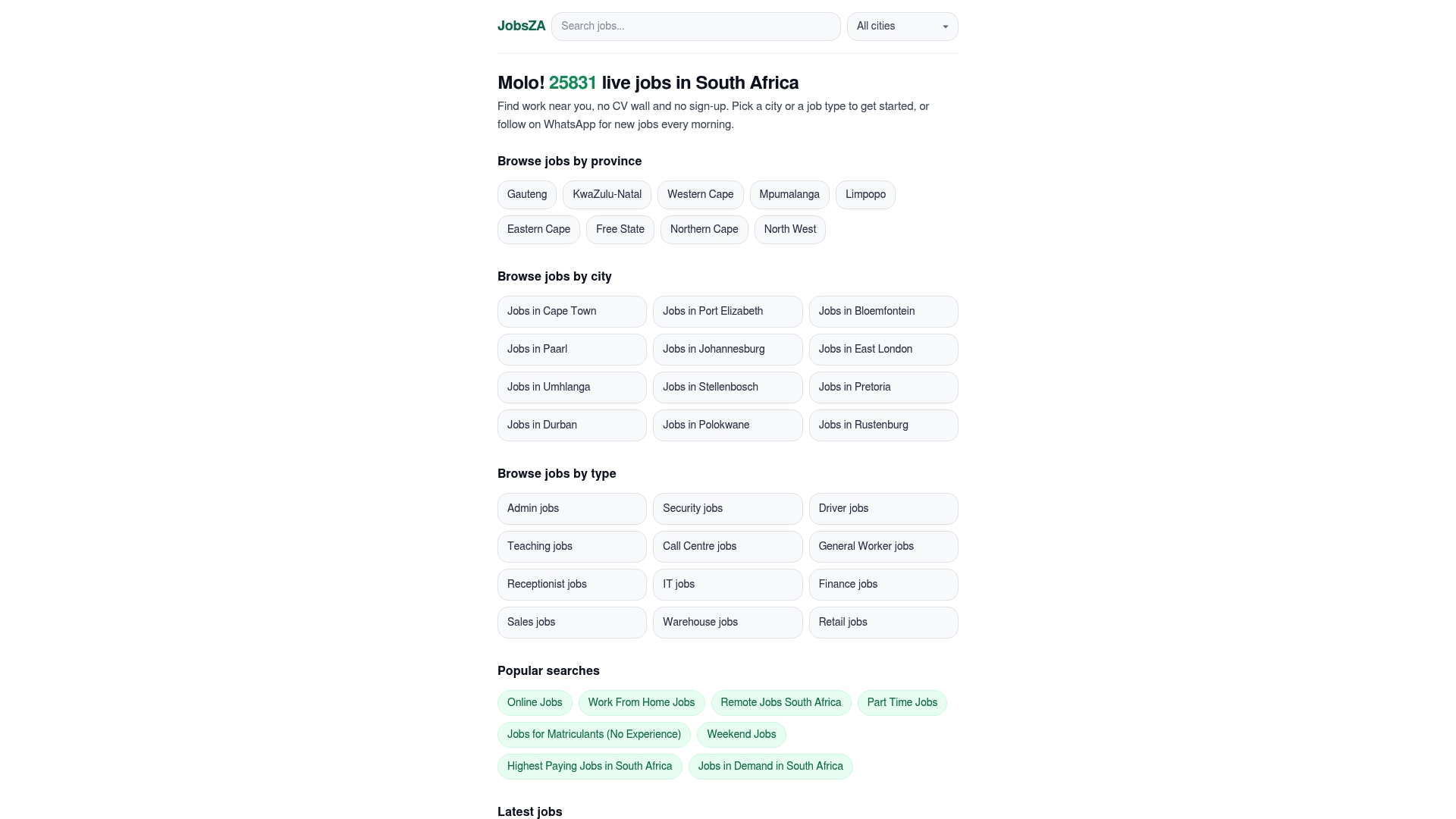
The daily WhatsApp alert means you see new listings before most applicants have opened their laptops. For part-time and online roles, the category filters narrow the feed to exactly what you’re looking for in seconds. Findjobsza is free for jobseekers; employers pay to post, so there is no paywall on your end.
Start with the remote listings page, set your WhatsApp alert, and apply to your first five roles today.
Useful sources and further reading
The figures and expert quotes in this article draw on the following sources, selected for freshness, direct relevance to South Africa, and named expert attribution:
- PNet July 2026 Job Market Trends Report (ABS Africa TV summary) — primary source for SA remote-work growth statistics
- TechCentral: Remote work in South Africa hits record high — 28% and 41% growth figures
- EWN: UK companies increasingly hiring South Africans — Sasha Knott quote and sector-spread data
- ProDaily: How to actually find legitimate remote jobs in South Africa — daily routine, ATS keywords, fee guidance
- GigsZA: Which remote job sites are best for South Africans? — Douw Steyn hybrid-strategy recommendation
Key market figures at a glance:
| Metric | Figure | Source |
|---|---|---|
| SA remote opportunities, H1 2026 vs H1 2025 | +28% year-on-year | PNet July 2026 Job Market Trends Report |
| SA remote opportunities, H1 2026 vs two years prior | +41% over two years | PNet July 2026 Job Market Trends Report |
| Finance remote roles growth (two years) | More than quadrupled | PNet July 2026 Job Market Trends Report |
| Marketing and design remote roles growth (since 2024) | Doubled | PNet July 2026 Job Market Trends Report |
Sources were selected based on three criteria: published in 2026 or citing 2026 data, direct relevance to South African jobseekers, and named expert or institutional attribution.
FAQ
What is the most legitimate site for remote jobs in South Africa?
Findjobsza is the most accessible legitimate local option, with no-signup browsing and daily WhatsApp alerts. For vetted international listings, FlexJobs manually reviews every posting before it goes live.
Which single global board is best for South African remote jobseekers?
LinkedIn is the strongest single global board because it combines a large volume of remote listings with direct recruiter access and an integrated profile that doubles as your application. Set the “Remote” filter and create a daily alert for your target role.
Do remote job sites charge jobseekers a fee?
Most do not. FlexJobs is the main exception, charging a membership fee in exchange for manually vetted, scam-free listings. Upwork deducts a service fee from freelancer earnings on completed contracts. Every other platform on this list is free to browse and apply.
How do I make my remote job application stand out?
Include explicit remote-work keywords in your CV and profile: tool names like Slack, Zoom, and Microsoft Teams, plus behaviours like time management and phrases describing outcomes you delivered while working independently. ATS filters on most platforms actively penalise vague CVs that omit these terms.
How many applications does it typically take to land a remote role?
Most South African jobseekers who apply consistently need between 50 and 100 targeted applications before receiving their first remote offer. Applying to roughly five well-matched roles each day and tracking progress in a spreadsheet is the routine that correlates most strongly with success.
Recommended
Start with your city.
21 959 live jobs, filtered by city and suburb. No sign-up wall, no CV upload just to look.