Blue collar recruiting in South Africa: agency or direct hire?
22 August 202612 min read

Contents13 sections
- 1Table of Contents
- 2What do blue-collar recruitment agencies do in South Africa?
- 3Should you use an agency or hire directly for this role?
- 4How to choose a responsible blue-collar recruitment agency
- 5Sourcing and screening tactics for trades and manual roles
- 6Managing cost, transport, and seasonal recruitment fairly
- 7Hiring around the artisan shortage: what actually works
- 8How Findjobsza helps you act on this today
- 9What South African employers get wrong about blue-collar hiring
- 10Post your vacancy directly and skip the agency markup
- 11Sources
- 12FAQ
- 13Recommended
Blue collar recruiting in South Africa: agency or direct hire?
Use a blue-collar recruitment agency when you need volume fast, face a genuine skills scarcity, or lack in-house payroll capacity for temporary labour. Hire directly when the role is permanent, single-post, and you can run a skills-first screen yourself. That’s the whole decision in one line, but getting it right also means acting today.
Post the vacancy now, whether through an agency or directly on Findjobsza, and build a practical skills-task into the job brief before you write a single interview question. Certificates lie sometimes; a 20-minute test rarely does.
Before you post anything, three compliance reminders matter more than most job ads bother to mention:
- Pay at least the national minimum wage of R30.23 per hour, effective from 1 March 2026.
- Register and deduct UIF for every employee, agency-placed or direct.
- Issue written particulars of employment on day one, not week three.
South Africa’s unemployment rate sits at 33.6%, rising to 46.3% once discouraged jobseekers are counted. Labour supply is not your problem. Finding the right person, fast and lawfully, is.
Table of Contents
- What do blue-collar recruitment agencies do in South Africa?
- Should you use an agency or hire directly for this role?
- How to choose a responsible blue-collar recruitment agency
- Sourcing and screening tactics for trades and manual roles
- Managing cost, transport, and seasonal recruitment fairly
- Hiring around the artisan shortage: what actually works
- How Findjobsza helps you act on this today
- What South African employers get wrong about blue-collar hiring
- Post your vacancy directly and skip the agency markup
- Sources
- FAQ
What do blue-collar recruitment agencies do in South Africa?
A blue-collar recruitment agency sources, vets, and places workers for warehouse, construction, manufacturing, and skilled trades roles, then usually handles the payroll admin that comes with temporary placements. Most agencies working in industrial workforce solutions offer some combination of the following:
- Candidate sourcing and reference checks across trades, general labour, and machine operators
- Temporary Employment Services (TES) arrangements, where the agency remains the legal employer of record
- Payroll processing, UIF and SDL administration, and payslip issuing for placed workers
- Onboarding support, including safety induction and site-specific orientation
- Replacement guarantees if a placed worker doesn’t work out within an agreed window
A decent agency can shrink time-to-fill for a warehouse picker role from three weeks to five days, because they already have vetted candidates on file rather than starting from zero. That speed comes at a fee, usually a percentage of the placed worker’s wage or a flat markup on the hourly rate.
Watch for red flags before signing anything. Any agency charging workers a fee to be placed is violating responsible recruitment principles. Vague payroll deductions, no physical office near your site, and reluctance to share a sample contract are all reasons to walk.
Should you use an agency or hire directly for this role?
Run each vacancy through four questions before deciding.
- How urgent is it, and how many do you need? One permanent boilermaker with three months’ notice period? Hire directly. Fifteen general labourers for a plant shutdown starting Monday? Call an agency.
- How scarce is the skill? Common roles like packers or drivers are easy to source yourself. Certified artisans are a different story entirely.
- Do you have payroll and compliance capacity for temporary or seasonal staff? If UIF registration, SDL calculations, and short-term contracts already overwhelm your HR team, an agency’s TES structure removes that burden.
- Is the need seasonal or permanent? Seasonal harvest labour or a six-week construction push rarely justifies building an internal recruitment pipeline.
A quick cost comparison helps too: direct hire costs you time and internal admin hours; agency hire costs a placement fee, typically 15% to 25% of first-year wage for permanent roles, or a per-hour markup for temporary staff.
Pro Tip: Run the numbers on admin hours, not just the invoice. If your HR team spends six hours a week on UIF and payslip queries for five temp workers, the agency fee often pays for itself.
How to choose a responsible blue-collar recruitment agency
Not all agencies operate the same way, and the difference shows up fast once workers are on-site. Before signing a contract, verify these three areas.

Responsible recruitment practices. Confirm the agency never charges workers a placement fee, discloses payroll deductions in writing, and can show current UIF and SDL compliance. Stronger Together’s South African resources give a solid benchmark for what ethical recruitment looks like in this market.
Operational proof. Ask for a local office or representative near your site, evidence of experience in your specific sector (mining, agriculture, manufacturing), two contactable references from similar clients, and confirmation they run a health and safety induction before workers arrive on-site.
Commercial terms. Get clarity on replacement guarantees (what happens if a placed worker quits in week one), invoicing cycles, whether the agency carries its own liability insurance, and their B-BBEE status if that matters for your procurement policy.
Ten questions worth asking on the first call:
- Do you charge workers any fee to be placed?
- Can you send a sample employment contract?
- What’s your UIF and SDL compliance status?
- Who is my local point of contact?
- What sectors do you specialise in?
- Can I speak to two current clients?
- What’s your replacement guarantee period?
- How do you invoice, weekly or monthly?
- Do you carry public liability insurance?
- What does your on-site safety induction cover?
Sourcing and screening tactics for trades and manual roles
Certified artisans are scarce, but competent workers aren’t always the same as certified ones. Skills-first screening finds people the certificate-only approach misses.
- Run a short practical test: four tasks scored on safety, tool handling, speed, and fault-finding, typically completed in half a day
- Offer a paid trial shift instead of relying purely on interviews
- Score candidates against a checklist rather than a gut feeling
For sourcing, don’t limit yourself to one channel. WhatsApp-based job alerts reach candidates who never check traditional job boards, community noticeboards near industrial areas still work, and TVET colleges are worth a direct call for graduating cohorts. Referrals from existing staff remain one of the highest-quality sources for warehouse and general labour roles.
Before anyone starts, verify ID, right to work in South Africa, basic health and safety competency, and at least one site-based reference from a previous employer.
Pro Tip: Pay candidates for the trial shift, even a half-day one. It cuts no-shows dramatically and signals you run a fair operation, which matters more than you’d think in a tight labour pool.
Managing cost, transport, and seasonal recruitment fairly
Total cost-to-company for a blue-collar hire goes well beyond the hourly rate. Budget for the wage, statutory deductions, and transport before you commit to headcount.
| Cost item | 2026 figure or rule |
|---|---|
| National minimum wage | R30.23 per hour |
| UIF | 1% employee + 1% employer |
| SDL | 1% of payroll, only if annual payroll exceeds R500,000 |
| Transport | Budget separately; disclose upfront, never deduct retroactively |
Include transport in the offer, either as a stipend or employer-arranged shuttle, rather than leaving workers to absorb it. SIZA’s seasonal recruitment guidance recommends disclosing transport costs before the worker accepts the role, which prevents disputes once they’re already on-site.
- Never deduct wages retroactively for uniforms, tools, or transport without written agreement
- For seasonal agriculture or mining shutdown work, confirm the agency is an accredited TES partner before engaging
Hiring around the artisan shortage: what actually works
The gap between artisan demand and supply is widening, not closing. Employers reporting recruitment difficulty for skilled trades roles jumped from 10% to 22%, while TVET college output (NC(V) throughput) peaked at just 14% in 2024. The average certified artisan is now in their mid-fifties, meaning retirements will outpace replacements for years.
Waiting for certified graduates isn’t a strategy; instead, consider preparing students for career success by teaching real-world skills to build your own artisan pipeline. Build your own pipeline instead:
- Sponsor apprenticeships or learnerships tied to your specific plant equipment
- Partner directly with TVET colleges rather than posting and hoping
- Run competence assessments that recognise on-the-job skill, not just paper qualifications, an approach supported by industry analysis of South Africa’s artisan gap
- Offer a clear path from labourer to qualified tradesperson, with mentoring built in
Retention matters as much as sourcing here. A worker who sees an incremental certification path stays; one who sees a dead-end job doesn’t.
How Findjobsza helps you act on this today
Speed matters more than most hiring guides admit, and Findjobsza is built around exactly that problem for South African employers.
- No CV uploads or sign-ups required, which removes friction for candidates who’ve stopped bothering with traditional applications
- Filter by city, province, or job type, useful when you’re hiring for a specific site rather than a national search
- Daily WhatsApp job alerts put your listing in front of candidates every morning, not buried in an inbox
To start: post the role, attach a short skills-task to the listing so applicants self-screen before you interview, and check daily as WhatsApp alerts bring in new applicants. For roles competing with better-paying trades, it’s worth glancing at what similar roles pay elsewhere before finalising your offer.
| Point | Details |
|---|---|
| Fastest route for volume | Use an agency for urgent or high-volume temporary needs; direct hire for single, permanent roles |
| Skills-first beats certificates-only | Practical tests and paid trial shifts find competent workers faster than waiting for scarce artisan certificates |
| Compliance is non-optional | Pay R30.23/hr minimum, register UIF, and issue written particulars from day one |
| Transport prevents disputes | Disclose transport costs upfront rather than deducting them after the fact |
| Findjobsza speeds direct hiring | No-CV posting and daily WhatsApp alerts help employers fill roles fast without agency fees |
What South African employers get wrong about blue-collar hiring
Most hiring advice treats blue-collar recruitment as a scaled-down version of white-collar hiring, just with less paperwork. That’s backwards. The paperwork burden, UIF, SDL, written particulars, sectoral determinations, is often heavier for temporary and seasonal blue-collar roles than for a single permanent office hire.
The bigger error is treating certification as a proxy for competence. With TVET throughput this low and the artisan workforce ageing out, employers who insist on paper qualifications before considering a candidate are shrinking their own pool for no good reason. A worker who passes a scored practical test on safety and fault-finding is often a better bet than one with a certificate and no recent hands-on experience.
Where I’d push back on conventional wisdom: agencies get treated as the default answer to every blue-collar staffing gap. They’re the right answer for volume, urgency, and payroll complexity. They’re the wrong answer for a single permanent role you could fill yourself in two weeks with a well-written brief and a fair skills test. Know which problem you actually have before you reach for the phone.
Post your vacancy directly and skip the agency markup
If you’ve read this far, you probably already know whether your vacancy needs agency muscle or just a faster way to reach the right candidates directly. For the second group, that’s exactly the gap Findjobsza fills: post a role, skip the CV pile, and let daily WhatsApp alerts put your listing in front of job-seekers actively looking that morning, not three weeks from now.
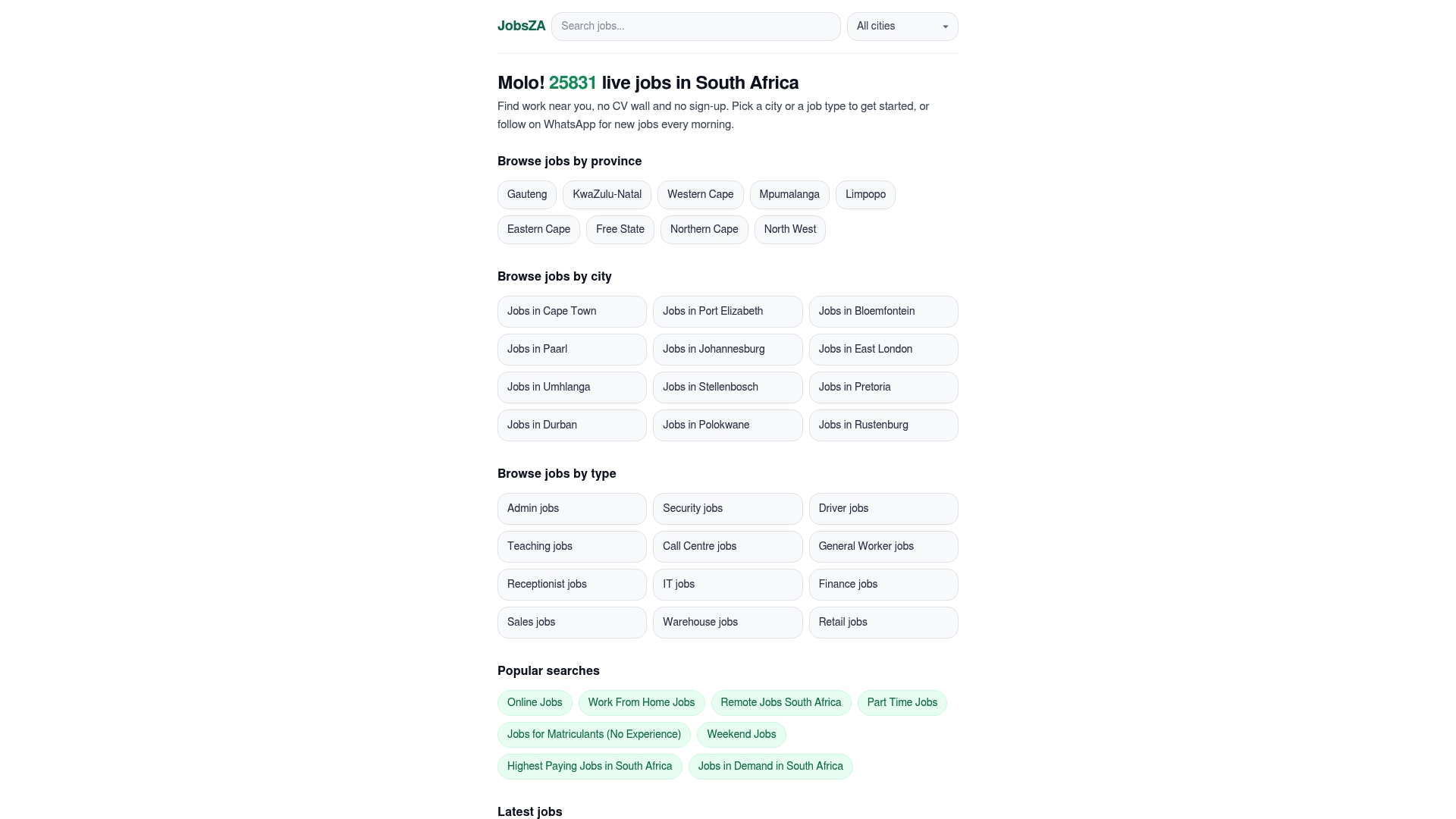
Findjobsza works for warehouse pickers, general labourers, machine operators, and skilled trades alike, without the placement fees or long-term contracts that come with agency staffing. Browse candidates by city or job type, and if the role sits closer to admin or support functions than the shop floor, the same no-CV flow applies on the jobs in demand page. For seasonal or shift-based positions, the weekend jobs listings reach candidates specifically looking for that kind of work. Post your vacancy today and let the WhatsApp alerts do the sourcing overnight.
Sources
- Stronger Together ZA — responsible recruitment resources
- We News — South Africa’s skills crisis in the trades (2026)
- SIZA: best practices in recruiting seasonal labour
FAQ
What are some examples of blue-collar jobs in South Africa?
Common blue-collar roles include warehouse pickers and packers, boilermakers, electricians, forklift operators, construction labourers, machine operators, and agricultural or seasonal farm workers. Demand tends to spike around plant shutdowns, harvest seasons, and construction project starts.

How can I apply for a job through an online platform like Findjobsza?
Findjobsza lets job-seekers browse listings by city or job type with no CV upload or sign-up required, then apply directly to the employer. Candidates can also enable daily WhatsApp alerts to receive new listings each morning without checking the site manually.
How do I send my CV to recruitment agencies?
Most South African recruitment agencies accept CVs by email or through an online portal, and reputable agencies never charge a fee for this. Confirm the agency’s data handling and privacy practices before sending personal documents, and avoid any agency requesting payment to process an application.
Should I use a recruitment agency or hire blue-collar workers directly?
Use an agency for urgent, high-volume, or seasonal hiring where you lack in-house payroll capacity; hire directly for single permanent roles you can screen yourself with a practical skills test.
Recommended
Start with your city.
20 068 live jobs, filtered by city and suburb. No sign-up wall, no CV upload just to look.