The job search tips that actually shorten your search in 2026
24 August 202612 min read

Contents14 sections
- 1Key Takeaways
- 2Table of Contents
- 3Job search tips for a CV that beats ATS and persuades humans
- 4How do referrals and networking speed up a job search?
- 5Where should you look for jobs, and how do you avoid ghost listings?
- 6Tailoring applications: fewer, sharper applications beat mass submissions
- 7How should you prepare for interviews in 2026?
- 8How do you follow up without seeming pushy?
- 9Which upskilling moves actually help while you’re searching?
- 10How Findjobsza fits into a faster job search
- 11What the data actually tells you to do first
- 12Sources
- 13FAQ
- 14Recommended
The job search tips that actually shorten your search in 2026
Here are the actions that produce the most interviews and offers right now, ranked by leverage.
- Tailor your CV to each role — three reworded bullets beat a full rewrite.
- Ask for referrals before you apply cold. Referrals convert to offers at roughly four times the rate of cold applications, yet most job seekers spend the bulk of their week on applications instead.
- Set alerts on niche boards and company pages, not just the big aggregators.
- Practice interview answers out loud and record yourself.
- Track every application with a simple follow-up schedule.
- Close one visible skill gap with a short course or a single portfolio piece.
- Apply with precision — ten well-matched applications a week beats fifty generic ones.
- Use a real-time discovery channel, like daily job alerts, to catch fresh listings before they go stale.
In the next 60 minutes: pick one job posting, rewrite your top three CV bullets around its actual keywords, and message one contact for a 15 minute conversation. That combination does more for your search than a full afternoon of scrolling job boards.
Key Takeaways
Referrals convert significantly better than cold applications, and tailored, ATS-aware CVs paired with out-loud interview practice consistently produce more offers than high-volume generic applications.
| Point | Details |
|---|---|
| Prioritise referrals | Spend about 40% of search hours on networking since referrals convert around four times better than cold applications. |
| Tailor, don’t mass-apply | Ten well-matched applications a week outperform dozens of generic submissions under modern ATS screening. |
| Rehearse out loud | Recording practice answers reveals filler words and pacing problems silent review misses. |
| Follow up within 48 hours | Add one new piece of evidence rather than a plain check-in, and log it in a tracker. |
| Use daily alerts as discovery | Platforms with morning WhatsApp updates surface fresh listings before they go stale. |
Table of Contents
- Job search tips for a CV that beats ATS and persuades humans
- How do referrals and networking speed up a job search?
- Where should you look for jobs, and how do you avoid ghost listings?
- Tailoring applications: fewer, sharper applications beat mass submissions
- How should you prepare for interviews in 2026?
- How do you follow up without seeming pushy?
- Which upskilling moves actually help while you’re searching?
- How Findjobsza fits into a faster job search
- What the data actually tells you to do first
- Sources
- FAQ
Job search tips for a CV that beats ATS and persuades humans
Applicant tracking systems reject CVs for formatting they can’t parse and content that reads like a job description instead of a track record. Skip tables, text boxes, and columns. Use standard headings (Experience, Education, Skills) and let keywords appear naturally inside sentences, not as a stuffed list at the bottom.
The bigger fix is turning duties into outcomes. Compare:
- “Responsible for managing social media accounts” → “Grew Instagram engagement 38% in six months by shifting posting schedule to peak traffic windows.”
- “Handled customer complaints” → “Resolved 90% of escalated complaints within 24 hours, cutting refund requests by a third.”
- “Assisted with inventory” → “Rebuilt stock tracking process that cut monthly count time from six hours to two.”
For each application, reorder the top half of your CV so the most relevant role or project sits first, swap in the exact phrasing from the job ad where it’s true, and cut anything from the top third that doesn’t relate to this specific role.
Quick CV checklist: contact details current, one-line summary matched to the role, metrics in at least half your bullets, no tables or graphics, consistent date format, spell-checked, saved as a plain PDF, file named with your actual name, under two pages, and no CV submissions or logins needed if you’re browsing platforms built to skip that friction.
Pro Tip: Keep a “master CV” with every bullet you’ve ever written, then build each tailored version by deleting from it rather than starting fresh — it’s faster and you never lose a good line.
How do referrals and networking speed up a job search?
Referrals beat cold applications for a simple reason: someone already vouches for you before a recruiter opens your CV. That trust converts. Short informational interviews, 15 to 20 minutes, build the kind of relationship that produces an introduction later, without ever asking anyone for a job outright.
- Reach out with curiosity, not a request. Message someone in a role or company you’re targeting and ask for 15 minutes to learn about their path. Don’t attach your CV.
- Ask about the work, not the vacancy. Good questions: “What does a typical week look like?” or “What surprised you most about this industry?”
- Close with a specific ask. “Is there someone else in your network doing similar work I should talk to?” is far more likely to produce a lead than “Do you know of any openings?”
Aim for three to five of these conversations a week alongside your applications.
Pro Tip: Send a two-line thank-you note within 24 hours of every informational interview. It’s the cheapest relationship-maintenance move in the entire search.
Where should you look for jobs, and how do you avoid ghost listings?
General job boards flood you with volume, but niche boards and direct company career pages often surface higher-quality, less competitive leads. Local recruiters in South Africa consistently point candidates toward targeted platforms and direct recruiter relationships over blanket applications for exactly this reason.
- Set alerts on two or three niche boards plus the career pages of five to ten target companies.
- Check alert relevance weekly. If a source keeps sending stale or unrelated roles, drop it.
- A platform with daily push updates, like WhatsApp job alerts, catches new postings before they’re buried.
- Before tailoring an application, verify the listing: is it recently posted, does the company have an active presence elsewhere, and does the description match a real, specific team or project? Two “no” answers means it’s likely a ghost job.
- If a role has been reposted repeatedly for months with no movement, skip the application form and message the hiring manager directly on LinkedIn instead. It’s faster and shows initiative.
Tailoring applications: fewer, sharper applications beat mass submissions
Modern hiring systems, including AI-scored screening used across 2026 hiring, reward relevance, specificity, recency, and outcomes over sheer application volume. Ten tailored applications a week, sent with real attention to each posting, consistently beat fifty generic ones.
- Rewrite your headline to match the exact job title or closest natural variant.
- Reorder or reword three CV bullets to mirror the language and priorities in the posting.
- Write a three-sentence cover note naming the company, one specific reason you want the role, and one metric from your background that matches their need.
AI tools can speed drafting, but treat every generated line as a starting point, not a final answer. Read it back and cut anything that doesn’t sound like you.
Before hitting submit, do a two-minute check: does your headline match the job title, does at least one bullet use their exact terminology, and would a hiring manager know within ten seconds why you’re a fit?
Pro Tip: Keep a swipe file of three cover-note openings you’ve already written well. Adapting one takes two minutes instead of ten.
How should you prepare for interviews in 2026?
Practising answers out loud, ideally recorded, reveals filler words, weak phrasing, and confidence drops that silent rehearsal simply misses. You don’t notice you say “um” nine times a minute until you hear it played back.

The STAR framework structures behavioural answers cleanly: Situation (context in one sentence), Task (what you were responsible for), Action (what you actually did), Result (the outcome, ideally with a number). Write one STAR answer for your biggest achievement, your hardest conflict, and your best example of learning fast, and you’ve covered most common prompts.
For video and AI-screened interviews: sit facing a window or lamp, not a bright light behind you, position the camera at eye level, and glance at the lens rather than the screen when you answer.
- 24 hours before: review the job posting and your three STAR answers once, out loud.
- One hour before: test your camera and audio, close every other tab, and read your opening line one more time.
How do you follow up without seeming pushy?
- Send a follow-up within 48 hours of an interview, adding one new piece of evidence (a relevant link, a clarifying point you wish you’d made) rather than just “checking in.” Job search guides consistently recommend this window as the sweet spot between attentive and impatient.
- Track every application in a simple spreadsheet: company, role, date applied, stage, next action, notes.
- After a rejection, ask one specific question: “Is there anything I could have shown that would have strengthened my application?” Apply any answer you get to the next role you tailor for.
Which upskilling moves actually help while you’re searching?
Two options work better than a scattershot approach: a focused micro-credential (one to four weeks) that closes a gap a job description keeps mentioning, or one strong portfolio artifact that proves you can do the actual work.
- If three job ads in a row mention a specific tool or skill you lack, take the short course.
- If you already have the skill but no proof, build the artifact instead: a one-page case writeup, a small project summary, or a short public repository.
- Present it as a link in your CV summary or cover note, not buried in an attachment nobody opens.
Check listings for in-demand roles before committing time, since demand in areas like financial services, cybersecurity, and logistics is shifting fast.
How Findjobsza fits into a faster job search
Findjobsza lets you browse listings by city or job type with no CV upload and no account, and it pushes new postings straight to WhatsApp every morning, so you see fresh listings before they go stale.
- Set your city and category once, then let the morning alerts do the scanning for you.
- Log any listing you apply to straight into your tracker, same as any other source.
- Use it to surface entry-level and part-time roles you’d otherwise miss between networking conversations.
Pro Tip: Treat platform alerts as a discovery layer, not your whole strategy. Pair every listing you find there with the same tailoring and follow-up steps you’d use anywhere else.
Widening your search to remote roles or flexible weekend work can also shorten the gap between applications and income while you keep networking toward the role you actually want.
What the data actually tells you to do first
Most job-search advice treats networking, CV polish, and interview prep as equally weighted tasks on a checklist. The numbers don’t support that. If referrals convert at roughly four times the rate of cold applications, and most people still spend the majority of their search hours applying cold, that’s not a minor inefficiency. It’s the single biggest lever most job seekers leave unpulled.
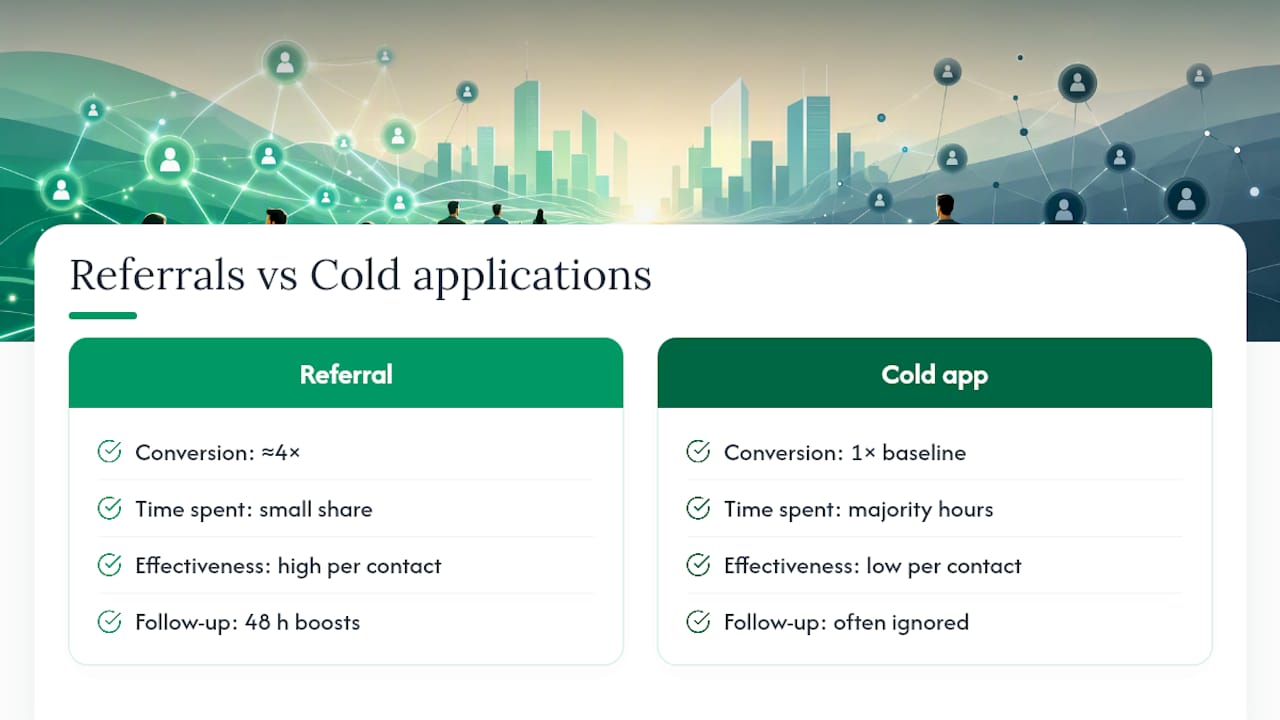
The conventional wisdom oversells volume. Sending fifty applications a week feels productive and produces almost nothing, because modern screening rewards specificity over reach. Ten tailored applications alongside three networking conversations will beat that fifty every time.
What’s underrated is the follow-up step. People treat it as an afterthought, but a 48-hour follow-up with new evidence keeps you visible in a process that otherwise runs cold fast. If you take one thing from this: fix your ratio of networking to applications before you fix anything else. Everything downstream, your CV, your interview answers, your follow-up, only matters once someone actually reads them.
Sources
FAQ
What is the 7 second rule for a CV?
It refers to the idea that recruiters form a first impression of a CV within about seven seconds, scanning for job title match, clear structure, and obvious relevance before reading in detail. That’s why your top third, headline, and first few bullets need to carry the strongest, most tailored content.
Why is Gen Z struggling to find jobs?
Entry-level competition has intensified as more graduates chase fewer visible junior roles, and many rely on generic mass applications instead of referrals or targeted outreach, which convert far better. Building even a small network early and tailoring applications closes much of that gap.
How can you find a job quickly?
Prioritise referrals and networking conversations over blanket applications, since referrals convert at roughly four times the rate of cold applications, and pair that with ten tailored applications a week rather than dozens of generic ones. Setting up daily job alerts on a platform like Findjobsza also helps you act on fresh listings before they go stale.
How often should you follow up after applying?
Follow up within 48 hours of an interview, and add a new piece of evidence rather than a plain check-in message. For applications with no interview yet, a single follow-up after one to two weeks is reasonable.
Should you use AI tools to write your CV or cover letters?
AI tools can speed up drafting tailored bullets and cover notes, but every line needs a human read-through to sound authentic and to confirm it accurately reflects your experience.
Recommended
Start with your city.
20 467 live jobs, filtered by city and suburb. No sign-up wall, no CV upload just to look.