Part-time job alerts: get notified before the competition
16 August 202613 min read

Contents13 sections
- 1Key takeaways
- 2Table of Contents
- 3How to set up part-time job alerts across channels
- 4How to make alerts actually deliver useful matches
- 5What alert messages look like and how quickly you’ll be notified
- 6Typical pay and basic legal rules for part-time work
- 7How to spot scams and verify legitimate part-time listings
- 8How Findjobsza alerts work and why they help
- 9What a disciplined alerts routine actually looks like
- 10Findjobsza gets you there first
- 11Sources
- 12FAQ
- 13Recommended
Part-time job alerts: get notified before the competition
The fastest way to land a part-time role is to receive city-filtered job alerts by WhatsApp and email the moment a vacancy goes live, then apply within the first hour. Most openings fill quickly, and the candidates who get there first are rarely the most qualified — they’re the ones who saw the listing first.
Here’s how to start receiving alerts right now:
- Visit Findjobsza and browse part-time listings without registering.
- Select your city or province from the filter menu to narrow results to your area.
- Subscribe to WhatsApp morning updates so new listings reach you daily before you open a job board.
Findjobsza is built for exactly this. No CV upload required, no lengthy registration, and listings are filtered by city or job type from the first click. The WhatsApp alert channel delivers new part-time openings every morning, which means you’re reviewing fresh vacancies before most people have opened their phones. For retail jobs, admin roles, security shifts, and weekend work, that timing advantage is real.
Pro Tip: Save the Findjobsza WhatsApp number to your contacts immediately after subscribing. Messages from unsaved numbers often get buried or flagged as spam, and you’ll miss time-sensitive listings.
Key takeaways
City-filtered WhatsApp and email alerts, backed by a complete profile and multiple keyword variations, give part-time job seekers the fastest and most relevant notifications available.
| Point | Details |
|---|---|
| Use city-filtered alerts | Narrow your location to a specific city or suburb, not a broad province, for relevant results. |
| WhatsApp beats email for speed | Morning WhatsApp updates reach you before most job boards refresh, giving you a first-mover edge. |
| Run multiple keyword alerts | Create separate alerts for each job title variant to avoid missing listings with different wording. |
| Verify every listing | Check the employer name, source attribution, and contact details before sharing any personal information. |
| Findjobsza for low-friction alerts | Browse part-time listings by city with no registration required and subscribe to daily WhatsApp updates. |
Table of Contents
- How to set up part-time job alerts across channels
- How to make alerts actually deliver useful matches
- What alert messages look like and how quickly you’ll be notified
- Typical pay and basic legal rules for part-time work
- How to spot scams and verify legitimate part-time listings
- How Findjobsza alerts work and why they help
- What a disciplined alerts routine actually looks like
- Findjobsza gets you there first
- Sources
- FAQ
How to set up part-time job alerts across channels
Setting up alerts takes under ten minutes if you follow a clear sequence. The channel you choose matters as much as the keywords you use.
- Choose your platform. Start with Findjobsza for WhatsApp-first alerts with no registration barrier. For email-based alerts, use platforms that let you filter by job type and city before saving the search.
- Select “part-time” as the job type. Never leave this field blank. A general alert for “sales assistant” in Cape Town will flood your inbox with full-time roles you can’t take.
- Set a precise location. Choose a specific city or suburb rather than a broad province. As Jobrato’s setup guide explains, using a sub-node like “Cape Town Northern Suburbs” keeps alerts within a realistic commuting range.
- Set alert frequency to daily. Weekly digests are too slow for part-time roles. Daily is the minimum; WhatsApp morning updates are faster still.
- Name each alert. Label it something like “PT Retail Cape Town” so you can track which search strings produce quality matches and which produce noise.
- Confirm your subscription. Check your email spam folder or WhatsApp message requests immediately after signing up. Missed confirmation messages are the most common reason alerts never arrive.
Comparing channels: WhatsApp, email, and push notifications
WhatsApp alerts win on speed and data cost. A text message uses almost no data, arrives instantly, and doesn’t require opening an app. Email alerts are better for roles that include detailed job descriptions you want to read carefully before applying. Push notifications from browser-based platforms are the least reliable — they depend on the browser being open and notification permissions being active.
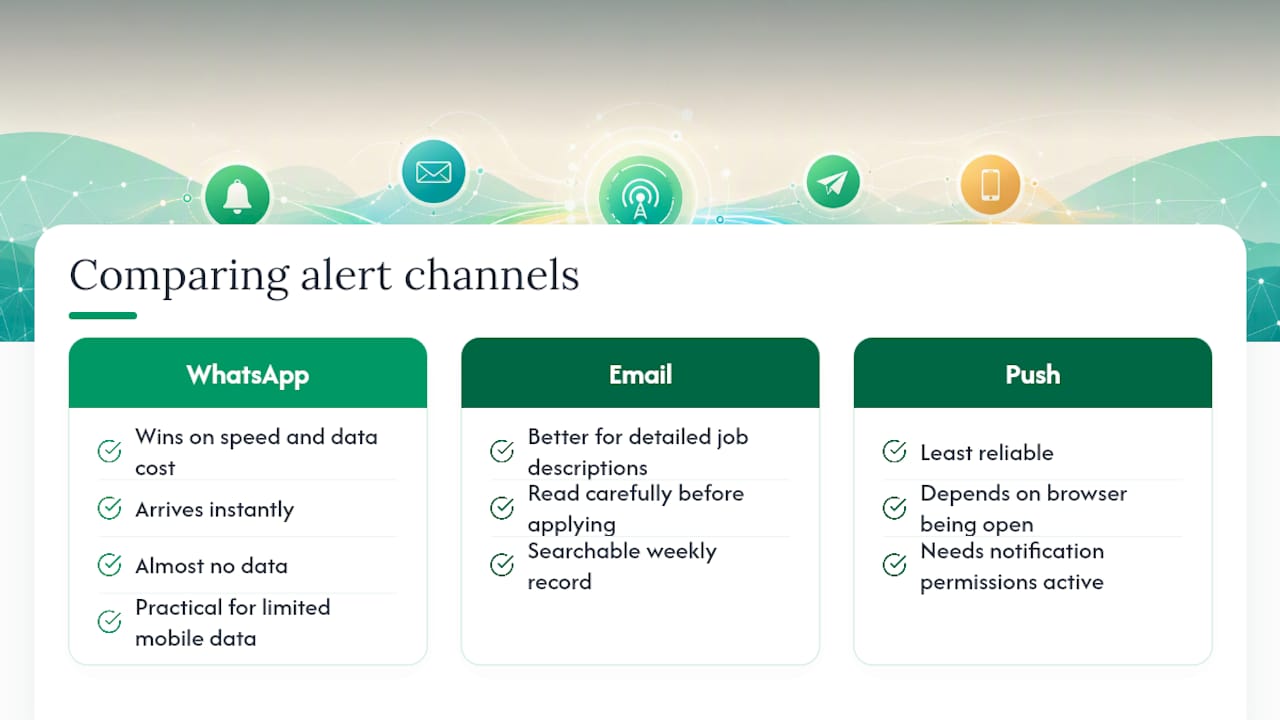
For most part-time seekers with limited mobile data, text-first delivery via WhatsApp or SMS is the practical choice. Save data-heavy browsing for Wi-Fi sessions when you’re uploading a CV or completing a full application.
Pro Tip: Set up both a WhatsApp alert and a daily email digest for the same search. WhatsApp catches the urgent roles; email gives you a searchable record of everything that came through that week.
How to make alerts actually deliver useful matches
An alert is only as good as the profile and keywords behind it. Broad searches produce noise; narrow ones miss opportunities. The goal is a tight middle ground.
Profile checklist before you activate any alert:
- Complete every field in your profile, including your city, availability (mornings, weekends, evenings), and a short headline that names your strongest skill.
- Upload a CV, even a basic one. Career guides consistently show that a complete profile with a CV materially increases the chance a recruiter opens your application when an alert produces a match.
- Set your correct city. Alerts that don’t match your location field may rank you lower in recruiter searches, even if you applied.
Keyword strategy:
Don’t rely on a single job title. A cashier role might be listed as “till operator,” “checkout assistant,” or “POS cashier.” Create separate alerts for each variant. For finance roles, run three alerts: “bookkeeper part-time,” “junior accountant,” and “accounts payable clerk.” The ICB job-hunting guide specifically recommends this multi-title approach to catch more relevant opportunities.

Add a minimum salary filter where the platform allows it. This alone cuts a significant share of irrelevant matches.
Pro Tip: Keep a simple spreadsheet with each alert name, the platform it’s on, and the number of matches it produces per week. After two weeks, pause any alert delivering fewer than two relevant results and replace it with a tighter keyword.
What alert messages look like and how quickly you’ll be notified
Most WhatsApp and email alerts deliver new listings within minutes to a few hours of posting, depending on how often the platform crawls its source feeds. Findjobsza’s morning WhatsApp updates batch overnight listings and send them early each day, which means you get a curated set rather than a drip of individual pings.
A well-structured alert message should include:
- Job title and employer or recruiter name
- City or suburb where the role is based
- Hours or shift pattern (part-time, weekends, mornings)
- Pay indicator or salary range where disclosed
- A direct link to the full listing or application page
When an alert arrives, the sequence matters:
- Open the message and read the title and location first. If it’s not in your city or doesn’t match your hours, skip it immediately.
- Save listings that look relevant before you do anything else. Roles get filled or taken down quickly.
- Apply the same day. For part-time roles in retail, sales, and security, same-day applications consistently outperform those sent 48 hours later.
- Message the employer or recruiter directly if the listing includes contact details. A brief, professional message sent within hours of the alert can put you ahead of applicants who only submitted a form.
Typical pay and basic legal rules for part-time work
Statistics South Africa recorded a drop from 1,115 million part-time workers in December 2025 to 1,059 million in March 2026, a quarterly loss of 56,000 positions and a year-on-year decline of 73,000 jobs. Fewer available roles means more competition for each listing, which reinforces why speed of application matters.
Pay for part-time work varies widely by sector. Retail and hospitality roles typically pay at or just above the national minimum wage. Admin and data-entry positions often pay slightly more, particularly for candidates with verified computer skills. IT and finance roles that are structured as part-time contracts can pay hourly rates comparable to full-time equivalents.
The Basic Conditions of Employment Act applies to part-time employees and sets clear limits:
- Ordinary hours cannot exceed 45 per week (9 hours per day for a 5-day week).
- Overtime must be paid at one-and-a-half times the normal rate, or the employee must receive paid time off in lieu.
- Employees are entitled to a daily rest period of at least 12 consecutive hours and a weekly rest period of 36 consecutive hours, which must include Sunday.
- Work on a Sunday must be paid at double the normal rate, or at one-and-a-half times if Sunday is a regular working day for that employee.
The UASA 2026 employment report found that roughly 41% of working individuals operate without formal employment contracts. If a role you find through an alert doesn’t offer a written contract, ask for one before starting. The Act’s protections apply regardless of whether the employer volunteers them.
How to spot scams and verify legitimate part-time listings
Part-time job alerts attract fraudulent listings because the roles are often entry-level, the applicants are sometimes desperate, and the postings move fast. Knowing the red flags before you respond saves time and protects your personal information.
Red flags to watch for:
- Any listing that asks you to pay a registration fee, training fee, or “starter kit” cost before you begin work.
- WhatsApp messages from unknown numbers offering jobs you never applied for, with no employer name or company registration number.
- Vague job descriptions that promise high earnings for minimal hours with no explanation of the actual work.
- Requests for your ID number, bank account details, or copies of personal documents before a formal interview has taken place.
- No physical address, no company website, and no verifiable contact person named in the listing.
Verification steps:
- Search the company name on the Companies and Intellectual Property Commission (CIPC) website to confirm it is registered.
- Call the company’s main switchboard number (found independently, not from the listing) and ask whether the role is genuine.
- Check that the listing on the alert platform includes a named recruiter or employer with contact details. Findjobsza attributes each listing to its source, which makes this check straightforward.
- If a listing looks suspicious, report it to the platform directly and delete the alert source. On WhatsApp, block the number and report it as spam.
Never share financial information with a prospective employer before signing a formal offer letter.
How Findjobsza alerts work and why they help
Findjobsza is built around the specific friction points that slow down part-time job seekers: mandatory registration, CV uploads before you can even browse, and listings that aren’t filtered by location.
Key features:
- Daily WhatsApp morning updates with new part-time listings, delivered before most job boards refresh.
- Email alerts for seekers who prefer a searchable inbox record.
- City and province filters applied at the listing level, so you see roles in your area from the first page.
- No CV upload or account creation required to browse or apply.
- Clear source attribution on each listing, so you know whether you’re responding to a direct employer or a recruiter.
- Category pages for admin jobs, retail, security, teaching jobs, and more, each filterable by city.
How to subscribe in three steps:
- Select the WhatsApp alert option and save the number to your contacts.
- Choose your preferred categories (retail, admin, weekend shifts) and confirm your subscription.
The UASA report’s finding that 41% of workers operate without formal contracts is a reminder that many part-time roles are posted informally and filled fast. A platform that surfaces listings daily, without requiring you to log in each time, keeps you in the running for those roles.
What a disciplined alerts routine actually looks like
Every morning at 7:15 AM, the WhatsApp alert arrives. Scroll through the listings in under two minutes: title, city, hours. Anything that fits gets saved to a dedicated folder. By 8:00 AM, two or three applications are already submitted.

That routine sounds simple, and it is. The discipline is in the separation: one WhatsApp number for job alerts, one email folder labelled “Part-time applications,” and a weekly review every Friday to pause alerts that haven’t produced a single relevant match. Within three weeks of running that system, the noise drops and the signal gets sharper.
The practical takeaway you can copy right now: create a separate email label or WhatsApp folder for job alerts today, before you subscribe to anything else. Mixing alerts into your general inbox is how good listings get buried.
Findjobsza gets you there first
Waiting for a role to appear on a general job board usually means arriving after the first wave of applicants. Findjobsza’s part-time job listings are updated daily and delivered by WhatsApp every morning, so you’re reviewing new openings before most people open a browser. No registration, no CV upload required to browse, and every listing shows the city and source so you know exactly what you’re responding to.
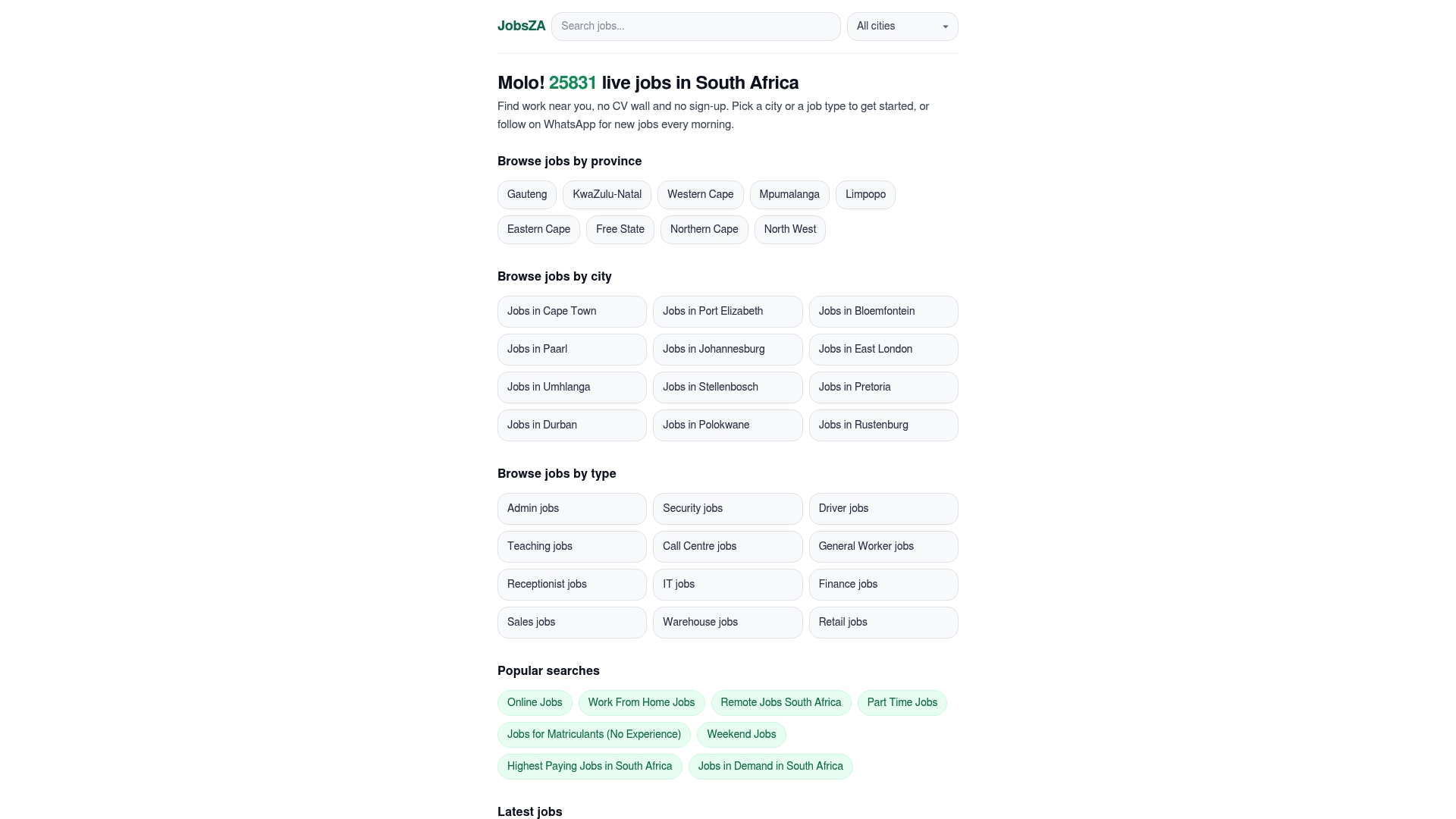
For weekend shifts and jobs in demand, the city filter narrows results to your area in one click. Subscribe to the WhatsApp alert, save the number, and you’re set up in under two minutes. Visit Findjobsza to browse current part-time vacancies and activate your alert today.
Sources
- Employment falls in SA’s Formal Non-Agricultural Sector in First Quarter of 2026 | Statistics South Africa
- Basic Conditions of Employment Act (full text) — Department of Labour
- 2026 UASA SAER and 4th UASA/BMR Employment Index highlight changing realities of work in South Africa
- Job Hunting Made Easier - ICB
Consult the Basic Conditions of Employment Act directly or speak with a registered labour consultant if you have a dispute about hours, pay, or contract terms. This article provides general information, not legal advice.
This article is general information, not a substitute for advice from a qualified lawyer. Consult a qualified legal professional about your own circumstances before acting on anything here.
FAQ
How much does a part-time job pay in South Africa?
Pay depends on the sector. Retail and hospitality roles typically pay at or near the national minimum wage, while admin and finance part-time positions often pay higher hourly rates. Always check whether the advertised rate meets the current national minimum wage before accepting an offer.
How can I find a part-time job quickly?
Set up a city-filtered WhatsApp alert on a platform like Findjobsza and apply the same day listings arrive. Speed of application is the single biggest factor for entry-level and shift-based part-time roles.
How do I find part-time jobs near me?
Use a location filter set to your specific city or suburb rather than a broad province. Findjobsza lets you filter listings by city from the first page, with no account required to browse.
Where can I find part-time jobs in Cape Town?
Findjobsza lists part-time vacancies filtered by Cape Town across retail, admin, security, and other sectors. Browse part-time listings and subscribe to the WhatsApp alert to receive new Cape Town openings each morning.
Recommended
Start with your city.
19 638 live jobs, filtered by city and suburb. No sign-up wall, no CV upload just to look.