WhatsApp job application: apply safely in South Africa
7 August 202612 min read

Contents14 sections
- 1Table of Contents
- 2When is a WhatsApp job application actually appropriate?
- 3How to send a WhatsApp job application: templates and best practices
- 4What recruiters can and cannot ask — and how to protect your data
- 5Red flags and how the typical WhatsApp job scam unfolds
- 67-step verification checklist before you engage with any recruiter
- 7What to do if a WhatsApp job contact looks suspicious
- 8Safer ways to get WhatsApp job alerts through Findjobsza
- 9Key takeaways
- 10Why verified alerts matter more than most job seekers realise
- 11Findjobsza brings verified job listings straight to your WhatsApp
- 12Useful sources and reporting contacts in South Africa
- 13FAQ
- 14Recommended
WhatsApp job application: apply safely in South Africa
Yes, you can use WhatsApp to apply for jobs in South Africa — but only when the recruiter or employer can be independently verified through official channels. The single most important action before you share anything: confirm the vacancy exists on the company’s official careers page.
Before you go further, run this quick check:
- Did the recruiter contact you first, out of nowhere? Pause and verify.
- Is there a job posting on the company’s official website or a recognised platform?
- Have you been asked for money, your ID number, or bank details? Stop immediately.
The Department of Employment and Labour warns that legitimate corporate employers in South Africa do not typically initiate recruitment through unsolicited WhatsApp messages. WhatsApp is a useful channel for scheduling interviews or quick follow-ups — not for first contact from an unknown number.
Table of Contents
- When is a WhatsApp job application actually appropriate?
- How to send a WhatsApp job application: templates and best practices
- What recruiters can and cannot ask — and how to protect your data
- Red flags and how the typical WhatsApp job scam unfolds
- 7-step verification checklist before you engage with any recruiter
- What to do if a WhatsApp job contact looks suspicious
- Safer ways to get WhatsApp job alerts through Findjobsza
- Key takeaways
- Why verified alerts matter more than most job seekers realise
- Findjobsza brings verified job listings straight to your WhatsApp
- Useful sources and reporting contacts in South Africa
- FAQ
When is a WhatsApp job application actually appropriate?
WhatsApp works as a recruitment channel under specific conditions. The key word is verifiable.
Legitimate use-cases:
- A recruiter you already engaged via email or a job portal follows up on WhatsApp to schedule an interview.
- A company’s official careers page or job listing explicitly states “apply via WhatsApp” with a verified business number.
- An employer-run chatbot on WhatsApp (linked directly from a verified careers page) collects your application details.
- A recruiter at a staffing agency you contacted first sends a WhatsApp message from a number matching their company email domain.
When it is not appropriate:
- An unsolicited message arrives from an unknown number offering a job you never applied for.
- The entire recruitment process happens only on WhatsApp, with no email, no company letterhead, and no official job reference.
- You are asked to keep the opportunity confidential or act within hours.
- The offer involves an overseas employer you cannot verify, with a salary that seems unrealistically high for the role.
Research into corporate hiring practices confirms that legitimate companies follow structured processes: formal email domains, scheduled interviews, and reasonable timelines. A recruiter who skips all of that and stays exclusively on WhatsApp is a warning sign, not a convenience.
How to send a WhatsApp job application: templates and best practices
Sample message (applicant-initiated, responding to a verified listing)
Sample message (recruiter-initiated follow-up, after prior email contact)
Attachment rules:
- Send your CV as a PDF only. Photos of documents compress poorly and look unprofessional.
- Never send your ID document, certified copies, or bank details over WhatsApp at any stage.
- Keep file sizes under 5 MB to avoid delivery failures.
Timing and tone: message during business hours (8 AM–5 PM on weekdays). Use your real full name and a professional profile photo. For follow-ups, wait at least three business days before sending a second message.
Pro Tip: Check the WhatsApp Business profile before you reply. A legitimate business account will show a linked website, a consistent company name, and often a verified green badge. If the profile shows only a mobile number with no business details, treat it as unverified.
For guidance on presenting yourself well in any application channel, resume tips from ResumeMint cover how to structure and name your documents for professional impact.
What recruiters can and cannot ask — and how to protect your data
South African law is clear on this point.
Section 15(1) of the Employment Services Act prohibits any person or recruitment service from charging a job seeker a fee for employment services. Any payment request — for training, registration, a uniform, or a background check — is illegal and a definite red flag. The Department of Employment and Labour has explicitly warned job seekers about this.
Never share these on WhatsApp, at any stage:
- Your full ID number or a copy of your ID document.
- Bank account details or proof of banking.
- Certified copies of qualifications (before a formal written offer).
- Your home address or next-of-kin details.
A legitimate employer may request certified documents after a formal written offer has been issued on company letterhead, through a secure HR portal or official email. Not before. Not on WhatsApp.
Practical privacy steps:
- Ask the recruiter to send all formal requests from a company email address (not Gmail or Yahoo).
- Request that document submissions go through a secure portal or official email, not WhatsApp.
- Screenshot and save any suspicious request before blocking the number.
Red flags and how the typical WhatsApp job scam unfolds
Scammers follow a predictable pattern. Knowing the stages makes it easier to exit early.
The five-stage scam flow (as documented by CheckJobScam):
- Hook: An unsolicited WhatsApp message offers a high-paying, flexible job with minimal requirements.
- Credibility phase: The scammer shares fake company logos, cloned branding, or a forged offer letter to build trust.
- Pivot to paid task: You are asked to complete small “paid tasks” or buy training materials to unlock your earnings.
- Payment request: Once you have invested time or a small amount, a larger payment is requested to release your “earnings.”
- Radio silence: After payment, all contact stops.
Africa Check’s investigation into fake Capitec job adverts is a textbook example: scammers cloned Capitec’s branding and circulated WhatsApp messages promising R6,000 vacancies, linking to unofficial forms. The real Capitec directs all applicants to its official careers page only.
Common red flags to watch for:
- Unsolicited first contact from an unknown number.
- Requests for any upfront payment (training, registration, uniform, background check).
- Vague job descriptions with no company address or HR contact.
- Recruiter uses only a Gmail, Yahoo, or Hotmail address.
- International or unverified phone number.
- Pressure to decide or pay within hours.
- Requests for ID or bank details before any formal interview.
South Africa’s unemployment rate makes this worse. With a significant portion of the working-age population actively seeking work, scammers send bulk WhatsApp messages knowing the odds of finding a desperate recipient are high.
7-step verification checklist before you engage with any recruiter
Run through this before replying to any WhatsApp job message or sending a single document. CheckJobScam’s verification guide and Bizcraft’s identity-fraud reporting both support this approach.
- Check CIPC registration. Search the company name on the CIPC portal to confirm it is a registered South African entity.
A legitimate recruiter will welcome these checks. Anyone who pushes back or pressures you to skip them is telling you something important.
What to do if a WhatsApp job contact looks suspicious
If something feels wrong, act fast. Do not reply, even to say you are not interested — responding confirms your number is active and can increase the volume of scam messages you receive.
Immediate steps:
- Stop all communication. Do not send another message.
- Take screenshots of every message, the contact’s profile, and any documents or links shared.
- Note the phone number, any email addresses used, and the name of the company claimed.
- Block the number on WhatsApp (open the chat → tap the contact name → “Block”).
- Report the number to WhatsApp (use the “Report” option in the same menu).
Report to authorities:
- Department of Employment and Labour: email fraud@labour.gov.za or call the labour helpline.
- National Human Trafficking Hotline: 0800 222 777 (free, 24/7).
- South African Police Service: if you shared identity documents, open a case immediately.
If you already paid money: contact your bank within hours to request a transaction recall. Banks can sometimes reverse payments if reported quickly. If your ID documents were shared, place a fraud alert with the South African Fraud Prevention Service (SAFPS).
Read more about how scams operate on WhatsApp and what patterns to watch for on the Findjobsza articles page.
Safer ways to get WhatsApp job alerts through Findjobsza
The safest way to use WhatsApp for job searching is to receive alerts from a platform that has already done the verification work for you.
Findjobsza sends daily WhatsApp job alerts directly to job seekers across South Africa. Every listing on the platform comes from verified employers and recruiters — you are not responding to a cold message from an unknown number. You are receiving curated vacancies that have been posted by paying employers with confirmed business details.
What Findjobsza offers:
- Real-time WhatsApp alerts with new listings every morning.
- Browse by city, province, or job type — no CV upload or registration required.
- Listings across all sectors: admin roles, in-demand positions, remote work, part-time, and entry-level.
- No upfront fees for job seekers, ever — fully aligned with Section 15(1) of the Employment Services Act.
This is the difference between a verified alert and a cold scam message: you chose to subscribe, the source is known, and the listings are tied to real employer accounts.
Key takeaways
WhatsApp is a legitimate job application channel in South Africa only when tied to verifiable, official recruitment — never pay, never share ID or bank details, and always run the 7-step verification checklist before engaging.
| Point | Details |
|---|---|
| Verify before you engage | Always confirm the vacancy on the company’s official careers page before replying to any WhatsApp message. |
| Never pay or share ID details | Section 15(1) of the Employment Services Act makes upfront fees illegal; sharing ID or bank details over WhatsApp is never required by legitimate employers. |
| Know the five scam stages | Hook, credibility, paid task, payment request, then silence — exit at stage one by not replying to unsolicited messages. |
| Report suspicious contacts | Block and report on WhatsApp, then contact fraud@labour.gov.za or the National Human Trafficking Hotline at 0800 222 777. |
| Use Findjobsza for verified alerts | Findjobsza delivers daily WhatsApp job alerts from verified employers, with no CV upload or registration required. |
Why verified alerts matter more than most job seekers realise
South Africa’s job market has a specific vulnerability that most generic WhatsApp safety guides miss: the gap between formal HR portals and the channels most people actually use daily. Scammers exploit that gap deliberately. They know that WhatsApp feels personal and immediate, and that a message arriving there carries a different psychological weight than an email landing in a spam folder.
The advice to “just be careful” is not enough. The scam flows documented by CheckJobScam are sophisticated enough to fool people who consider themselves tech-savvy. The Capitec fake advert example is instructive: the branding was convincing, the salary was plausible, and the form looked official. What gave it away was the link — it did not go to capitec.co.za.
The practical answer is not to avoid WhatsApp entirely. It is to control where your WhatsApp job information comes from. A cold message from an unknown number is a risk you take on blind. A morning alert from a platform you subscribed to, with listings tied to verified employer accounts, is a fundamentally different thing. That distinction is worth building into how you search.
Findjobsza brings verified job listings straight to your WhatsApp
Most job seekers in South Africa already have WhatsApp open all day. Findjobsza puts that to work safely: instead of hoping a recruiter who messages you is legitimate, you receive a curated list of verified vacancies every morning — no registration, no CV upload, no guessing.
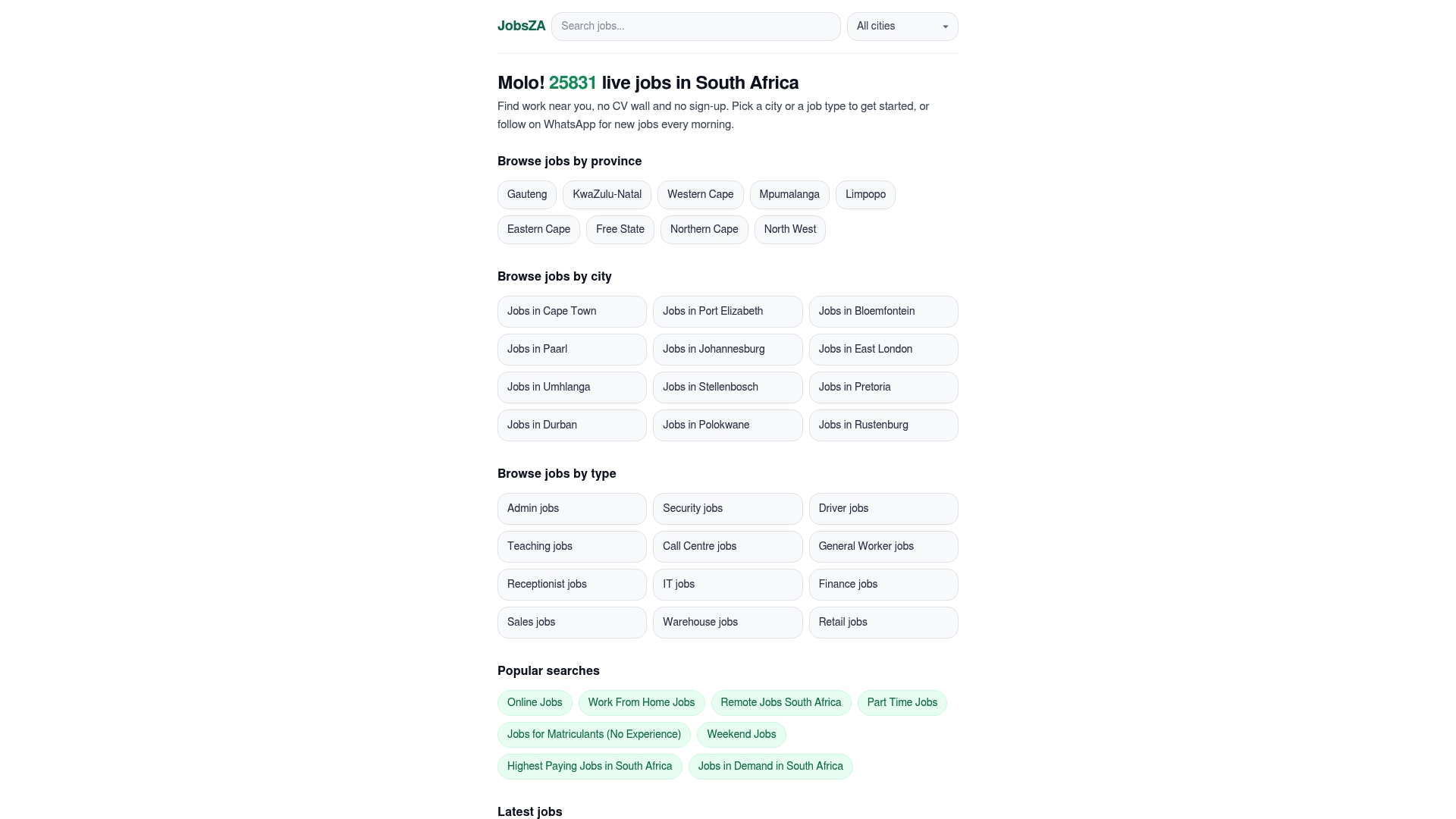
Browse online jobs or in-demand roles across South Africa right now, filtered by city or job type. Every listing comes from an employer who has paid to post — which means a real business with a real vacancy, not a bulk scam message. Sign up for daily WhatsApp alerts on Findjobsza and start your morning with verified opportunities instead of risk.
Useful sources and reporting contacts in South Africa
| Resource | Contact / Link | Purpose |
|---|---|---|
| Dept of Employment and Labour | fraud@labour.gov.za | Report job scams and illegal fee requests |
| National Human Trafficking Hotline | 0800 222 777 (free, 24/7) | Report trafficking-linked fake job offers |
| CIPC company search | cipc.co.za | Verify company registration in South Africa |
| Africa Check | africacheck.org | Fact-check circulating job adverts and scam claims |
| CheckJobScam | checkjobscam.co.za | Verify job posts and report fake listings |
| Findjobsza articles | findjobsza.co.za/articles | Guides on safe job searching in South Africa |
Quick reporting steps on WhatsApp:
- Work-seekers warned not to pay for employment — Department of Employment and Labour
- Department of Employment and Labour cautions public as scammers continue unrestrained on social media
- WhatsApp job scams South Africa: the complete guide
- How to Spot a Fake Job Post in South Africa: The Complete Checklist | CheckJobScam
- WhatsApp and Facebook job scams in South Africa
- SCAM: Be wary of ‘R6,000’ vacancies for Capitec advertised in unverified social media posts — Africa Check
- Job Scams in South Africa: 7 Red Flags to Look Out For — Jobrato
FAQ
Are recruiters on WhatsApp legit?
Some are, but only when they can be verified through official channels. A legitimate recruiter will have a company email, a vacancy reference, and a job listed on the employer’s official careers page — if they cannot provide all three, treat the contact with caution.
How do I know if it is a scammer on WhatsApp?
Key signs include unsolicited first contact, requests for upfront payment, vague job descriptions, Gmail-only email addresses, and pressure to act fast. Run the 7-step verification checklist above before engaging with any unknown recruiter.
Is it normal for a job to contact you through WhatsApp?
It can happen legitimately, but only as a follow-up after prior contact through official channels. The Department of Employment and Labour confirms that legitimate corporate employers do not typically initiate recruitment through cold WhatsApp messages.
Can I apply for a job via WhatsApp safely?
Yes, when the employer’s WhatsApp number is listed on their official careers page or a verified platform like Findjobsza. Send a brief professional message with your PDF CV, state the role and reference number, and never share ID or bank details over the app.
Recommended
Start with your city.
19 529 live jobs, filtered by city and suburb. No sign-up wall, no CV upload just to look.