Best job apps in South Africa: 2026 shortlist
3 August 202619 min read

Contents12 sections
- 1Table of Contents
- 2How do the top job apps compare side by side?
- 3App-by-app mini reviews: what each platform actually does well
- 4How do you choose the best job app for your situation?
- 5How we selected and tested these apps
- 6Which app should you try first, and what should you do this week?
- 7Key takeaways
- 8Why local-first apps change the job search in South Africa
- 9Findjobsza: browse daily South African listings with no sign-up required
- 10Useful sources and further reading
- 11FAQ
- 12Recommended
Best job apps in South Africa: 2026 shortlist
For most South African job seekers, Findjobsza is the app to open first: no CV, no sign-up, daily WhatsApp alerts, and listings filtered by city or province the moment you land on the site. The rest of this shortlist covers every major platform worth your time, from government-backed matching to professional networking to classifieds.
Here is the quick verdict for each:
- Findjobsza — best for fast, local discovery with zero friction (no CV or account required)
- LinkedIn — best for professionals who want recruiter visibility and networking alongside job listings
- Indeed — best for broad coverage and quick-apply across many sources at once
- CareerJunction — best for mid-career and skilled technical roles with South African employers
- PNet — best for established local listings posted directly by SA employers
- Careers24 — best for nationwide searches across multiple industries with sector filters
- JobMail — best for entry-level and regionally posted classifieds-style roles
- Glassdoor — best when you want salary data and company reviews before you apply
- Gumtree Jobs — best for informal, short-term, and gig-style local listings
- Employment Services of South Africa (ESSA) — best for government-verified listings and free career counselling at a Labour Centre
Who should open which app first:
- Recent matriculant or no experience: Findjobsza, JobMail, Gumtree Jobs
- Mid-career professional: LinkedIn, CareerJunction, PNet
- Remote worker: LinkedIn, Indeed, Findjobsza
- Gig or part-time seeker: Gumtree Jobs, Findjobsza, JobMail
- Government job seeker: ESSA, Careers24, PNet
Real-time alerts give applicants a measurable edge in high-volume sectors like retail, hospitality, and security, where many roles fill on a first-come basis. That single factor shapes much of the ranking below.
Table of Contents
- How do the top job apps compare side by side?
- App-by-app mini reviews: what each platform actually does well
- How do you choose the best job app for your situation?
- How we selected and tested these apps
- Which app should you try first, and what should you do this week?
- Key takeaways
- Why local-first apps change the job search in South Africa
- Findjobsza: browse daily South African listings with no sign-up required
- Useful sources and further reading
- FAQ
How do the top job apps compare side by side?
The table below compares all ten platforms on the dimensions that actually affect your chances: where they work, how you apply, what alerts they send, and what makes each one different.
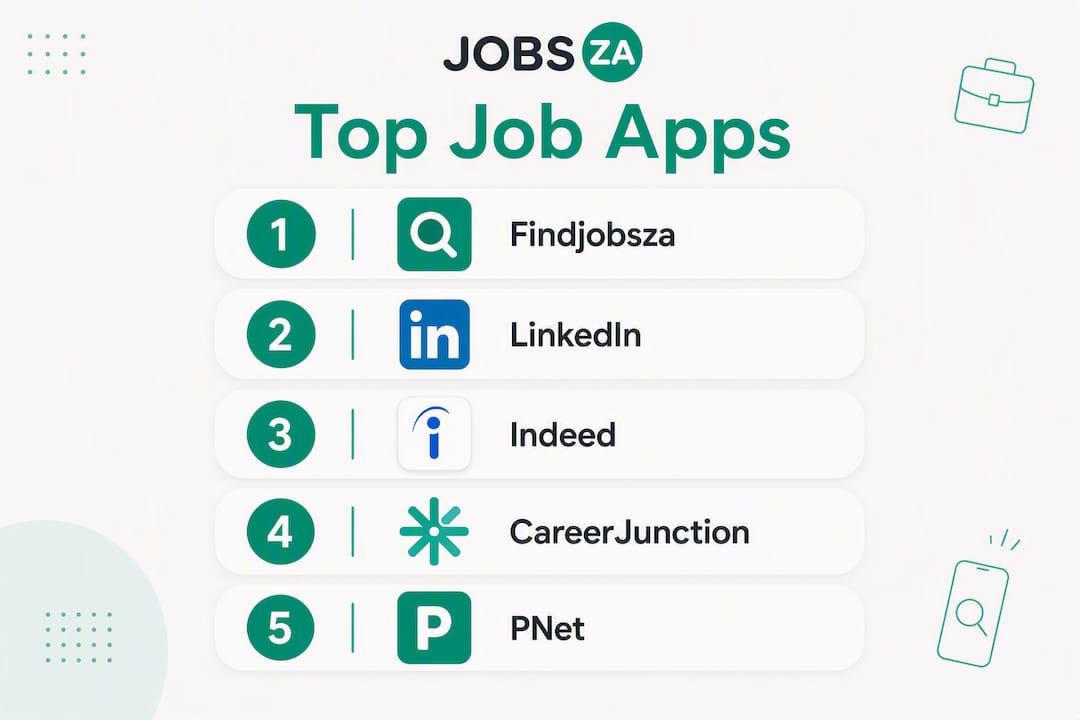
| App | Best for | Platforms | SA coverage | Cost to job seeker | Apply method | Alerts | Unique features |
|---|---|---|---|---|---|---|---|
| Findjobsza | Fast local discovery, no-CV daily search | Web | National, city/province filters | Free | Direct apply / WhatsApp | Daily WhatsApp alerts | No CV or sign-up required; WhatsApp job alerts |
| Professional networking and recruiter outreach | iOS / Android / Web | National + international | Free / Premium | In-app CV / Easy Apply | Push, email | Recruiter InMail, company follow, skills endorsements | |
| Indeed | Broad aggregation, quick apply | iOS / Android / Web | National | Free | In-app CV / external link | Push, email | Aggregates listings from many sites; salary estimates |
| CareerJunction | Skilled and technical SA roles | iOS / Android / Web | National (metro focus) | Free | External link / email | Local employer listings; sector filters | |
| PNet | Established SA employer-posted vacancies | iOS / Android / Web | National | Free | In-app CV / external link | Push, email | Longstanding SA employer network |
| Careers24 | Nationwide multi-industry search | iOS / Android / Web | National | Free | In-app CV / external link | Push, email | Industry-specific filters; broad national reach |
| JobMail | Entry-level and regional classifieds | Web / limited mobile | National (regional focus) | Free | Email / external link | Classifieds-style local listings | |
| Glassdoor | Salary research and company transparency | iOS / Android / Web | National + international | Free / Premium | External link | Push, email | Employee reviews; salary insights; interview Q&As |
| Gumtree Jobs | Informal, gig, and short-term local roles | iOS / Android / Web | Metro / local | Free | Email / WhatsApp | Community classifieds; localised reach | |
| ESSA | Government-verified listings and counselling | Web / in-person | National (Labour Centres) | Free | In-person / online registration | — | Free career counselling; government job matching |
How to read this table: “SA coverage” tells you whether the platform pulls listings from across the country or concentrates on specific metros. “Apply method” tells you how you actually submit — some apps keep everything in-app, others redirect you to an employer site or email. “Alerts” shows whether the platform can notify you the moment a new role appears. For high-turnover sectors like retail or security, the alerts column is the most important one on the page.
App-by-app mini reviews: what each platform actually does well
Findjobsza
Findjobsza is built for the South African job seeker who wants to move fast. You browse by city, province, or job type without creating an account or uploading a CV. Every morning, a WhatsApp alert drops new listings directly into your phone. That flow suits sectors where roles fill quickly: admin, sales, retail, and entry-level positions. The platform covers full-time, part-time, freelance, and entry-level roles nationally.

Pros: Zero sign-up friction; daily WhatsApp alerts; strong city and province filters. Downside: Less suited to senior executive searches or roles requiring a detailed LinkedIn-style profile.
Pro Tip: Subscribe to WhatsApp alerts for your city the moment you start your search — roles in high-turnover sectors often fill within hours of posting.
LinkedIn is the only platform on this list where the job listing is almost secondary to the profile. Recruiters search LinkedIn directly, so a complete profile with a clear headline and listed skills can bring opportunities to you rather than requiring you to hunt. The Easy Apply feature lets you submit a saved CV in seconds. For South African professionals targeting corporate, tech, or remote roles, LinkedIn is non-negotiable. Kayman Recruitment Group notes that international remote hiring for South African professionals is growing in 2026, and LinkedIn is the primary channel for that traffic.
Pros: Recruiter visibility; networking; Easy Apply; company research. Downside: Premium features (InMail, who viewed your profile) sit behind a paid tier.
Indeed
Indeed aggregates listings from employer sites, recruitment agencies, and other job boards, so one search often surfaces roles you would miss on a single-source platform. Quick Apply lets you submit a stored CV without leaving the app. Coverage across South Africa is solid, though the sheer volume of listings means you need to use location and salary filters aggressively to avoid noise.
Pros: Wide aggregation; quick-apply; salary estimates; mobile app. Downside: Listing quality varies because Indeed pulls from many sources, including outdated postings.
CareerJunction
CareerJunction focuses on skilled and technical roles posted by South African employers directly. If you are a mid-career professional in engineering, finance, IT, or healthcare, the listing quality here tends to be higher than on broad aggregators because employers are actively paying to post. The mobile app is functional; email alerts are reliable.
Pros: Local employer focus; sector filters; strong for technical roles. Downside: Thinner coverage for entry-level or informal roles.
PNet
PNet has been part of the South African job market for long enough that many established employers default to it when posting vacancies. The platform’s strength is its employer-facing tools, which means the listings you see were placed deliberately rather than scraped. Alerts are available via push and email.
Pros: Longstanding SA employer network; reliable listings; push alerts. Downside: Interface feels dated compared to newer platforms.
Careers24
Careers24 covers the broadest range of industries nationally and lets you filter by sector, location, and experience level. It suits job seekers who are open to multiple industries or who are doing a wide first sweep before narrowing down. The platform is free to use and the alert system works reliably.
Pros: Broad national reach; industry filters; free. Downside: High listing volume can make it harder to find niche or specialist roles.
JobMail
JobMail operates more like a classifieds board than a traditional job portal, which makes it genuinely useful for entry-level, regional, and informal roles that larger platforms overlook. If you are looking for work in a smaller town or a role that does not require a formal CV process, JobMail is worth checking. The mobile experience is limited, so desktop browsing works better here.
Pros: Entry-level and regional focus; classifieds-style listings. Downside: Limited mobile app; fewer corporate or senior listings.
Glassdoor
Glassdoor’s real value is not the job listings themselves but the employee reviews and salary data attached to every company profile. Before you apply anywhere, checking the Glassdoor page for that employer takes two minutes and can save you from a bad hire. Salary ranges for South African roles are available, though coverage is thinner than for US or UK companies.
Pros: Salary transparency; company culture reviews; interview question archives. Downside: SA-specific salary data is less comprehensive than for international markets.
Pro Tip: Use Glassdoor to research a company before your interview, not just before you apply. Knowing the average interview format and common questions gives you a real edge.
Gumtree Jobs
Gumtree is where informal, short-term, and gig-style roles live. Retail assistants, domestic workers, security guards, drivers, and hospitality staff are regularly posted here by small businesses and individuals who would never pay to list on a formal job board. Applications often go via WhatsApp or email, which means you can move fast. Local guides recommend including classifieds platforms as part of a broad entry-level search strategy.
Pros: Informal and gig roles; local reach; WhatsApp apply. Downside: Less employer verification; higher risk of scam listings (see red flags below).
Employment Services of South Africa (ESSA)
ESSA is the government’s free job-matching service, run by the Department of Employment and Labour. You register online or walk into any Labour Centre for free counselling, CV help, and job matching. It is the only platform on this list backed by the state, which matters if you want verified listings and access to government-supported placement programmes. It is not the fastest or most modern experience, but for job seekers who need structured support, it is a resource most people underuse.
Pros: Free; government-verified; counselling and placement support. Downside: Slower process; fewer private-sector listings than commercial platforms.
How do you choose the best job app for your situation?
The right app depends on your experience level, the type of role you want, and how fast you need to move. Here is a practical checklist to work through before you commit to one platform.
- Define your role type first. Entry-level and informal roles live on Findjobsza, JobMail, and Gumtree. Skilled technical roles belong on CareerJunction and PNet. Networking-led corporate roles need LinkedIn.
- Check local coverage. A platform with thousands of listings nationally may have very few in your city. Filter by location before you judge the volume.
- Decide how fast you need to apply. For high-turnover sectors like retail or security, real-time alerts are the deciding factor. Findjobsza’s WhatsApp alerts and Indeed’s push notifications both serve this need.
- Match the apply method to your situation. If you do not have a polished CV yet, platforms that allow direct apply or email applications (Findjobsza, Gumtree) reduce friction. LinkedIn and CareerJunction expect a complete profile.
- Look for recruiter access. If you want headhunters to find you, LinkedIn is the only platform where that happens at scale. CareerJunction and PNet also have recruiter-facing tools.
- Use more than one app. The Department of Employment and Labour recommends using multiple online platforms alongside company websites and social media.
Red flags to watch for:
- Any platform or employer asking you to pay an application fee or training deposit. The Department of Employment and Labour is explicit: legitimate employers do not charge job seekers to apply.
- Listings with no company name, no job description detail, or contact details that are only a personal cell number.
- Requests to send personal banking details before an interview.
“Legitimate employers in South Africa should not ask job applicants to pay for training or to pay application fees. Requests for payment are strong red flags.” — Department of Employment and Labour
Profile examples:
- Recent matriculant: Start with Findjobsza (no CV barrier) and browse jobs for matriculants. Add Gumtree for local informal roles.
- IT professional: LinkedIn for recruiter visibility, then CareerJunction for local employer listings. Browse IT jobs on Findjobsza for daily alerts on new vacancies.
- Remote worker: LinkedIn first, then Indeed for aggregated remote listings. Findjobsza’s remote jobs page covers SA-based remote roles.
- Gig or part-time seeker: Gumtree for informal roles, Findjobsza for part-time and weekend listings.
Pro Tip: Tailor your CV or profile headline to the specific role type on each platform. A generic “seeking employment” headline on LinkedIn is invisible to recruiters. A specific title like “Junior Bookkeeper | 2 years experience | Cape Town” gets found.
How we selected and tested these apps
Every app on this list was evaluated against five criteria: local coverage (does it actually surface roles in South African cities?), notification features (push, email, or WhatsApp?), apply flow (how many steps from seeing a job to submitting?), user experience on mobile and web, and recruiter reach (can employers or headhunters find you?).
The selection process included hands-on checks of each platform’s South African listing volume, app-store rating reviews, and cross-referencing with local job-search guides and recruiter commentary from Kayman Recruitment Group. Government resources from the Department of Employment and Labour were used to verify ESSA’s features and to source the scam-warning guidance.
When testing apply flow, two micro-metrics proved most predictive of real-world usefulness: time-to-apply (how many seconds from seeing a listing to submitting) and local match rate (what share of results are actually in the user’s province or city). Platforms that scored well on both ranked higher, regardless of total listing count.
“Registering on trusted job portals, setting alerts, and checking company websites gives you the best coverage — some roles appear on company pages before they reach any job board.” — A practical guide to finding employment in South Africa in 2026
Niche platforms that focus on contract, flexible, or sector-specific roles can produce higher-quality matches than general aggregators for certain job-seeker segments. That finding shaped the inclusion of CareerJunction and ESSA alongside the broad aggregators.
Limits and disclaimers: App features, listing volumes, and availability change. Always verify that an app is available in your region before committing time to building a profile. App-store ratings reflect user sentiment at a point in time and may not capture recent updates.
Which app should you try first, and what should you do this week?
By profile:
- Entry-level / matriculant: Findjobsza. No CV needed, WhatsApp alerts, and city filters get you to relevant listings in under a minute.
- Mid-career professional: LinkedIn for recruiter visibility, CareerJunction for local employer listings.
- Remote worker: LinkedIn first, then Findjobsza’s remote jobs page for SA-based remote roles.
- Gig / part-time seeker: Gumtree Jobs for informal roles, Findjobsza for part-time and weekend listings.
- Government job seeker: ESSA for verified listings and free counselling at your nearest Labour Centre.
The single app this team recommends most often for South African job seekers is Findjobsza: it removes every barrier between you and a listing, and the WhatsApp alert system means you hear about new roles before most applicants have opened their laptop.
7-day starter plan:
- Day 1: Sign up for Findjobsza WhatsApp alerts for your city. Browse jobs in demand to see which sectors are hiring now.
- Day 2: Build or update your LinkedIn profile. Add a specific headline, a summary, and your three most recent roles.
- Day 3: Set up Indeed and Careers24 alerts for your target role and location.
- Day 4: Apply to at least five roles across two platforms. Tailor the first paragraph of each application to the specific job.
- Day 5: Research two or three target employers on Glassdoor. Note salary ranges and common interview questions.
- Day 6: Register on ESSA if you want access to government-supported placement and free counselling.
- Day 7: Follow up on any applications submitted earlier in the week with a short, polite email.
Key takeaways
The single most effective approach to job searching in South Africa is combining a local-first platform like Findjobsza for daily alerts with one professional network (LinkedIn) and one broad aggregator (Indeed) to cover all bases.
| Point | Details |
|---|---|
| Start local and alert-first | Findjobsza’s WhatsApp alerts give you same-day notice of new listings, critical in fast-hire sectors. |
| Match the app to your experience level | Entry-level seekers do best on Findjobsza, JobMail, and Gumtree; professionals need LinkedIn and CareerJunction. |
| Never pay to apply | The Department of Employment and Labour warns that legitimate employers do not charge application or training fees. |
| Use at least two platforms | No single app covers every listing; combining a local platform with a broad aggregator maximises coverage. |
| Findjobsza for fast local search | Browse by city or province with no CV or sign-up, and receive daily WhatsApp alerts for new vacancies. |
Why local-first apps change the job search in South Africa
The conventional wisdom in job searching is to cast the widest net possible: post your CV everywhere, apply to everything, and let volume do the work. That logic made sense when job boards were scarce. It does not hold in 2026, when mass-applying without tailoring runs a high risk of rejection because many employers use Applicant Tracking Systems that screen generic CVs before a human ever reads them.
What actually moves the needle in South Africa specifically is speed and local relevance. A retail manager in Durban posting a vacancy on a Friday afternoon wants someone who can start Monday. The applicant who hears about that role via a WhatsApp alert at 8 AM Saturday and applies before noon has a structural advantage over someone who finds the listing on a broad aggregator two days later.
That is the practical argument for a South Africa-first platform. It is not about patriotism or supporting local tech. It is about the mechanics of how hiring actually works in high-turnover sectors here. Recruiters in South Africa, particularly in retail, hospitality, and security, often fill roles from the first credible batch of applications. Getting into that batch requires knowing about the role fast.
The other thing most job-search advice misses is that recruiter behaviour in South Africa differs from global norms. Many local recruiters still prefer direct contact via WhatsApp or email over formal ATS portals. Platforms that support those channels, rather than forcing everything through a standardised apply form, tend to produce faster outcomes for job seekers in those sectors.
Findjobsza: browse daily South African listings with no sign-up required
Most job platforms make you create an account, upload a CV, and wade through listings before you find anything relevant to your city. Findjobsza skips all of that. You land on the site, filter by city or province, and see today’s listings immediately. No CV, no registration, no waiting.
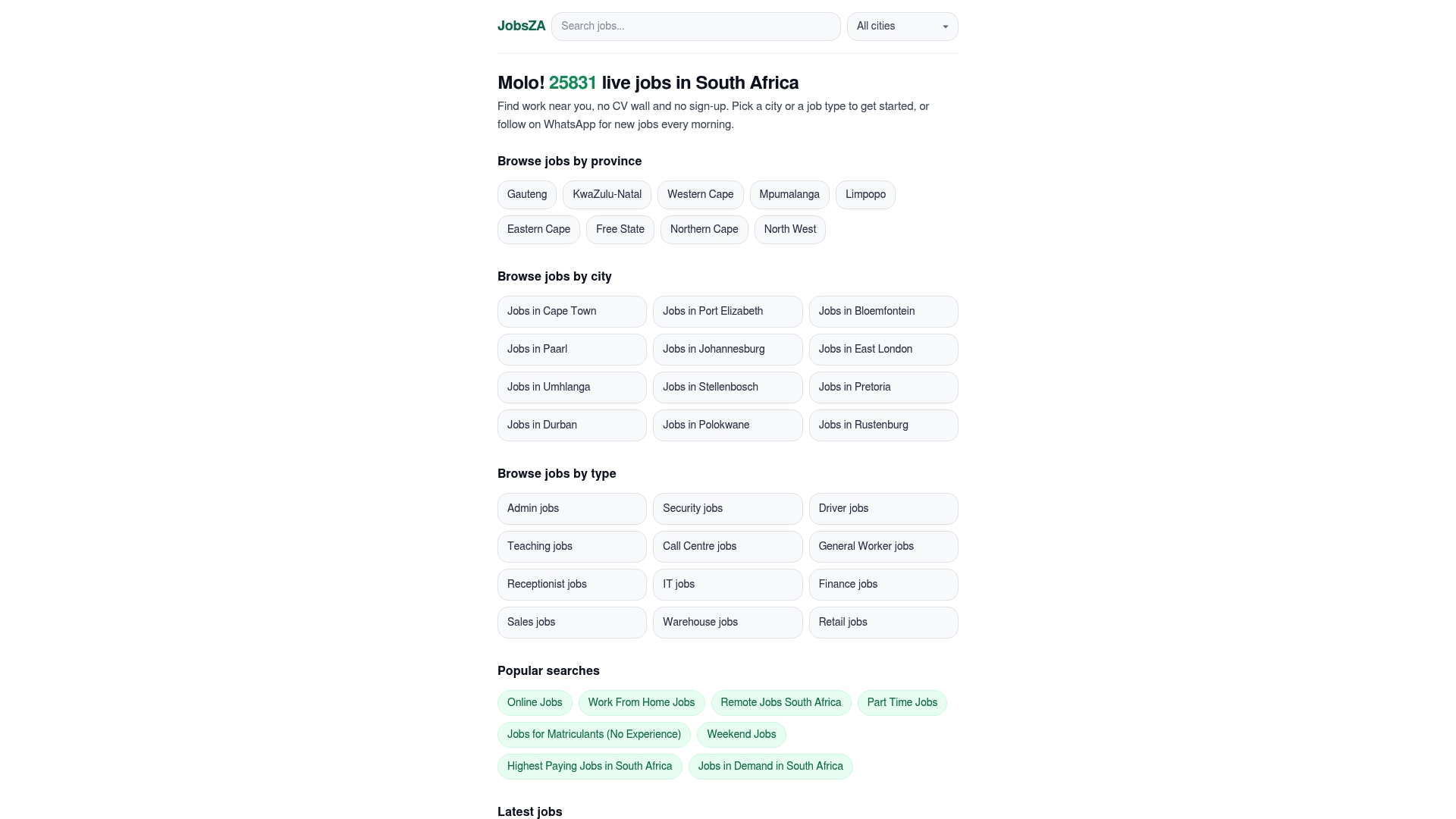
The WhatsApp alert system is the sharpest practical advantage: new listings arrive in your phone every morning, so you are always in the first wave of applicants. For part-time roles, online jobs, and in-demand positions across South Africa, that timing matters.
What you get immediately:
- Daily WhatsApp job alerts for your city or province
- City, province, and job-type filters with no account required
- Full-time, part-time, freelance, and entry-level listings in one place
- Direct apply flow with no CV upload barrier
To get started: visit Findjobsza, select your city or job type, and subscribe to WhatsApp alerts. You will have your first relevant listings within 24 hours.
Useful sources and further reading
- **Department of Employment and Labour — ESSA** (Government/official) — The primary source for ESSA registration, Labour Centre locations, scam warnings, and official job-seeker guidance.
- Finding a job: tips on how to find a good job (Department of Employment and Labour PDF) (Government/official) — Official CV, cover letter, and job-search tips including platform and social media advice.
- A practical guide to finding employment in South Africa in 2026 (CareerC SA) (Recruiter/blog) — Practical 2026 guidance on alerts, portals, and company-website checks.
FAQ
Which job app is best for South African job seekers?
Findjobsza is the strongest starting point for most South African job seekers: it requires no CV or sign-up, covers listings by city and province, and sends daily WhatsApp alerts so you apply before roles fill.
Is there a free job app that works without uploading a CV?
Yes. Findjobsza lets you browse and apply without uploading a CV or creating an account. Gumtree Jobs and JobMail also allow email or WhatsApp applications with no formal CV process.
What app jobs pay the most in South Africa?
App-based gig work in delivery and rideshare tends to pay more during peak hours, but skilled roles in IT, finance, and engineering found via LinkedIn, CareerJunction, or Findjobsza’s IT listings typically offer higher sustained earnings than gig platforms.
How do I avoid job scams on apps?
The Department of Employment and Labour is clear: legitimate employers do not ask applicants to pay application or training fees. Avoid any listing with no company name, vague job details, or a request for banking information before an interview.
Is there a government job app in South Africa?
ESSA (Employment Services of South Africa), run by the Department of Employment and Labour, is the government’s free job-matching service. You can register online at the Labour Department website or visit a Labour Centre for free counselling and placement support.
Recommended
Start with your city.
21 896 live jobs, filtered by city and suburb. No sign-up wall, no CV upload just to look.