Entry level salaries in South Africa (2026): what you need to know
2 August 20269 min read

Contents11 sections
- 1Table of Contents
- 2How does your qualification level affect starting pay?
- 3Why total compensation changes what an offer is actually worth
- 4How to benchmark a salary offer before you accept
- 5What to expect from pay in your first 1–3 years
- 6Practical negotiation tips for your first job offer
- 7Where to find live entry-level listings and real salary signals
- 8Findjobsza gets you to live entry-level listings without the friction
- 9Key takeaways
- 10FAQ
- 11Recommended
Entry level salaries in South Africa (2026): what you need to know
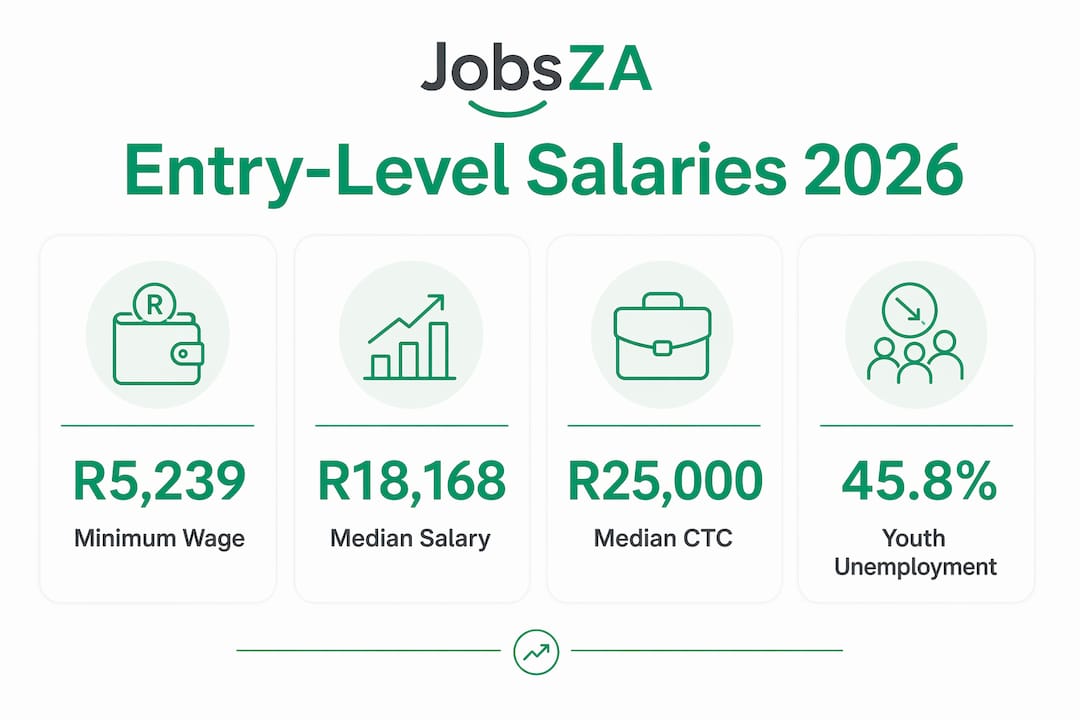
Most entry-level workers in South Africa earn somewhere between the national minimum wage floor and roughly R18,000 a month, depending heavily on qualification and sector. As of 1 March 2026, the statutory NMW sits at R30.23 per ordinary hour worked, which converts to R5,239.46 per month on a 40-hour week or R5,894.40 on a 45-hour week (using the standard 4.333 factor). EPWP workers fall under a separate dispensation at R16.62 per hour.
The gap between a matriculant and a graduate starter is stark. Research by Remchannel puts the median basic monthly salary for a matriculant with no experience at R5,700, barely above the NMW monthly floor. A graduate on a permanent contract earns a median basic of R18,168, with a total package median of R25,000. In financial services, ICT, and technical mining roles, Remchannel reports graduate starters averaging R26,568 a month.
- First step for every jobseeker: Ask for the hourly rate and weekly hours, convert to monthly, then request the full cost-to-company (CTC) breakdown before comparing offers.
Conversion method: all monthly figures use the Department of Employment & Labour’s 4.333-week factor applied to either a 40- or 45-hour workweek, as of 1 March 2026.
Table of Contents
- How does your qualification level affect starting pay?
- Why total compensation changes what an offer is actually worth
- How to benchmark a salary offer before you accept
- What to expect from pay in your first 1–3 years
- Practical negotiation tips for your first job offer
- Where to find live entry-level listings and real salary signals
- Findjobsza gets you to live entry-level listings without the friction
- Key takeaways
- FAQ
How does your qualification level affect starting pay?
Education moves the number more than almost anything else at entry level. A matric certificate gets you in the door at or near the NMW in retail, admin, and security. A diploma or certificate qualification typically lifts the floor into the R8,000–R14,000 range for roles like office administration or apprentice trades. A three- or four-year degree, particularly in engineering, IT, or finance, shifts the baseline dramatically.

Junior IT and engineering roles show this most clearly: entry-level software developers start between R20,000 and R28,000 per month, while entry-level engineering positions range from roughly R11,682 to R24,545 depending on discipline.
Contract type matters just as much. A permanent role carries leave, UIF, and often medical and retirement contributions. An internship or learnership stipend can legally sit below the NMW under specific Skills Development Act provisions. Fixed-term contracts usually match permanent pay rates but strip out long-term benefits. If a listing says “entry level” but lists two or more years of required experience, treat the pay offer with scepticism — Remchannel’s managing director Lindiwe Sebesho has called this practice inappropriate, noting employers should maintain proper pay ranges and job descriptions.
Why total compensation changes what an offer is actually worth
A R23,000 CTC offer with employer retirement matching and medical aid can be worth more than a R25,000 cash-only offer. Here is why: CTC includes everything the employer spends on you. Subtract retirement fund contributions, medical aid, group life, and disability cover to get your cash salary. Then subtract PAYE and 1% UIF to find take-home. A R25,000 CTC package typically lands around R19,600 in your bank account.
Employer retirement contributions started at 22 compound over decades. Medical aid membership also starts your late-joiner-penalty protection clock. Ask three specific questions about any benefits package: What is the employer’s contribution versus yours? When does vesting apply to retirement matching? Is medical aid a contribution or just scheme access?
Pro Tip: Price what the benefits would cost you privately before deciding a lower-headline offer is worse. The benefits-rich package routinely wins by more than the cash gap suggests.
How to benchmark a salary offer before you accept
Compare your offer against the sector and role, not against what your friends earn in different fields. The Remchannel survey data and HR Trust’s 2026 placement figures give sector-specific medians. For finance roles, graduate accountants on SAICA articles earn R12,000–R20,000; junior financial analysts R18,000–R28,000. Admin roles sit at R10,000–R18,000 for office administrators.
Three steps to benchmark any offer:
- Convert the hourly or monthly figure to CTC if it is not already stated.
- Check the sector median using Remchannel or HR Trust data for your role and experience band.
- Look at live listings on Findjobsza to see what employers in your city are currently advertising for the same role.
An offer dramatically below the sector median is information about the employer, not just the market.
What to expect from pay in your first 1–3 years
Most entry-level workers in South Africa do not see large increases in year one. With youth unemployment at 45.8% and overall unemployment at 32.7% as of Q1 2026, bargaining power at the start is limited. The practical reality: many offers cluster near the NMW floor because more people are looking for work than there are jobs available.
Year two and three are different. Candidates who add verified short courses, accredited certifications, or documented community service can justify a higher salary at their next review because employers see lower onboarding risk. The skill growth in your first three years reprices you far more than any entry-level negotiation does. Ask for a written six-month review commitment when you accept an offer — that single ask often outperforms negotiating R500 more at signing.
Practical negotiation tips for your first job offer
Negotiation at entry level is real, but it works differently than at senior level. Large corporates run banded salary scales; you rarely move the number itself. What you can negotiate: grade placement if your qualifications straddle two bands, the review date, relocation support, and at smaller employers, the base figure itself.
The asks that land are specific and evidenced. “The sector median for this role is R18,000 and my offer is R14,000” is a conversation. “I feel I deserve more” is not. Questions worth asking every employer before you sign:
- What is the full CTC breakdown, including all employer contributions?
- Is the 13th cheque or performance bonus inside or outside the quoted figure?
- When is the first formal salary review, and what does it depend on?
- What is the employer’s contribution to retirement and medical aid?
Youth development programmes and skills pathways that build verifiable credentials before your first job search give you something concrete to point to in that conversation.
Where to find live entry-level listings and real salary signals
Live job listings are one of the best real-time salary signals available. Advertised salaries on active listings reflect what employers are actually willing to pay right now, not what a survey captured six months ago. Retail jobs and security roles cluster near the NMW and show you the floor in practice. Sales listings often show base plus commission structures that surveys miss entirely.
For remote or flexible starts, online and remote listings have grown as a category and sometimes offer entry-level IT, admin, and customer service roles that pay above the in-office equivalent for the same experience level.
Findjobsza gets you to live entry-level listings without the friction
No CV uploads. No registration. Findjobsza lets you browse jobs for matriculants and filter by city or job type in seconds, with new listings pushed to your WhatsApp every morning so you see openings before most applicants do.
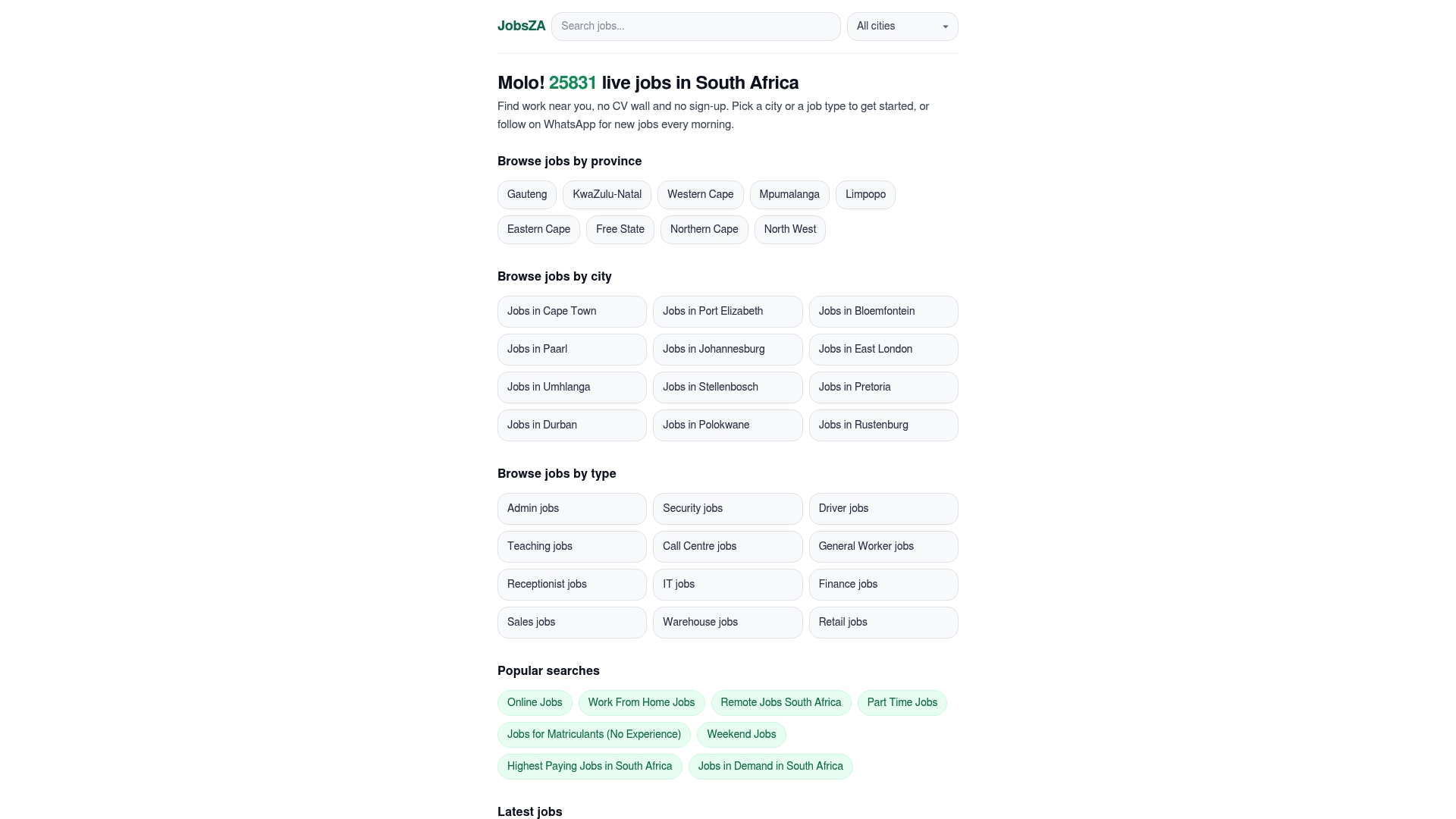
Three ways to use it right now:
- Search “matriculant” or your qualification type to filter roles that match your level.
- Open each listing and check the hours, contract type, and whether benefits are listed alongside the salary.
- Subscribe to WhatsApp alerts so in-demand roles reach you the morning they go live.
Employers post directly on Findjobsza to reach local candidates fast, with no agency fees. If you are hiring, the platform connects you to active jobseekers across South Africa’s major cities without the overhead of a traditional recruitment process.
Key takeaways
Entry-level salaries in South Africa range from the national minimum wage monthly floor up to much higher salaries for in-demand graduate roles, with differences mainly influenced by qualifications, sector, and total compensation structure.
| Point | Details |
|---|---|
| NMW floor (March 2026) | R30.23/hour converts to R5,239.46/month on a 40-hour week. |
| Matric vs graduate gap | Matriculant median basic is R5,700; graduate permanent median basic is R18,168. |
| CTC vs take-home | A R25,000 CTC package typically lands around R19,600 in your bank account. |
| Benchmark by sector | Compare your offer to the sector and role median, not to friends in different fields. |
| Find live listings | Findjobsza lists entry-level roles by city and job type with no sign-up required. |
FAQ
What is the minimum wage for entry-level workers in South Africa?
The statutory NMW is R30.23 per hour from 1 March 2026, which converts to R5,239.46 per month on a 40-hour week. EPWP workers are covered by a separate rate of R16.62 per hour.
How much do graduates earn at entry level in South Africa?
The median basic monthly salary for a graduate on a permanent contract is R18,168, with a total package median of R25,000. Graduates in ICT, engineering, and financial services can earn R26,568 or more.
What is the difference between CTC and take-home pay?
CTC is everything the employer spends on you, including retirement and medical contributions. A R25,000 CTC package typically delivers around R19,600 in take-home after benefit deductions, PAYE, and UIF.
Where can I find entry-level jobs in South Africa without uploading a CV?
Findjobsza lists part-time and entry-level roles across South Africa with no CV upload or registration required, and sends daily WhatsApp alerts with new openings.
Can I negotiate my first salary in South Africa?
Yes, particularly at smaller employers and where your qualifications straddle two salary bands. Come with sector benchmark data, ask about review timing, and negotiate the full package rather than the headline number alone.
This article provides general information about entry-level pay in South Africa and is not professional legal or financial advice. Confirm current rates and your specific employment conditions with the Department of Employment & Labour or a qualified HR professional.
Recommended
Start with your city.
22 050 live jobs, filtered by city and suburb. No sign-up wall, no CV upload just to look.