Non-Discriminatory Job Ads in South Africa: A Practical Guide
2 November 202615 min read

Contents17 sections
- 1TL;DR
- 2Table of Contents
- 3What makes a job advert discriminatory
- 4Which characteristics are protected
- 5Wording that excludes, and how to fix it
- 6When a specific requirement is lawful
- 7Affirmative action and equity wording
- 8A pre-publish checklist for employers and recruiters
- 9For job seekers: spotting a problem advert
- 10What to do about a discriminatory advert or hiring process
- 11Perspective
- 12Where neutral adverts meet real vacancies
- 13Find jobs without CVs or sign-ups
- 14Writing and reading adverts: quick reference
- 15FAQ
- 16Sources
- 17Recommended
Non-Discriminatory Job Ads in South Africa: A Practical Guide
A job ad is non-discriminatory when it asks only for what the job genuinely needs and says nothing about who the applicant is. In South Africa the Employment Equity Act applies from the advert onward, not only at the interview. Recruitment, advertising and selection criteria must not be discriminatory. This guide is for both sides: employers and recruiters who write adverts, and job seekers who want to spot an unfair one and know what to do about it.
TL;DR
- An advert that specifies an age range, or asks applicants to state their age or marital status, is illegal under the Employment Equity Act, subject to its exceptions for affirmative action and inherent job requirements.
- Write about the job, not the person: real duties, real competencies, and only the qualifications the role genuinely requires.
- Words like “young” or “energetic” can exclude applicants through stereotyping, so replace them with the skill or outcome you actually need.
- Job seekers who believe an advert or selection process was unfair should try to resolve it first, then refer it in writing to the CCMA within six months.
Table of Contents
- What makes a job advert discriminatory
- Which characteristics are protected
- Wording that excludes, and how to fix it
- When a specific requirement is lawful
- Affirmative action and equity wording
- A pre-publish checklist for employers and recruiters
- For job seekers: spotting a problem advert
- What to do about a discriminatory advert or hiring process
- Perspective
- Where neutral adverts meet real vacancies
- Find jobs without CVs or sign-ups
- Writing and reading adverts: quick reference
- FAQ
- Sources
What makes a job advert discriminatory
The law looks at the whole hiring chain. The Employment Equity Act prohibits discrimination at work and when applying for a job, and that covers how a vacancy is advertised. An advert can discriminate in two ways: openly, by naming a characteristic, or quietly, by using wording or requirements that shut out a group for no job-related reason.
Open examples are easy to spot:
- “Female receptionist wanted”
- “Applicants must be between 25 and 35”
- “Single applicants only”
- “Please state your age and marital status on your application”
The last two are the ones many small employers do not realise are a problem. Specifying an age range, or requiring applicants to state their age or marital status, is illegal under the Act, apart from its exceptions.
The quiet cases are harder. A requirement such as “must have own car” for a desk job, or “must be a recent graduate” for a role that needs three years of skills, may filter people out by age, disability or background without any link to the work. The test is always the same: does this requirement describe something the job truly needs?
Which characteristics are protected
The Department of Employment and Labour’s booklet on the Act lists the grounds on which discrimination is not allowed. They include race, gender, sexual orientation, pregnancy, marital status, family responsibility, ethnic or social origin, colour, age, disability, religious belief, political opinion, language and HIV status.
In practice, each ground tends to show up in an advert in a typical way:
| Ground | Typical problem wording | Neutral alternative |
|---|---|---|
| Age | “Young, dynamic team”, “under 30” | “Energy and willingness to learn” only if tied to a duty, otherwise describe the work |
| Gender | “Salesman”, “waitress”, “females only” | “Sales consultant”, “waiter or waitron”, no gender stated |
| Marital status or family responsibility | “Single”, “no dependants” | State the actual hours and travel the job involves |
| Race or ethnic origin | Naming a race or “must look presentable” in a coded way | Describe the professional standard of work, such as uniform or safety gear |
| Religion | “Must be Christian” for a non-religious role | Remove it, unless it is genuinely part of the role |
| Language | “Mother-tongue speaker” | State the language level the work needs, such as “fluent in isiZulu and English to serve customers” |
| Disability | “Must be physically fit” | List the real physical tasks, such as “lifting up to 20 kg”, if they are essential |
| HIV status, pregnancy | Medical or pregnancy questions in the application | Leave them out of the advert and the form |
The table is a writing aid, not a legal opinion. For anything borderline, check the wording against the job itself.
Wording that excludes, and how to fix it
The official how-to guide on non-discriminatory selection and recruitment says that wording which specifies an age, gender, religion or race, or uses stereotyping terms such as “young”, may exclude applicants. Its advice is to emphasise the competencies the job requires and to state its inherent or essential core functions accurately.
That gives you a simple rewriting method.
- Start from the duties. List what the person will actually do on a normal day.
- Turn each duty into a competency. “Handles cash” becomes “experience operating a till and reconciling takings”.
- Mark what is essential and what is nice to have. Do not let a nice-to-have behave like a hard filter.
- Delete personal descriptors. Anything about who the person is, rather than what they can do, should go.
- Read it as a stranger. Would a 55-year-old, a wheelchair user, a mother of three, or a non-South African with a valid work permit feel the advert is meant for them?
The same guide advises employers to create job descriptions that are realistic, linked directly to the job functions, and free of subjective jargon, because these are the foundation of non-discriminatory recruitment.
Before and after: a retail example
Before: “Young, energetic female sales assistant needed. Must be single, with own transport. Matric and a good appearance.”
After: “Sales assistant needed for a busy store. You will serve customers, handle the till, and keep shelves stocked. Matric required. Must be able to work Saturdays and one late shift a week. Experience with a point-of-sale system is an advantage.”
The second version tells every applicant what the job is. It removes age, gender, marital status and “appearance”, and it replaces “own transport” with the actual working hours, which is what the employer needs to know.
Before and after: a driver example
Before: “Strong young man to drive delivery truck.”
After: “Delivery driver. Valid code C1 licence and a valid PrDP, if the load requires one. You will load and unload up to the weights listed, follow a daily route sheet and complete delivery paperwork.”

The after version describes the licence and tasks, which are the real requirements. Check the licence code and permit your own vehicle and load require before you publish.
When a specific requirement is lawful
Not every requirement that screens applicants out is unlawful. A qualification, a licence or a physical ability can be a genuine requirement of the role. A pilot needs a pilot’s licence, and an accountant role may need a registered professional designation.
The key point is who has to prove it. According to the CCMA’s information sheet on unfair discrimination, when an employer relies on an inherent job requirement to treat applicants differently, the onus is on the employer to show that the differentiation is fair.
A practical way to apply this before publishing:
- Can you point to a task in the job description that needs this requirement?
- Would a person without it be unable to do that task, even with reasonable support?
- Have you written the requirement as a skill or credential, not as a personal trait?
- Could you explain the requirement to a CCMA commissioner in two sentences?
If the answer to any of these is no, the requirement probably belongs in the “advantageous” list or nowhere.
Affirmative action and equity wording
Many employers worry that equity targets and non-discriminatory adverts conflict. The Act deals with this directly. It recognises fair discrimination as part of an affirmative-action programme that is in line with the Act, and the department’s booklet gives a training programme designed to advance Black women as an example.
Two cautions for employers:
- The measure must be genuine and rationally implemented. The department’s guidance says that a valid affirmative-action measure must be rationally implemented.
- You must follow your own process. In a 2026 dispute, the Labour Court held that disregarding a selection panel’s recommendations breached the SAPS National Instruction and was procedurally irrational. Even a legitimate equity goal does not excuse an unfair or inconsistent process.
If your equity plan affects who you are looking for, say so in a short, factual line that refers to your employment equity plan, and keep the job requirements themselves neutral. Do not write personal descriptors into the duties.
A pre-publish checklist for employers and recruiters
Run every advert through these questions before it goes live, on any platform, in a WhatsApp group or on a notice board.
- Does the job title avoid gender (“salesperson”, not “salesman”)?
- Is there any age range, “young”, “mature” or years-since-graduation limit?
- Does the advert or application form ask for age, marital status, pregnancy status or family plans?
- Is every qualification tied to a duty?
- Are physical requirements specific and essential, such as lifting weights, rather than “must be fit”?
- Are language requirements stated as a level the work needs?
- Is any “appearance” or “presentable” wording replaced by a dress or safety standard?
- Does the advert say how to ask for reasonable adjustments, for example for an interview?
- Is the application route simple enough that someone without a data-heavy device or a printer can use it?
The last point matters more than most employers think. Barriers that look neutral, such as demanding a long CV in a specific format or a full document pack up front, can screen out good candidates who have limited access to a computer. Our own guide to free tools and smart hiring habits covers practical ways to keep the process lean and open.
Household and childcare roles
Small employers, including families hiring childcare help, also write adverts. The same principle applies: describe the duties, the hours and the skills, not the person. If you are hiring for a childcare or au pair role, it helps to understand the worker’s side as well, and this overview of au pair safety and rights in South Africa shows what clear expectations look like from both parties.
For job seekers: spotting a problem advert
You do not need to be a lawyer to see the warning signs. Watch for:
- Adverts that give an age range or ask your age or marital status.
- Gendered job titles with no job-related reason.
- Requirements that have nothing to do with the duties, such as appearance or family situation.
- Application forms that ask about pregnancy, health status or family plans before any offer.
Not every unclear advert is unlawful, and an advert aimed at an equity group may be lawful under the Act’s affirmative-action provisions. But an advert that names a protected trait with no job reason deserves a question.
A second set of warning signs is about safety rather than discrimination: adverts that ask you to pay a fee, hand over your ID and bank details immediately, or contact a private number only. A legitimate employer does not need those to show you a vacancy.
What to do about a discriminatory advert or hiring process
The route is set out in the Department of Employment and Labour’s summary of the Act. An applicant must make a reasonable attempt to resolve the dispute, then refer it in writing to the CCMA within six months for conciliation.
In practice:
- Keep evidence. Screenshot the advert, note the date, the employer and where you saw it. Save any messages and the application form.
- Raise it with the employer in writing. A short, polite email that names the problem wording and asks for a response is a reasonable attempt to resolve the matter.
- Refer to the CCMA in writing within six months. The CCMA will try to conciliate.
- If conciliation fails, the next step depends on your earnings. An applicant earning below the BCEA earnings threshold may elect CCMA arbitration or Labour Court adjudication. Those above the threshold may go to the Labour Court or, by written agreement, to CCMA arbitration.
The possible outcome is not trivial. The CCMA has the power to award compensation or damages, or order an employer to take specific steps to prevent similar discrimination in future.
Overall monitoring of employer compliance sits elsewhere. While the CCMA handles conciliation, the Commission for Employment Equity monitors employer compliance and advises the Minister on implementation of the Act.
For a specific case, speak to the CCMA, a labour union or a labour law practitioner. The right steps depend on your facts, your earnings and your timing.
Perspective
We built FindJobsZA around a simple observation: the first barrier many job seekers meet is not the interview, it is the advert and the process around it. Long forms, forced sign-ups, CV uploads and scattered WhatsApp posts all favour people who already have time, data and a polished CV.
That is why we let you browse vacancies by city, province or job type with no CV upload and no registration. When an advert is easy to read and easy to act on, more people can answer it on their own merits. We think clearer, plainer adverts are good for employers too, because they attract the right applicants faster.
Our daily WhatsApp alerts follow the same idea: the morning’s new vacancies reach you directly, so you are not relying on forwarded messages of unknown origin. If you are an employer, write the advert about the job and the competencies it needs. Everyone who can do the work should be able to see themselves in it.
Nkosi
Where neutral adverts meet real vacancies
If you are searching, our listings are organised by what the job is and where it is, not by who you are. You can look at sales, retail, customer service, admin, logistics, driver, HR and finance jobs from one place, or go straight to a city page such as logistics jobs in Johannesburg or retail jobs in Germiston.
Teaching is a good example of a field where specific requirements matter, such as a recognised qualification and subject knowledge, and where location drives the search. You can browse teaching jobs in Cape Town, Pretoria or Durban and compare how each advert describes its duties and requirements.
Find jobs without CVs or sign-ups
FindJobsZA is built for South African job seekers who want to see vacancies directly. You can browse by city or job type without uploading a CV or creating an account, and you can receive new listings on WhatsApp every morning. Job seekers do not pay to browse or apply.
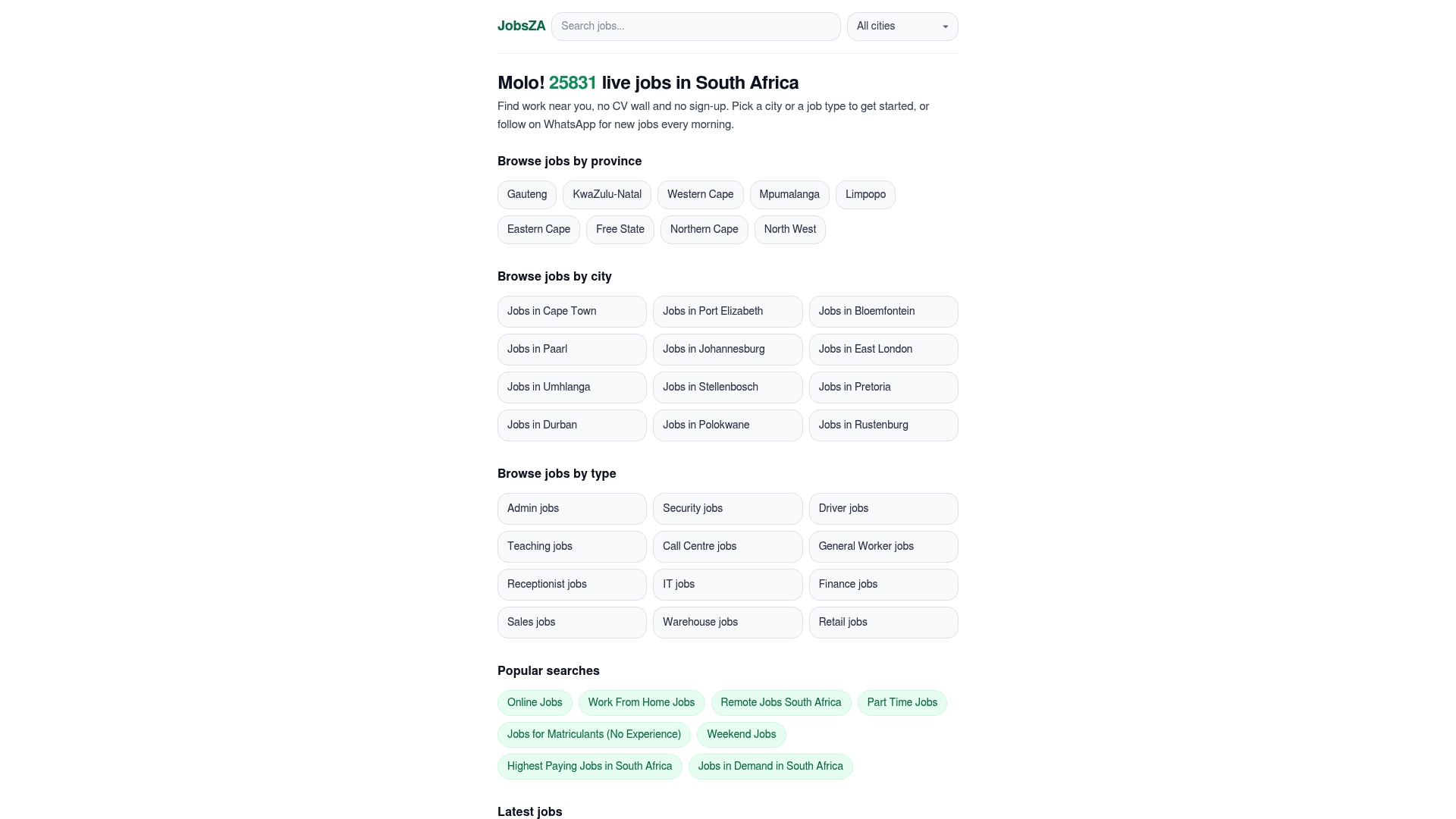
Start on the FindJobsZA home page, choose your city or category, and read each advert with the checklist above in mind. Employers and recruiters who want to reach candidates with clear, fair adverts can use the same pages to see how vacancies are presented.
Writing and reading adverts: quick reference
| If you are… | Do this | Avoid this |
|---|---|---|
| An employer | Describe duties, hours and essential skills | Age, gender, marital status, “young”, “presentable” |
| A recruiter | Ask the client to justify each hard requirement | Copying a client’s biased wording into your advert |
| A job seeker | Save evidence and ask politely in writing | Waiting longer than six months to refer a dispute |
| A small business | Keep the form short and the route to apply simple | Asking for personal details the job does not need |
FAQ
Can an advert ask for a certain age?
No, not as a general rule. An advert that specifies an age range, or requires applicants to state their age, is illegal under the Employment Equity Act, subject to its exceptions for affirmative action and inherent job requirements. If the real need is experience, ask for the experience instead.
Is it unlawful to say “Black women only” in an advert?
Not always. The Act recognises fair discrimination that forms part of an affirmative-action programme in line with the Act, and the department’s booklet gives a training programme for Black women as an example. The measure must be genuine and rationally implemented, so employers should check it against their employment equity plan.
How long do I have to report a discriminatory advert?
After making a reasonable attempt to resolve the matter, you must refer the dispute in writing to the CCMA within six months for conciliation. Keep screenshots and messages as evidence, and speak to the CCMA or a labour practitioner about your particular situation.
What can I say instead of “young and energetic”?
Describe what the energy is for. For example, write “able to stand for long periods and handle busy lunch-hour trade” if that is a real duty, or “willing to learn on the job” if training is offered. Always link wording to the actual job functions.
Sources
- What employers and workers need to know about Employment Equity
- How to guide: Selection and recruitment practices (non-discriminatory)
- CCMA information sheet: Unfair Discrimination in the Workplace
- Employment Equity in the Workplace
- Summary of the Employment Equity Act 55 of 1998
- South African Policing Union obo Singh v South African Police Service (Labour Court, 2026)
Recommended
Start with your city.
32 733 live jobs, filtered by city and suburb. No sign-up wall, no CV upload just to look.