Salary negotiation in South Africa: your practical guide
24 July 202623 min read

Contents20 sections
- 1Table of Contents
- 2Why negotiating changes your lifetime earnings
- 3When should you open a pay conversation?
- 4How to research market pay and build your evidence file
- 5What tactics and scripts actually work during negotiation
- 6How to respond to an offer: counter-offer flow and templates
- 7How to run an internal raise or promotion conversation
- 8What should you negotiate beyond base pay?
- 9Which South African resources help you benchmark pay?
- 10Negotiating salary when you are switching industries or roles
- 11Permanent, contract, and freelance: how employment type changes the negotiation
- 12What are your legal rights around salary negotiation in South Africa?
- 13How South African workplace culture shapes the negotiation
- 14What to do when the first offer is too low
- 15Key takeaways
- 16The negotiation conversation most people are not having
- 17Findjobsza helps you find offers worth negotiating
- 18Useful sources
- 19FAQ
- 20Recommended
Salary negotiation in South Africa: your practical guide
Yes, negotiate. Always. Fewer than 40% of South African professionals negotiate their salary, yet those who do typically add R30,000–R100,000 to their annual earnings. That gap compounds every year through future raises, bonuses, and external offers benchmarked against your current pay. The single fastest move you can make right now is to send one short, data-backed message requesting a conversation about the package.
Before you do anything else:
- Confirm the structure. Ask whether the figure quoted is CTC (cost-to-company) or basic salary. These are not the same number, and negotiating without knowing which one you are working with is the most common mistake South African candidates make.
- Set your three numbers. Calculate your walk-away minimum, your realistic target, and a stretch figure you can justify with market data.
- Request time to respond. Ask for 24–48 hours to review the offer before committing to anything.
Sample first message (email or WhatsApp): “Thank you for the offer. I’m genuinely excited about the role. Could we schedule a brief call to discuss the package? I’d like to share some market context that I think will be useful for both of us.”
Pro Tip: If you are unsure where your role sits in the market, browse jobs in demand in South Africa on Findjobsza before you respond to any offer. Seeing live listings with advertised ranges takes less than ten minutes and gives you a real anchor.
Table of Contents
- Why negotiating changes your lifetime earnings
- When should you open a pay conversation?
- How to research market pay and build your evidence file
- What tactics and scripts actually work during negotiation
- How to respond to an offer: counter-offer flow and templates
- How to run an internal raise or promotion conversation
- What should you negotiate beyond base pay?
- Which South African resources help you benchmark pay?
- Negotiating salary when you are switching industries or roles
- Permanent, contract, and freelance: how employment type changes the negotiation
- What are your legal rights around salary negotiation in South Africa?
- How South African workplace culture shapes the negotiation
- What to do when the first offer is too low
- Key takeaways
- The negotiation conversation most people are not having
- Findjobsza helps you find offers worth negotiating
- Useful sources
- FAQ
Why negotiating changes your lifetime earnings
The financial case for negotiating is not subtle. A typical annual uplift for South African professionals who negotiate is R30,000–R100,000. This increase becomes the base for your next raise, the benchmark a recruiter uses when they approach you in three years, and the floor your next employer anchors their offer to. Compounding works in your favor when you start from a higher number.
South African employers, for the most part, expect candidates to negotiate. A professional, data-backed counter-offer is read as a sign of competence, not aggression. Recruiters at firms like Robert Walters Africa are explicit about this: a well-handled negotiation rarely causes an offer to be withdrawn. What does cause friction is an emotional, poorly timed, or unjustified ask.
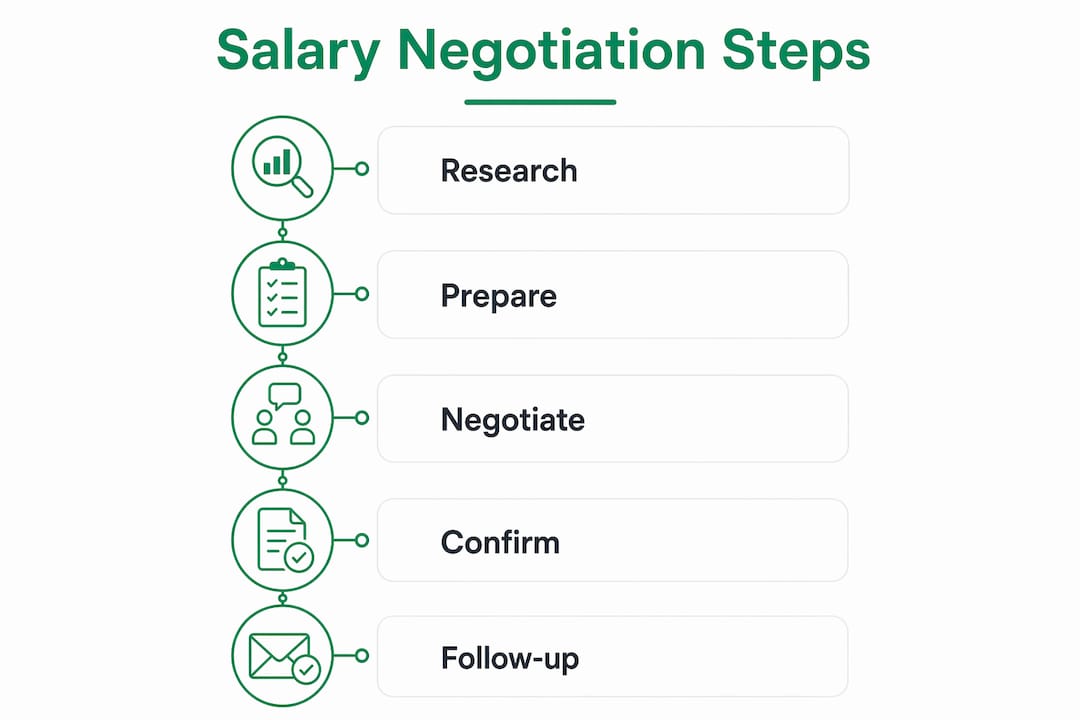
Some sectors will remain disciplined on base pay into 2026, with moderated salary growth across several industries. That makes the quality of your preparation more important, not less. When a company genuinely cannot move on base, the negotiation shifts to total reward, and knowing that in advance keeps you from walking away from a good package.
Pro Tip: South African offers are almost always quoted as CTC. Before you compare your offer to a friend’s salary or a survey figure, confirm you are comparing the same thing. A R30,000 CTC package and a R30,000 basic salary are very different in take-home terms.
Key reasons negotiation pays off:
- Every rand you add now raises the floor for future pay reviews.
- Employers budget negotiation room into most offers as standard practice.
- Non-salary items (leave, hybrid allowances, study budgets) are often easier to move than base pay.
- Candidates who negotiate signal self-awareness and market knowledge, both valued in professional roles.
When should you open a pay conversation?
Timing is leverage. The same ask lands very differently depending on when you make it.
High-leverage moments:
- After a formal job offer is made in writing or verbally.
- When you hold a competing offer from another employer.
- Immediately after a major measurable achievement (a project delivered, a client won, a cost saved).
- When your role has expanded materially beyond your original job description.
- During a scheduled performance review cycle, especially if the company runs annual or mid-year reviews.
Lower-leverage moments to avoid:
- Immediately after a company-wide restructuring or hiring freeze announcement.
- During a probation period, unless the offer itself was below market from day one.
- When your team or department is visibly under pressure or missing targets.
Early in the interview process, if a recruiter asks your salary expectation before you have enough information, defer. A clean response: “I’d prefer to understand the full scope of the role before discussing a number. Could you share the budgeted range?” This keeps you from anchoring too low before you know what the job is worth.
When you receive an offer, do not accept or decline on the spot. Asking for 24–48 hours to review is professional and expected. Use that window to do your research.
How to research market pay and build your evidence file
Good preparation is what separates a confident ask from an awkward one. Here is a practical workflow:
- Identify your role, level, and city. Salary ranges vary significantly between Johannesburg, Cape Town, and Durban, and between junior, mid, and senior levels. Be specific.
- Pull data from multiple sources. Use local recruiter salary guides (Robert Walters, Michael Page, Hays), South African job boards with advertised ranges, and industry-specific surveys. Cross-reference at least three sources.
- Understand CTC vs. basic. To estimate monthly take-home from a CTC figure, subtract employer contributions (medical aid, retirement fund, UIF) and then apply PAYE. A rough rule: for a CTC of R600,000 per year, your monthly take-home after standard deductions is typically in the R35,000–R40,000 range, depending on your tax bracket and benefit elections. Always confirm the benefit breakdown with HR.
- Set three numbers. Your minimum is the lowest you will accept and still take the role. Your target is the market median for your profile. Your stretch is the 75th percentile, justified by specific evidence.
- Build your BATNA. Your best alternative to a negotiated agreement is what you will do if talks fail. A competing offer, a strong internal position, or a freelance pipeline all strengthen your BATNA and your confidence.
- Compile your evidence file. Collect quantified achievements: revenue generated, cost savings delivered, team size managed, projects completed on time and under budget, certifications earned, and client outcomes. Vague claims lose; specific, quantified evidence wins.
| Evidence type | Example |
|---|---|
| Revenue impact | “Grew territory revenue in 12 months” |
| Cost savings | “Reduced supplier costs through renegotiated contracts” |
| Team leadership | “Managed a team across three provinces” |
| Project delivery | “Delivered ERP migration six weeks ahead of schedule” |
| Certifications | “Completed AWS Solutions Architect certification, reducing outsourcing spend” |
Pro Tip: Frame every achievement in rand or percentage terms before the conversation. “I improved customer satisfaction” is forgettable. “I reduced churn by 22%, retaining approximately R800,000 in annual contract value” is a number the hiring manager will remember.

What tactics and scripts actually work during negotiation
The tactics that move numbers
Anchor high. The first number stated in a negotiation has an outsized effect on the outcome. If you anchor at your target, you leave no room to move. Anchor at your stretch figure, justify it with data, and let the employer negotiate you toward your actual target.
Use calibrated questions. Instead of making demands, ask questions that invite the employer to solve the problem with you. “What would need to be true for the package to reach R X?” is far more effective than “I need R X.”
Hold silence. After you state your number, stop talking. Silence is uncomfortable, and the instinct is to fill it by softening your ask. Resist. The employer’s response will tell you more than anything you could add.
Prepare non-monetary tradeoffs. When base pay is genuinely fixed, total reward conversations open up. An extra five days of leave, a hybrid work arrangement, a sign-on bonus, or a committed six-month review date can close the gap between their offer and your target.
Scripts for each channel
Recruiter phone call: “I’ve done some research on the market for this role in [city], and based on comparable positions, I was expecting something closer to R[stretch figure] CTC. Is there flexibility to move the package in that direction?”
Hiring manager video call: “I’m very enthusiastic about joining the team. Based on my research and the outcomes I’ve delivered in my current role, I’d like to propose R[target] CTC. I’m happy to walk you through the data behind that number.”
Negotiation email (see full template in the next section).
Dos and don’ts
- Do anchor with a specific number, not a range. Ranges signal uncertainty and employers will anchor to the lower end.
- Do keep the tone collaborative. You are solving a problem together, not winning an argument.
- Don’t apologise for negotiating. “I’m sorry to ask, but…” immediately weakens your position.
- Don’t cite personal financial needs as justification. The employer is paying for market value, not your rent.
- Don’t issue ultimatums unless you are genuinely prepared to walk away.
How to respond to an offer: counter-offer flow and templates
The negotiation flow
- Acknowledge the offer warmly. Thank them, express genuine interest, and ask for time to review.
- Clarify the structure. Confirm CTC vs. basic, benefit inclusions, and any variable components.
- Present your counter. State your number, anchor it to market data and your evidence file, and keep it brief.
- Listen and respond to pushback. When they cite budget constraints, separate the merit of your ask from the timing. “I understand the budget position. Could we agree on a review date in six months tied to specific deliverables?”
- Request written confirmation. Once you reach verbal agreement, ask for the updated offer letter before you resign from your current role.
Email templates
Concise counter-offer email:
Subject: Re: [Role Title] Offer
Dear [Name],
Thank you for the offer — I’m genuinely excited about the opportunity. After reviewing the package and benchmarking against the current market for this role in [city], I’d like to propose a CTC of R[target figure]. This reflects [one-line evidence: e.g., “my track record in X and current market rates for senior Y roles in Johannesburg”]. I’m confident we can make this work and look forward to your thoughts.
Kind regards, [Your name]
Follow-up after verbal agreement:
Dear [Name],
Thank you for the conversation today. I’m pleased we’ve aligned on R[agreed figure] CTC, with a performance review scheduled for [date]. Could you send an updated offer letter reflecting these terms so I can complete my resignation process? I’m looking forward to starting on [date].
Phone script for live pushback:
“I hear you on the budget constraints. Given the scope of the role and what I bring to it, would it be possible to bridge the gap with a sign-on bonus or an earlier review date? I want to make this work.”
How to run an internal raise or promotion conversation
Internal negotiations are different from external ones. You are not selling yourself to a stranger. You are making a business case to someone who already knows your work.
- Choose the right moment. The strongest timing is after a measurable win, during a performance cycle, or when your role has expanded. Avoid asking during budget freezes or immediately after a team setback.
- Open with affirmation. Start by acknowledging what is working. “I’ve really valued the opportunities this year, and I want to talk about how we can align my compensation with the expanded scope of my role.”
- Present documented achievements. Use your evidence file. Specific numbers, specific outcomes, specific dates. Vague claims are easy to defer.
- State your request clearly. “Based on my research and the value I’ve added, I’d like to discuss moving my CTC to R[target figure], which aligns with the market rate for someone at this level.”
- Propose next steps. If the answer is not immediately yes, ask for a specific review date and agree on the deliverables that would justify the increase. Get that in writing.
If a raise is genuinely off the table right now, negotiate non-salary concessions: an extra week of leave, a flexible work arrangement, a training budget, or a formal title change that strengthens your next external application.
Pro Tip: After any verbal commitment from a manager, send a brief email summarising what was agreed. “As discussed, my CTC will move to R[X] from [date], with a review in [month].” This protects you and removes ambiguity.
What should you negotiate beyond base pay?
Base salary is one lever. In South Africa’s current market, it is often not the most movable one. Employers increasingly expect candidates to discuss total reward, and strong negotiators come prepared to trade.
| Benefit | When to prioritise it |
|---|---|
| Sign-on bonus | When base is fixed but you need to close a gap now |
| Guaranteed bonus | When variable pay is a significant part of the package |
| Medical aid contribution | When the employer’s contribution is below market |
| Retirement fund contribution | High value for long-term employees; often tax-efficient |
| Additional leave | High personal value; low cost to employer |
| Hybrid/remote work allowance | Relevant for roles with commute costs or data costs |
| Study/training budget | Valuable for career growth; often approved separately from salary budget |
| Relocation allowance | When moving cities for the role |
| Equipment allowance | Relevant for remote or field roles |
How to prioritise: Start with the items that have permanent value (base salary, retirement contributions, medical aid). Then move to one-time items (sign-on bonus, relocation). Leave the lifestyle items (extra leave, hybrid days) for last — they are often the easiest to get and can close a deal when cash is genuinely constrained.
Scripted swap example: “If moving the base isn’t possible right now, would you consider an additional five days of leave and a R15,000 training budget? That would make the overall package work for me.”
Which South African resources help you benchmark pay?
Building a defensible salary benchmark means combining multiple sources, not relying on one number from one survey. Here is how to use the main ones:
- Local recruiter salary guides. Robert Walters Africa, Michael Page, and Hays publish annual South African salary guides by sector and level. These are free to download and give you a credible, citable range.
- Job board listings. Filter by role title, city, and experience level on Findjobsza to see what employers are currently advertising. Pay transparency trends mean more listings now include ranges, making this a fast and current data point.
- Industry associations. Sector bodies in fields like engineering, accounting, and IT often publish compensation surveys for members.
- Government guidance. The Department of Labour publishes sectoral determinations and minimum wage floors, which set the legal baseline for many roles.
To build a defensible benchmark:
- Pull the median (50th percentile) from at least two recruiter guides for your role and city.
- Check current live listings on Findjobsza to see what is being advertised right now.
- Identify the 25th and 75th percentile to understand the range.
- Present the median as your target and the 75th percentile as your stretch, with a one-line explanation of why your profile sits above the median.
Using a Findjobsza listing in the conversation: “I pulled current listings for [role] in [city] this week. Comparable roles are advertising at R[X]–R[Y] CTC. My ask of R[target] sits within that range for someone at my level.”
For IT roles and finance roles, where skill scarcity can push advertised ranges above survey medians, live listings are often more useful than annual guides published months earlier.
Negotiating salary when you are switching industries or roles
A career pivot complicates the conversation because you cannot point to a direct comparable. The employer sees risk; your job is to reframe the narrative around transferable value.
Start by identifying the skills that cross over. A marketing manager moving into operations brings project management, stakeholder communication, and budget ownership. A teacher moving into corporate training brings curriculum design, facilitation, and performance measurement. Name those skills explicitly and attach outcomes to them.
On the numbers side, anchor to the destination role’s market rate, not your current salary. If you are moving from a R480,000 CTC role in one sector to a role that pays R600,000 in another, your current salary is irrelevant to the negotiation. The market rate for the new role is your anchor.
Expect a skills premium question: why should they pay market rate for someone without direct experience? Your answer is a combination of the speed of your ramp-up (supported by evidence of how quickly you have learned in the past) and the fresh perspective your background brings. Quantify wherever possible.
If the employer insists on a lower entry point, negotiate a structured review at three or six months tied to specific performance milestones. Get that in writing.
Permanent, contract, and freelance: how employment type changes the negotiation
Permanent roles
The standard negotiation playbook applies. Focus on CTC, total reward, and a written offer letter. The employer has long-term cost considerations, so non-salary benefits (medical aid, retirement, leave) carry real value.
Fixed-term contracts
Contract roles often pay a premium over permanent equivalents because the employer is not paying benefits and carries less long-term obligation. When negotiating a contract rate, factor in the cost of your own medical aid, retirement contributions, and the gap periods between contracts. A R50,000 monthly contract rate is not equivalent to a R50,000 monthly CTC permanent salary.
Ask about renewal terms upfront. A contract with a clear renewal path is worth more than one that ends abruptly, and that certainty has a negotiable value.
Freelance and independent contractors
Freelancers set day rates or project fees, not salaries. The negotiation is about scope, deliverables, and rate, not a package. Know your minimum viable day rate (your fixed costs divided by your billable days), your market rate (what comparable freelancers charge in your sector), and your value rate (what the outcome is worth to the client).
South African freelancers working with larger corporates should confirm whether the engagement requires a tax directive and whether VAT registration applies to their billing. These are not salary negotiation questions, but they affect your effective rate and should be settled before you sign.
What are your legal rights around salary negotiation in South Africa?
South African labour law does not compel an employer to accept a counter-offer, but it does protect employees from unfair treatment in the process. A few points worth knowing:
The Basic Conditions of Employment Act (BCEA) sets minimum standards for pay, leave, and working hours. No negotiation can result in a package that falls below these statutory minimums. Sectoral determinations set specific floors for industries like domestic work, retail, and hospitality.
The National Minimum Wage Act sets a floor below which no employee may be paid, regardless of what was agreed. As of 2025, the national minimum wage was R28.79 per hour for most workers (excluding learners and certain public works participants). Confirm the current rate with the Department of Employment and Labour, as it is reviewed annually.
Employers cannot discriminate in pay on the basis of race, gender, disability, or other protected characteristics under the Employment Equity Act. If you suspect your offer is below market because of a protected characteristic, you have recourse through the Commission for Conciliation, Mediation and Arbitration (CCMA).
Salary discussions between colleagues are not prohibited by South African law. Employers cannot legally prevent employees from disclosing their own salaries to each other, though many contracts include confidentiality clauses that have been tested in court.
This article is general information, not legal or financial advice. Confirm your specific situation with a qualified labour law practitioner or the Department of Employment and Labour.
How South African workplace culture shapes the negotiation
South Africa’s workplace culture is not monolithic. A negotiation in a large Johannesburg corporate looks different from one in a family-owned Cape Town business or a public sector institution in Pretoria.
In formal corporate environments, particularly in financial services, professional services, and large multinationals, negotiation is expected and handled through HR. The process is structured, and counter-offers are reviewed against internal pay bands. Knowing where you sit relative to those bands (often discoverable by asking HR directly) is useful.
In smaller businesses and family-run companies, the negotiation is often more personal and less structured. The decision-maker may be the owner. Tone matters more here. A collaborative, relationship-first approach works better than a formal, data-heavy presentation.
In the public sector, salary negotiation is largely constrained by occupational specific dispensations (OSDs) and government pay scales. There is less room to negotiate base pay, but conditions of service, allowances, and post levels can sometimes be discussed.
Ubuntu values, which emphasise community and mutual respect, influence how directness is received in many South African workplaces. This does not mean you should avoid asking for what you are worth. It means framing the conversation as a mutual benefit rather than a personal demand tends to land better. “I want to make sure this works well for both of us” is a phrase that fits the cultural register across most South African workplaces.
What to do when the first offer is too low
A low offer is not a rejection. It is the opening position.
First, do not react immediately. Thank them, ask for time to review, and use that window to confirm your benchmarks and decide whether the gap is bridgeable.
If the gap is small (within 10–15% of your target), a single counter-offer with clear justification usually resolves it. If the gap is large, you have two options: negotiate in stages, or ask directly whether the role’s budget is genuinely fixed.
“I appreciate the offer. Based on my research and the scope of the role, I was expecting something closer to R[target]. Is there flexibility to move the package, or is the budget fixed at this level?”
That question does two things. It gives the employer an easy path to say yes, and it tells you quickly whether you are negotiating or just delaying an inevitable no.
If they confirm the budget is fixed and the gap is too large, you can still negotiate total reward. A sign-on bonus, an accelerated review date, or additional leave can close a meaningful portion of the gap without touching the base salary line.
If none of that works and the offer is genuinely below your walk-away minimum, decline professionally. “I’ve given this careful thought, and I don’t think I can make the package work at this level. I hope we can stay in touch for future opportunities.” Doors stay open when you close them gracefully.
Key takeaways
Negotiating your salary is one of the highest-return actions you can take in your career: fewer South African professionals engage in this practice, yet those who negotiate well can add a substantial increase to their annual earnings and set a higher floor for every future raise.
| Point | Details |
|---|---|
| Always negotiate | Fewer than 40% of South African professionals negotiate, but those who do gain R30,000–R100,000 annually. |
| Clarify CTC vs. basic | Confirm the package structure before you counter — CTC and basic salary are not interchangeable figures. |
| Anchor with evidence | Use market benchmarks, quantified achievements, and live job listings to justify your stretch figure. |
| Negotiate total reward | When base pay is fixed, sign-on bonuses, extra leave, hybrid allowances, and training budgets can close the gap. |
| Get it in writing | Any verbal agreement on salary, review dates, or benefits should be confirmed in a follow-up email before you resign. |
| Use Findjobsza to benchmark | Browse current listings by role and city on Findjobsza to validate your target range with live market data. |
The negotiation conversation most people are not having
South African professionals underestimate how much of the negotiation happens before they walk into the room. The candidates who consistently land better offers are not necessarily more confident or more experienced. They are more prepared. They know their number, they know why it is right, and they have practiced saying it out loud.
The cultural hesitation around discussing money is real in South Africa, and it costs people. The discomfort of asking for R10,000 more per month is a one-time feeling. The cost of not asking is permanent. Every year you stay at a below-market salary, you are effectively subsidising your employer.
What actually shifts outcomes is the combination of a specific, justified number and a collaborative tone. Not aggression, not apology. Just a clear ask, grounded in data, delivered with the confidence of someone who has done the work. That is a skill, and like any skill, it improves with practice. Run the conversation with a friend, a mentor, or even out loud to yourself. The rehearsal matters more than most people admit.
Findjobsza helps you find offers worth negotiating
The strongest negotiating position is a better alternative. When you have another offer on the table, or even a shortlist of roles you are actively pursuing, the conversation with any employer changes. You are no longer asking for what you need. You are choosing between options.
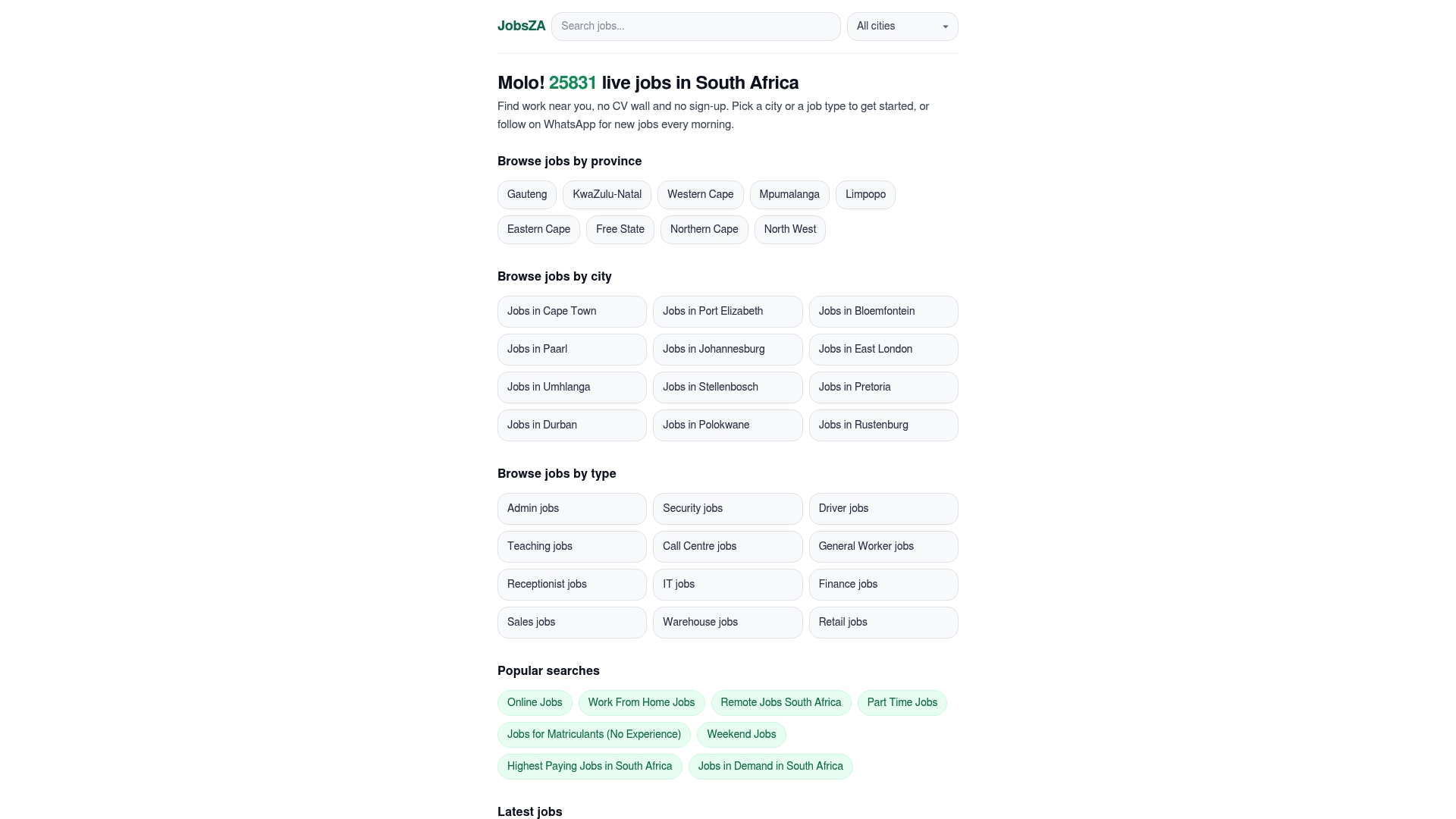
Findjobsza gives you that position faster. Browse jobs in demand in South Africa by city, province, or job type with no registration and no CV upload required. New listings arrive daily, and you can set up WhatsApp alerts to get fresh opportunities every morning before the market moves. Whether you are looking for remote roles to benchmark hybrid pay, or sector-specific listings to validate your target range, the platform puts current market data in your hands in minutes. Search what is available in your field today, and go into your next negotiation knowing exactly what the market is paying.
Useful sources
- The Communication Academy: Salary negotiation in South Africa — local data on negotiation rates and the R30,000–R100,000 uplift estimate; useful for building your opening case.
- Robert Walters Africa: How to negotiate salary — recruiter perspective on employer expectations and how professional counter-offers are received.
- Initiate International: Salary negotiation in 2026 — covers total reward trends, pay transparency, and sector-specific salary growth expectations.
- Questory: Interview preparation and salary negotiation in South Africa — practical guide covering CTC structures, offer evaluation checklists, and local negotiation norms.
- Key Recruitment: How to negotiate salary after a job offer — South African recruiter guidance on scripts, roleplay, and handling common pushbacks.
FAQ
How do you politely negotiate salary?
Thank the employer for the offer, express genuine enthusiasm for the role, and then present a specific counter-offer anchored to market data. Keep the tone collaborative: “I’d like to discuss the package — I’ve done some research that I think will be useful for both of us.”
What is the number one rule of salary negotiation?
Never accept the first offer without at least asking whether there is flexibility. Employers typically build negotiation room into their initial offers, and a professional counter-offer is expected in most South African hiring processes.
What is the 70/30 rule in negotiation?
The 70/30 rule suggests you should listen 70% of the time and speak 30% of the time during a negotiation. Asking calibrated questions and holding silence after stating your number are more effective than talking through your position repeatedly.
Can you lose a job offer for negotiating salary?
Rarely. A professional, data-backed counter-offer almost never causes an offer to be withdrawn. What can cause friction is an emotional, poorly timed, or unjustified ask, so grounding your counter in market benchmarks and quantified evidence keeps the conversation constructive.
When is the best time to negotiate salary in South Africa?
The strongest moment is immediately after a formal offer is made, before you accept. Other high-leverage points are when you hold a competing offer, after a major measurable achievement, or during a scheduled performance review cycle.
Recommended
Start with your city.
27 342 live jobs, filtered by city and suburb. No sign-up wall, no CV upload just to look.